
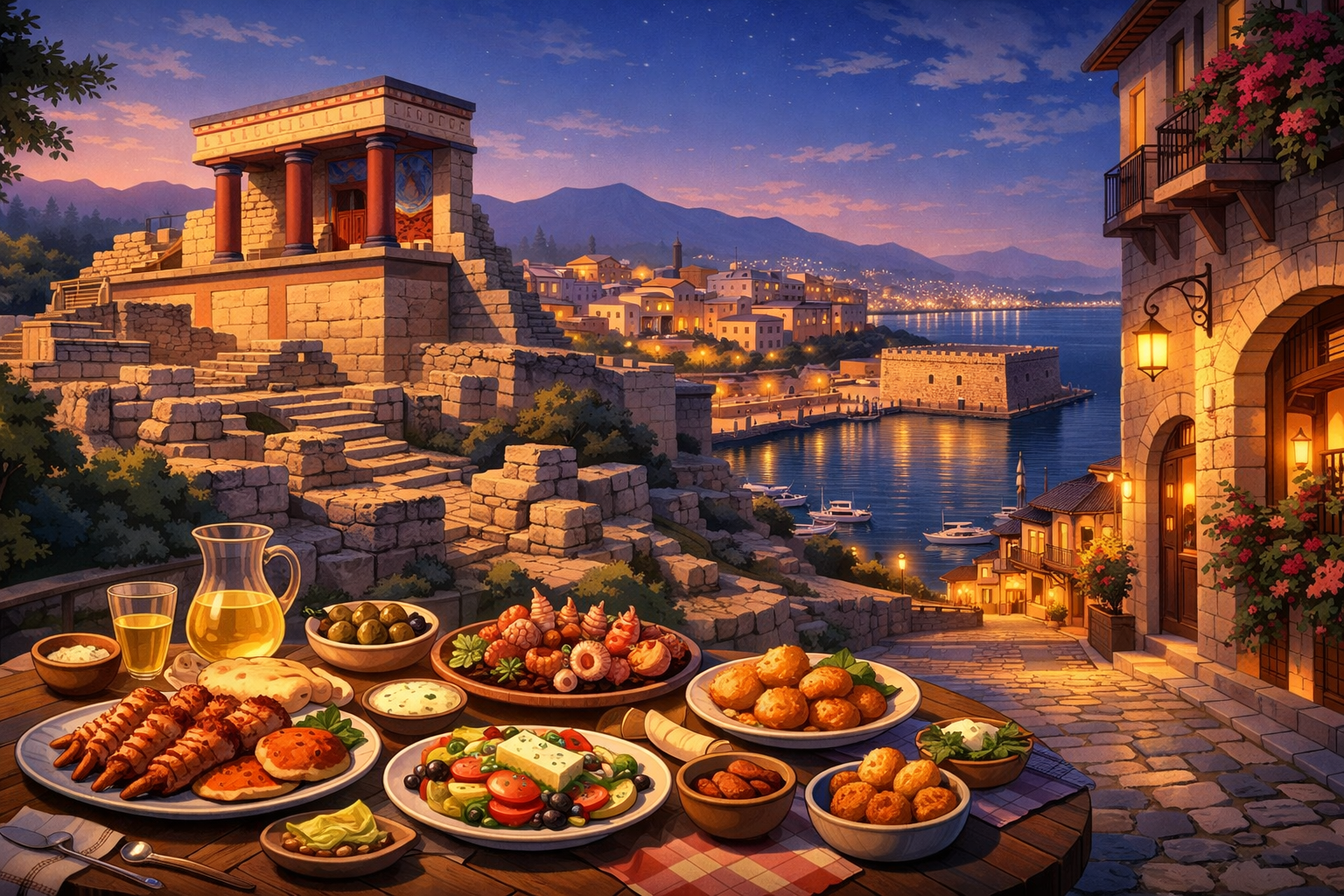
Day 1 — Heraklion: old town, Venetian harbor, and an evening walk
🚶 The first day is best devoted to Heraklion itself — a city that is often underestimated and seen merely as the transport gateway to Crete. In reality, it is a dense, lively, and very “authentic” Mediterranean center where Venetian heritage, traces of the Ottoman period, noisy modern urban life, and the feeling of an island capital all come together in one route. It is convenient to start in the historic core around Eleftherias Square and Lions Square: this is the easiest way to feel the rhythm of the city, see the Morosini Fountain, walk along 25th of August Street, and gradually make your way to the old harbor. This axis is especially good for a first introduction: it is not overwhelming, lets you move at a calm pace, stop for coffee, avoid wasting extra energy after a flight, and still get a very complete picture of Heraklion right away.
🏛️ The Morosini Fountain on Lions Square is one of the city’s most recognizable symbols and a wonderful starting point for a walk. Around it, Heraklion reveals itself as a southern, talkative, food-loving city: nearby are cafés, pastry shops, taverns, everyday city bustle, and the constant movement of locals. From here, it is pleasant to continue to the loggia, the Basilica of Saint Mark, the Church of Saint Titus, and then along 25th of August Street, which connects the inner center with the old port area. Along the way, the architecture changes literally every few minutes: austere stone façades, arcades, balconies, administrative buildings, old shops, and lively terraces create the feeling that the city lives in several eras at once.
🚶 A walk to the Venetian harbor and Koules Fortress is an essential part of the route. This is where Heraklion becomes especially cinematic: colorful fishing boats, the lines of the old arsenals, the open sea, wind, light on stone, and the long mole that invites a slow stroll. Koules Fortress guarded the entrance to the harbor for centuries and still dominates the shoreline, giving the whole area a stern, almost theatrical character. From the bastions and the waterfront, you get some of the best views in the city: behind you are the walls, domes, and façades of the center; ahead lies the Cretan Sea and, in clear weather, the silhouette of Dia Island. At sunset this place is especially beautiful: the stone turns golden, the boats sway in the harbor, and the city gradually shifts into a soft evening rhythm.
🍽️ The evening of the first day is logically best dedicated to Cretan cuisine, without rushing and without complicated transfers. It is better to choose a tavern in the center or by the harbor and focus not on the “tourist set,” but on island gastronomy: dakos with tomatoes and soft cheese, dolmadakia, fried zucchini, horta, local cheeses, dishes with freshly harvested olive oil, Cretan-style lamb or goat, and for dessert — yogurt with thyme honey or sweets made with phyllo. In Crete, food is rarely just dinner — it is part of the atmosphere, a long conversation with the island through taste, the aroma of herbs, bread, wine, and raki. After dinner, it is ideal to return to the harbor or make one more loop through the old center: evening Heraklion is softer, more beautiful, and more romantic than daytime Heraklion, and a short unhurried walk after eating makes the day feel complete and whole.