
Buy PDF guide

Buy PDF guide — 25.71 USD

PDF — 25.71 USD

JORDAN

JORDAN

Trace Jordan’s ancient spine from lively Amman to Madaba’s mosaics and Mount Nebo’s horizons, hike the wild canyons of Dana, then wander the rose-red façades of Petra and the secrets of Little Petra. Sleep under stars in Wadi Rum, dive Aqaba’s reefs, float in the Dead Sea, and return to Amman with desert dust and stories.

🧭 DAY-BY-DAY ITINERARY

Ready-made country and city routes with daily plans, sights, transport and accommodation. Buy PDF guides for independent travel.

🧭 DAY-BY-DAY ITINERARY


Day 1 — Amman: the Citadel (Jabal al-Qal'a) and the Roman Theater

  • 🚶 Start with the Amman Citadel — a hill where Bronze Age, Hellenistic, Roman, Byzantine, and early Islamic layers read like a “time cross-section”: the Temple of Hercules and the domed Umayyad Palace set the scale of the capital. Descend to the Roman Theater (2nd c.) — an amphitheater on the hillside that still functions as a city stage — and to the small Odeon. At dusk the facades gain a soft relief, and the contrasts of limestone and shadows emphasize the ancient layout of the central valley.


Day 2 — Amman: the Jordan Museum and the old downtown

  • 🚶 The Jordan Museum in the Ras al-Ain district is the “key” to the country’s archaeology: the ‘Ain Ghazal statues (9th millennium BCE), fragments of the Dead Sea Scrolls, and everyday-life reconstructions connect your later visits to Petra/Dana/Jerash into a single storyline. After the museum, stroll through downtown: bazaar vaults, house cornices, minarets, and columns — a living “architectural palimpsest” of the city.

Day 3 — Madaba and Mount Nebo: mosaics and biblical panoramas → transfer to Dana

  • 🚌 Transfer: Amman → Madaba (≈45–60 min) → Mount Nebo (≈15 min) → along the King’s Highway to Kerak (pause at the Crusader fortress) → Dana (≈2–2.5 hours on winding roads).

  • 🚶 In Madaba — the Greek Orthodox Church of St. George with the famous mosaic map of the Holy Land (6th c.) and the Archaeological Park with Roman-Byzantine fragments of domestic architecture. On Mount Nebo — the Moses Memorial and a view of the Dead Sea: Christian architecture on the plateau ridge, minimal volumes and austere stone.

Day 4 — Dana: terraced villages and ancient trails

  • 🚶 Morning in the Dana Biosphere Reserve: stone houses of the old village on the edge of sheer cliffs — an example of organic late Ottoman/Bedouin vernacular architecture. A short trek (2–4 h) along the canyon rim reveals the structure of the landscape where caravan routes have run since antiquity. In the afternoon — rest and preparation for Petra.

Day 5 — Petra: entry through the Siq and the “Treasury”

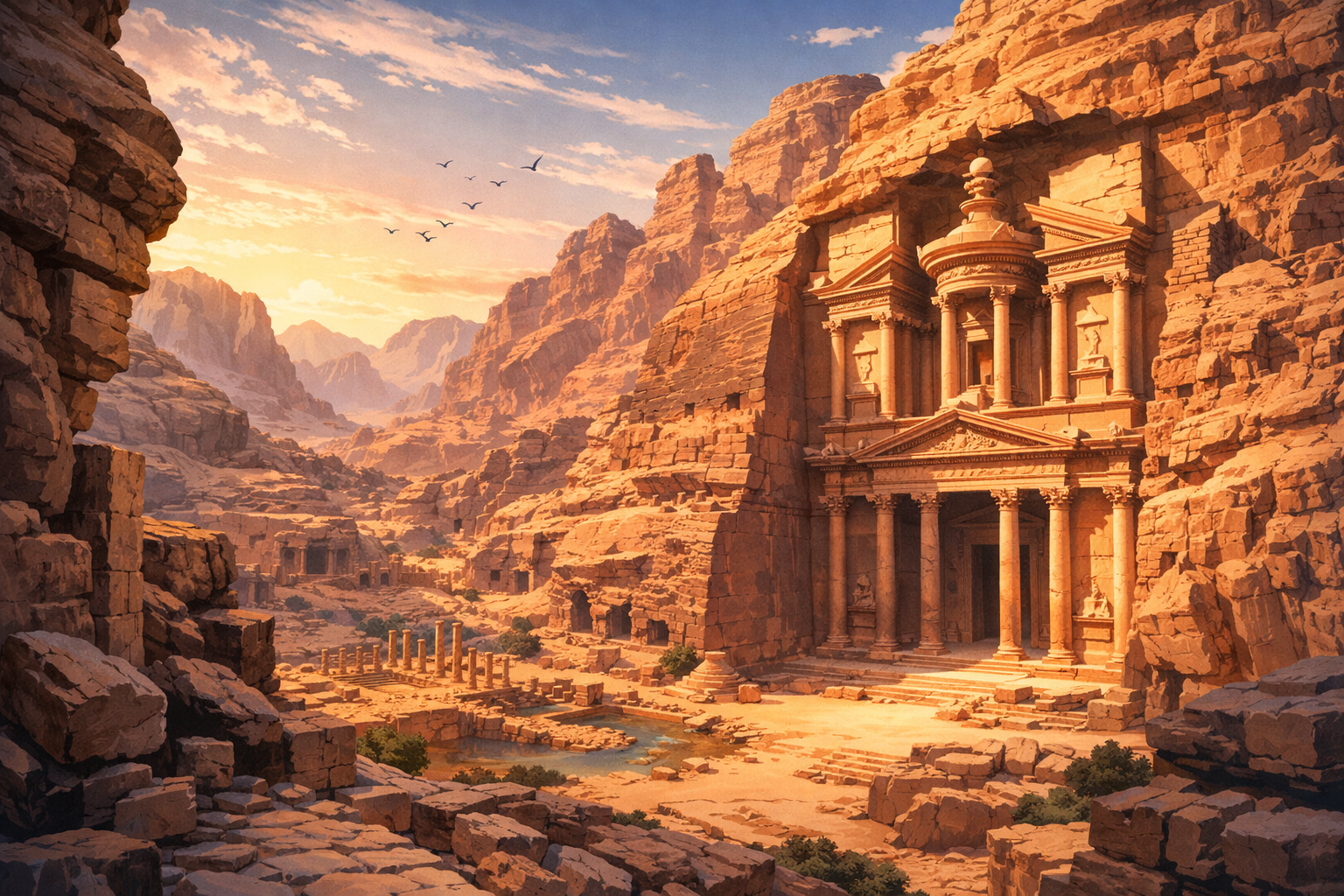
  • 🚶 The main day — read the city as “urbanism in rock.” First, the Siq — a narrow, almost theatrical canyon with geological “wing-like layers” and the Nabataeans’ ancient water engineering. The exit to Al-Khazneh (the Treasury): an iconic facade where Corinthian orders merge with Eastern sculptural forms. дальше — the Theater, the Colonnaded Street, the temple quarter of Qasr al-Bint. Return in the soft light of sunset — the perfect time for relief-focused photography.

Day 6 — Petra: “high points” and necropolises

  • 🚶 The second day — accents. The trail to the High Place of Sacrifice: panoramas of the “city-as-valley.” The Royal Tombs — variations of facade sculpture from строг to “baroque.” By evening — the climb to the Monastery (Ad-Deir) (a massive facade in a rock amphitheater), where you grasp the Nabataeans’ urban daring and the scale of the terraced plateaus.

Day 7 — Little Petra and the Petra Museum

  • 🚶 Morning — Little Petra (Siq al-Barid): a “suburb” of the caravan-trade capital with triclinia and traces of agricultural terraces — a look at the “everyday” architecture of the Nabataean world. Afternoon — the Petra Museum by the visitor center: the exhibits link the forms seen in the excavations with artifacts, reconstructing technologies, trade, and rituals. In the evening — depending on your mood, the “Petra by Night” show (a walk through the Siq by candlelight to the facade of Al-Khazneh).

Day 8 — Wadi Rum: the “Valley of the Moon” and Nabataean traces

  • 🚌 Transfer: Petra/Wadi Musa → Wadi Rum (≈1.5–2 hours). Entry via the visitor center. A 4×4 desert tour: arches, canyons, ochre-colored sandstones, petroglyphs, and a Nabataean temple — here the landscape and stone “write” their own architecture. Night in a Bedouin camp under millions of stars.

Day 9 — Aqaba: Ayla and the seaside fortress

  • 🚌 Transfer: Wadi Rum → Aqaba (≈1 hour). Visit the Ayla archaeological area — an early Islamic city with a harbor layout and fragments of walls; the Mamluk fortress by the waterfront — a fortification at the crossroads of the Red Sea and caravan routes. In the evening — отдых by the sea.

Day 10 — Dead Sea: the Panorama museum and the baptism site

  • 🚌 Transfer: Aqaba → the Dead Sea coast (via Wadi Araba; allow 4–4.5 hours with stops). Afternoon — the Dead Sea Panorama: a small museum of the geology and history of this unique “basin-like” landscape. If time allows — drive to the Baptism Site (Al-Maghtas) on the east bank of the Jordan River: a complex of churches and early pilgrimage archaeology.

Day 11 — Jerash from Amman: a “Roman city in the hills”

  • 🚌 Transfer: the coast → Amman (≈1–1.5 hours), then a day trip to Jerash (≈50–60 minutes). On site — the Oval Plaza, colonnaded streets, the Temple of Artemis, and two theaters; a rare, coherent Roman urban ensemble for the region set in the folds of hilly terrain. Return to Amman by evening.

Day 12 — Amman: final highlights and departure

  • 🚶 Morning — free time: favorite viewpoints, craft shops, and downtown cafés. Transfer to Queen Alia Airport (on average 35–45 minutes, depending on traffic). Match the trip’s “timeline”: Neolithic (‘Ain Ghazal) → Nabataeans (Petra) → Antiquity (Jerash) → medieval castles (Karak/Shobak) → Amman’s modernization.

Flight tickets

eSIM for travel

Buy PDF guide

Buy PDF guide — 25.71 USD

PDF — 25.71 USD