
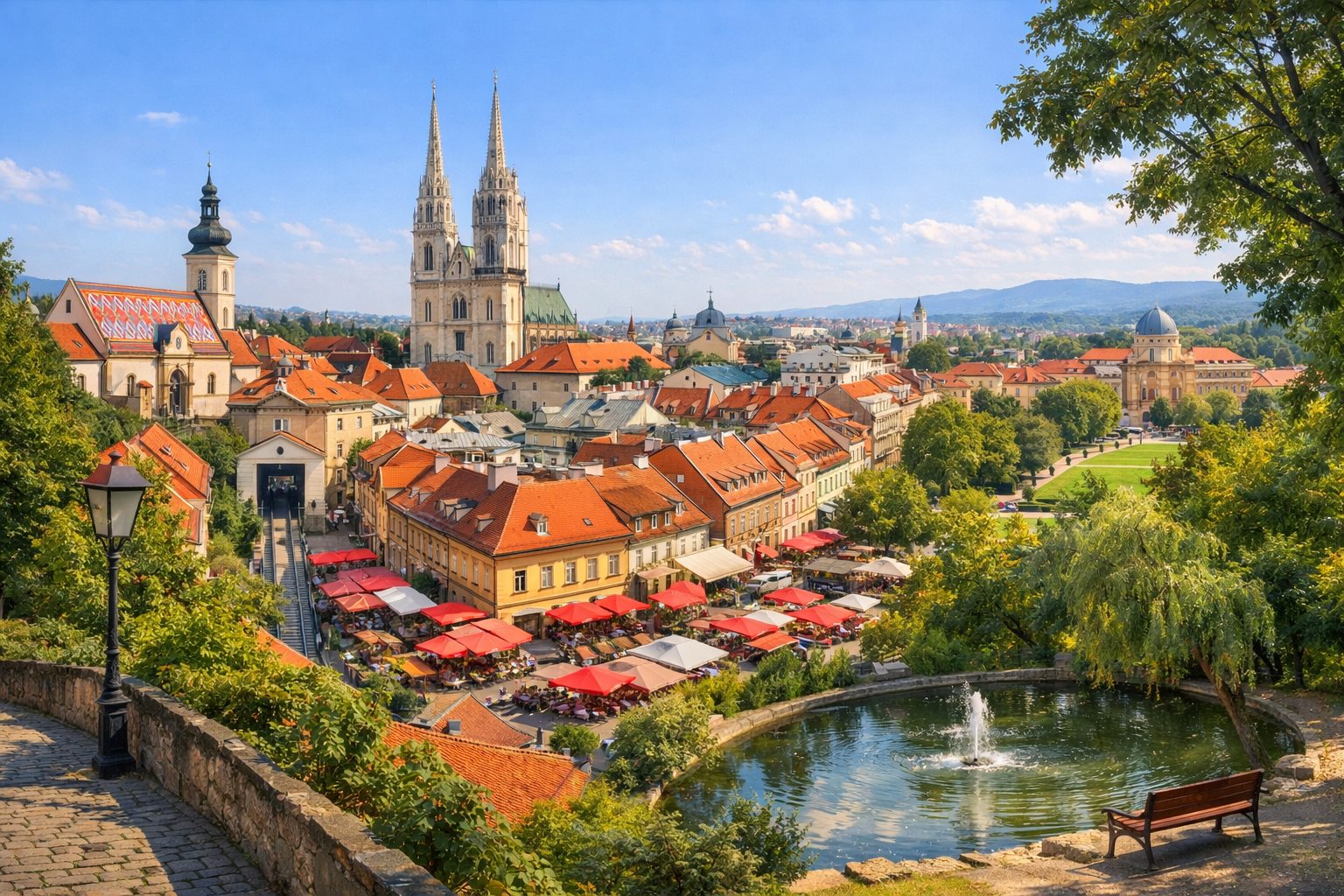
Day 1 — Zagreb: Upper Town, Dolac, and the old heart of the capital
🚶 Start your route from the city’s main axis — Ban Josip Jelačić Square, where Zagreb immediately opens up in two dimensions: business and historical. From here it’s very convenient to move around on foot without spending extra on transport, and the first day is best built as an unhurried introduction to the Upper Town and the markets, because the main points are close to each other. The season from April to October is especially good for this area: the light falls beautifully on the facades, terraces are open, and the narrow streets and stairways of the old center feel not like museum scenery, but like a living part of the city.
🥕 Then head to Dolac Market — Zagreb’s main market, often called the “belly of the city.” It is not just a place to buy vegetables, fruit, cheese, and pastries, but one of the city’s most characteristic rituals. Under the famous red umbrellas, you can feel everyday Zagreb: the smell of seasonal fruit, vendors’ conversations, rows of greens, homemade dairy products, and a simple, very local pace of life. For a budget trip, this is also a practical stop: it’s easy to buy an inexpensive breakfast or snack here — burek, pastries, fruit, yogurt, cheese, or something for a picnic in the park. Allow about 1–1.5 hours for a relaxed look around the market and a nearby coffee.
🚶 From Dolac, climb up into the Upper Town — the oldest and most atmospheric part of the Croatian capital. Here Zagreb becomes intimate: stone streets, courtyards, old lanterns, baroque facades, stairways between houses, and the feeling that the big city has suddenly become quiet and almost homelike. It makes sense to include a walk past Lotrščak Tower, panoramic viewpoints, St. Mark’s Church with its bright mosaic roof, and the streets around Čirilometodska and Opatička. Even without expensive tickets, the Upper Town gives a very rich impression, because its main asset is the setting itself, the viewpoints, and the chance to see a lot on foot.
🚠 If the funicular is running on schedule on the day of your trip, you can ride it once on the short historic ascent between the Lower and Upper Towns. It’s not a necessary expense, but it’s an inexpensive and very Zagreb-like detail of the route. If you want to save even more, the ascent and descent can easily be replaced by walking the stairs — the distance is short. For the whole Upper Town section, including photo stops and rest breaks, it’s reasonable to allow 3–4 hours without rushing.
🏛️ For museums on this day, it’s better to choose one so the itinerary stays budget-friendly and not overloaded. The best option is the Museum of Broken Relationships at Ćirilometodska 2. It is located right in the Upper Town and fits perfectly into a walking route. It’s a small, unusual, and emotionally powerful museum where personal objects and short stories turn into a very human narrative about love, breakups, memory, and self-irony. If you want something more locally artistic, the Croatian Museum of Naïve Art, also very close by, can be an alternative.
🍽️ In the evening, head down to the Tkalčićeva area and the neighboring streets. Here it’s better not to plan an expensive dinner, but to choose something simple: a bakery, an inexpensive konoba, a portion of soup, pasta, grilled food, or pizza. For a budget day in the center, expect food costs of about 8–18 € for a main meal and 2–5 € for coffee or pastries. The area is livelier and noisier at night, but Zagreb is generally considered safe; still, as in any tourist center, it’s better to keep an eye on your belongings and not leave your phone unattended on a table.
💤 Day summary: almost the entire route is done on foot, with minimal transport costs. This is the most economical way to see Zagreb beautifully and meaningfully: the old town, the market, panoramas, one good museum, and cozy streets without long transfers.