
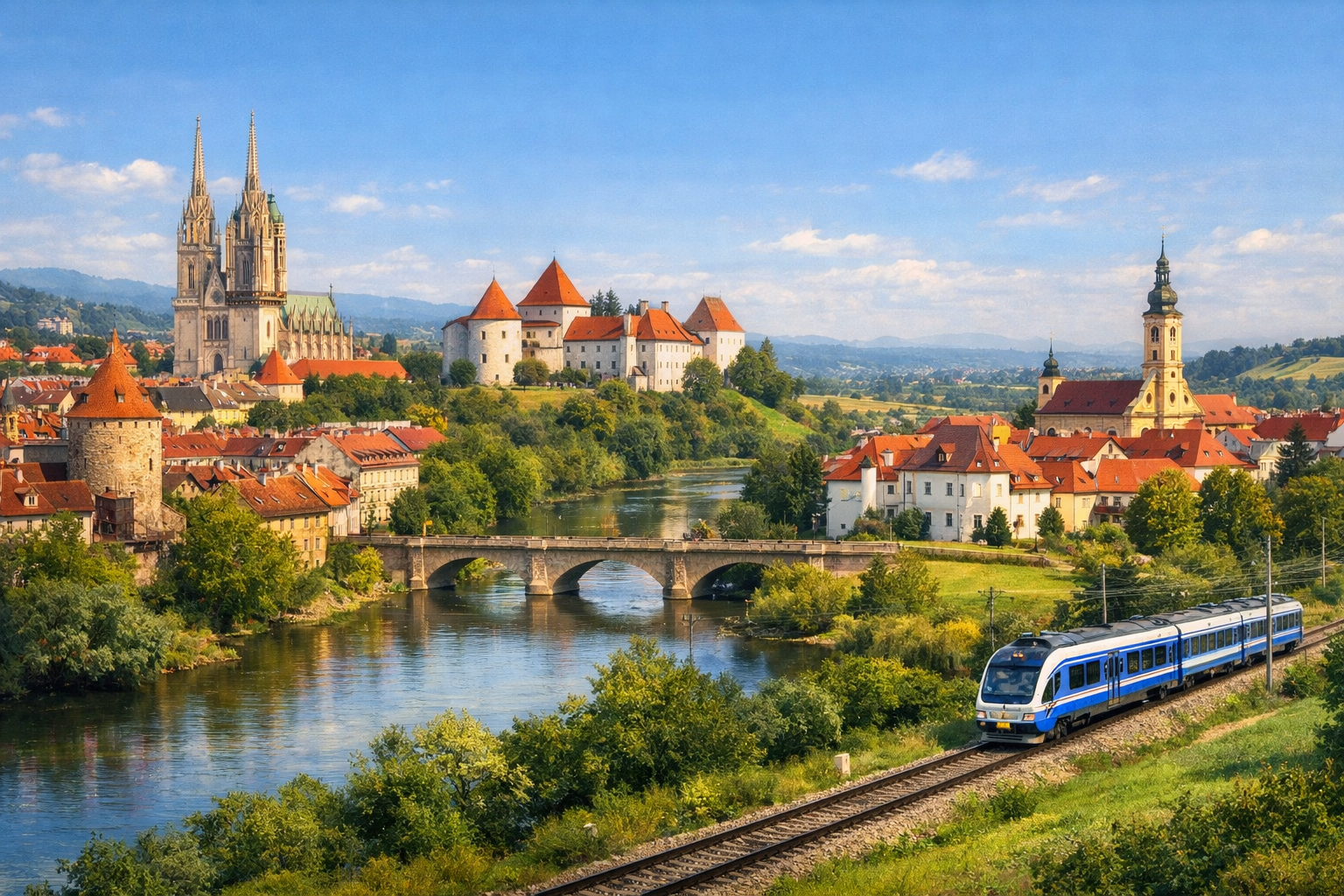
Day 1 — Zagreb: Upper Town, the cathedral quarter, and first panoramas
🚶 Start the route with a compact and very budget-friendly introduction to historic Zagreb. It is best to stay in the central part of the city and set out on foot right away: the old core is conveniently gathered within a short distance here, so on the first day you can almost avoid spending on transport. Upper Town is the part of the capital where medieval lanes, government buildings, church facades, and panoramic viewpoints come together into the atmosphere of a calm Central European capital. On St. Mark’s Square, one of Croatia’s most recognizable postcard views awaits you — St. Mark’s Church with its bright roof of colored tiles, featuring the coats of arms of Croatia, Dalmatia, Slavonia, and Zagreb itself. This is not just a beautiful facade: the church is considered one of the city’s oldest symbols, and the whole square is perceived as the heart of old Gradec — the ancient settlement from which historic Zagreb grew.
🚶 Then walk unhurriedly toward the Stone Gate and onward to the Kaptol district. This transition is especially good because it lets you feel how religious history, urban memory, and everyday life are literally layered together in Zagreb. The Cathedral of the Assumption of the Blessed Virgin Mary is the city’s most monumental sacred landmark and one of the key Gothic reference points in northern Croatia. Even if part of the complex is going through restoration, the quarter around the cathedral still makes a strong impression: towers, stone masonry, open squares, and the streets around Kaptol give the route a solemn, almost cinematic tone. After that, it makes sense to descend to Dolac market — a lively city market where you can have an easy and inexpensive snack: fresh pastries, fruit, cheese, burek, or a simple dish of the day will cost noticeably less than in tourist restaurants.
🚶 In the second half of the day, walk through Tkalčićeva ulica and Zrinjevac. Tkalčićeva is livelier and younger, with cafés and terraces, while Zrinjevac gives the opposite mood: avenues, a pavilion, neat trees, and the feeling of a leisurely Austro-Hungarian city. If you still have energy, add a short ride on the Zagreb funicular — it is not an essential expense, but it is inexpensive and very atmospheric. On a clear evening the old center is especially beautiful in the soft light, and you can end the day with a simple budget dinner in a bakery, bistro, or konoba, with a rough budget of about 10–18 € per person. For the first day, this is the optimal rhythm: no overload, no long transfers, and the maximum number of key impressions on foot.