
Buy PDF guide

Buy PDF guide — 8.57 USD

PDF — 8.57 USD

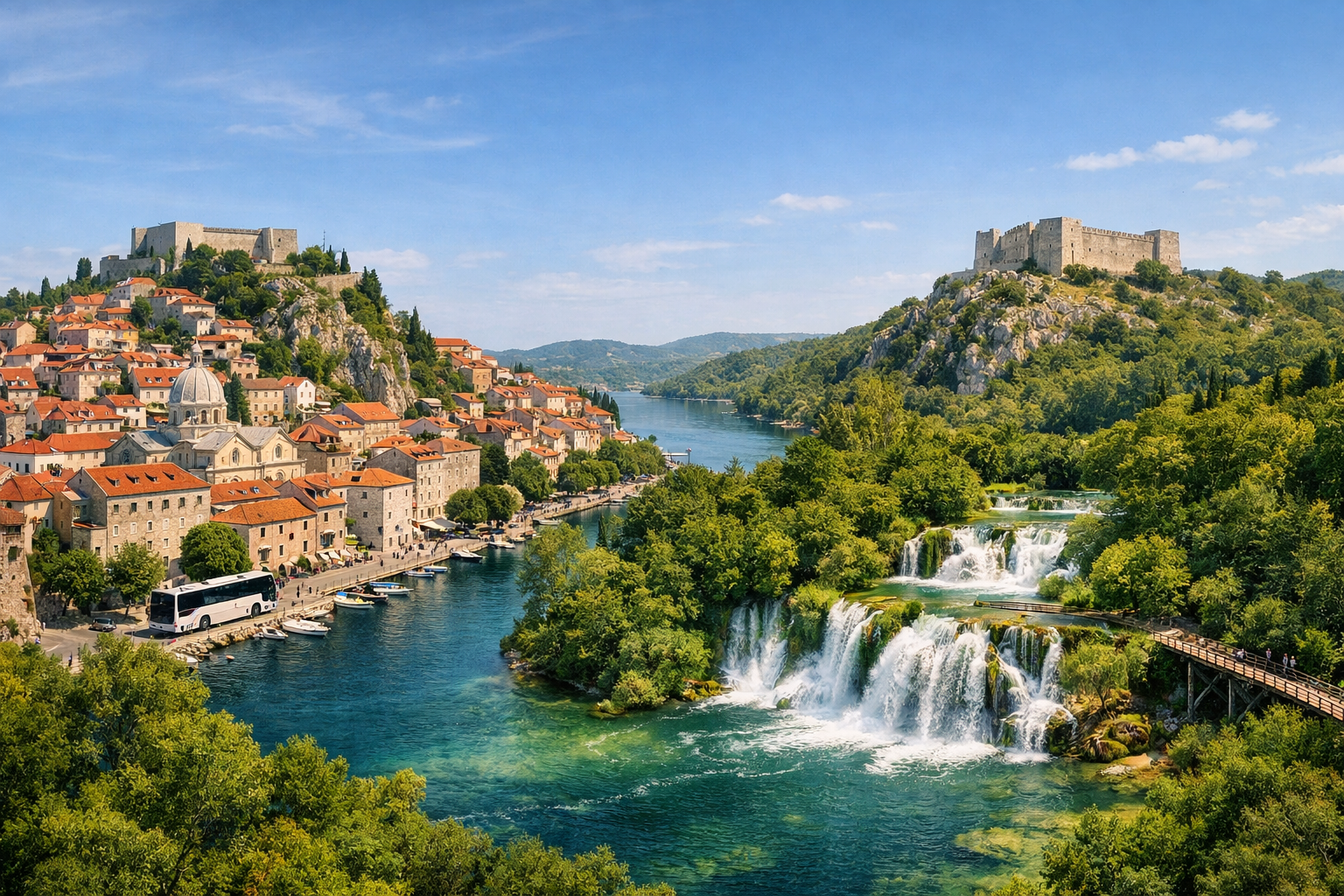
Croatia, Šibenik and Krka National Park. A budget trip through a medieval city, fortresses, and waterfalls using intercity buses.

Croatia, Šibenik and Krka National Park. A budget trip through a medieval city, fortresses, and waterfalls using intercity buses.

Discover Croatia on a budget with a trip from medieval Šibenik to the emerald waterfalls of Krka National Park. Wander stone streets and sea-view fortresses, then hop by bus to Skradin and into one of the country’s most beautiful natural escapes before returning to the coast.

🧭 DAY-BY-DAY ROUTE

Ready-made country and city routes with daily plans, sights, transport and accommodation. Buy PDF guides for independent travel.

🧭 DAY-BY-DAY ROUTE


Day 1 — Šibenik: the old town, the cathedral, and an evening at St. Michael's Fortress

  • 🚆 It is most convenient to plan a budget arrival through Šibenik as the only base for all 4 days. If you land at Split Airport, it makes sense to continue by public transport: first to Split or Trogir, then by intercity bus to Šibenik. From the Šibenik bus station to the waterfront is about 300 meters, so you can walk and avoid spending money on a taxi. From the Split area to Šibenik, usually allow about 1.5–2.5 hours including transfer waiting time and summer traffic jams.

  • 🚶 The first day is best devoted to old Šibenik — one of the most atmospheric medieval towns in Dalmatia. This is not a resort backdrop, but a real stone labyrinth of stairways, arches, narrow passages, and small squares where the Venetian past of the city can still be felt. Šibenik is especially good for a budget trip: it is pleasant to walk the historic center for free, and many of the best impressions here are connected not with expensive tickets, but with views of terracotta roofs, the sea bay, laundry on balconies, shaded alleys, and the slow rhythm of a southern town.

  • ⛪ The main point of the day is the Cathedral of St. James, a UNESCO site at Trg Republike Hrvatske 1, 22000 Šibenik. It is one of the most important monuments of Renaissance architecture on the Adriatic, built entirely of stone. The dome, carved decoration, and the famous 71 stone heads on the outer walls are especially impressive. Even if you only limit yourself to an exterior view, the place makes a strong impression: the cathedral seems to rise directly out of the stone steps of the square, and it is especially beautiful in the morning before the old town has heated up under the sun.

  • 🏛️ After the cathedral, you can visit Civitas Sacra, Tomislava 10, 22000 Šibenik — a modern interpretation center dedicated to the heritage of the cathedral and the historic core of the city. It is a good inexpensive stop for those who like not just to look at facades, but to understand how the city's history took shape, why Šibenik is important for Croatia, and how religious, maritime, and urban life have intertwined here for centuries.

  • 🍽️ For a budget lunch, look for bakeries, pizza by the slice to go, burek, sandwiches, and simple konoba away from the most touristy streets. A realistic daily food budget in an economical format is about 15–25 € per person if breakfast is partly covered by supermarket purchases and one meal is quick and inexpensive.

  • 🌇 In the evening, head up to St. Michael's Fortress, Zagrađe 21, 22000 Šibenik. This is the main viewpoint over the old town and one of the most expressive fortresses on the coast. From above, the whole logic of the place opens up: the bay, the islands of the archipelago, the mouth of the Krka, red roofs, the cathedral dome, and the rolling relief of the old center. In the golden hour, Šibenik looks almost theatrical — as if the whole city had been deliberately staged facing the sea. A standard ticket is approximately 11.5 €, and opening hours should be checked in advance because in summer the fortress sometimes closes earlier or entirely for concerts and festivals.


Day 2 — Šibenik: Barone and St. John's Fortresses, the city's rhythm without extra spending

  • 🚶 Dedicate the second day to Šibenik’s defensive belt. Unlike many coastal towns, the fortresses here are not just a formal attraction, but a whole system that explains how the city survived between the sea, trade, and military threat. The route is convenient to do on foot from the old center, gradually climbing upward without transport or extra expenses.

  • 🏰 Start with Barone Fortress, Put Vuka Mandušića 28, 22000 Šibenik. It stands above the old core and offers perhaps the most complete panoramic view of the city and the archipelago. This place is also well suited to a budget route because it can easily be combined with a long walk without additional spending. The fortress usually has multimedia elements and a café area, but even without them it is worth climbing up here for the air, the openness, and the feeling that the city reveals itself gradually, layer by layer.

  • 🚶 From Barone continue to St. John's Fortress, Put Tanaje 29, 22000 Šibenik. This is the highest and largest fortress in Šibenik, built in the 17th century in haste before the Ottoman threat. The climb requires a bit more effort, so be sure to bring water, headwear, and shoes with proper soles. The route itself is very scenic: the higher you go, the more clearly you see how the medieval town with its narrow streets gives way to broad views of the surroundings, rocky slopes, and lines of the coastline.

  • 💸 If you want to save as much as possible, on this day you can choose only one paid fortress and leave the second as a walking viewpoint with an exterior look along the way. If the budget allows, a combined ticket for the fortresses is usually more выгоднее than separate entries. For food on this day, it is convenient to bring supermarket purchases: water, fruit, yogurt, pastries, and ready-made salads noticeably reduce expenses without harming comfort.

  • 🏘️ After descending, leave time for the unhurried life of the city: Poljana, the waterfront, the stairways of the old center, small courtyards, and evening light on the facades. Šibenik is not a city that should be rushed through with checkmarks. Its value is precisely in allowing yourself to do nothing for half an hour: sit by a wall, look at the harbor, listen to bells and footsteps on stone. This format is especially good on a budget trip because the strongest impressions here are often free.

Day 3 — Krka National Park: Skradin and the Skradinski buk waterfalls

  • 🚌 The most logical and budget-friendly day of the trip is a public transport outing from Šibenik to Skradin. Intercity and regional buses between Šibenik and the surrounding area run regularly, but be sure to double-check the exact schedule the day before. For the ride itself one way, it is reasonable to allow about 20–35 minutes, plus time for walking to the entrance/pier and possible waiting.

  • 🌿 Skradin is a very good base for a gentle introduction to Krka. It is a small Dalmatian town by the water, where the river almost imperceptibly turns into the landscape of the national park. The waterfront, boats, stone houses, green slopes, and calm rhythm make it not just a transit point but a full-fledged location. Even a short walk through Skradin before entering the park adds contrast to the route: after strict stone Šibenik, there is more water, shade, and resort-like relaxation here.

  • 🎟️ For a budget trip, it is best to check the official national park web shop in advance and choose the appropriate entrance. A park ticket includes a visit to Skradinski buk and accessible land locations, and the approximate time to see the Skradinski buk area itself is about 2 hours not including the journey to it. Ticket prices depend on the season and entry format, so give only a rough guide: in high season the price may be noticeably higher than in the off-season; allow a range of about 15–40+ € per adult depending on the period.

  • 💦 Skradinski buk is one of Croatia’s most famous natural scenes: cascades of water, wooden boardwalks, powerful flows, emerald shades, humid air, and the constant sound of the river that drowns out the city rhythm and seems to reset your breathing. It is important not to hurry here. Walk slowly, pause at the viewpoints, and look not only at the main waterfall but also at the small rapids, moss, roots, old stone structures, and the way the water spreads into dozens of channels.

  • 🥪 To avoid inflating the budget, the best option is to bring water and a simple snack from Šibenik or a supermarket in Skradin, and leave a full meal for the return. In hot weather, be sure to keep in mind that even a short walk in the park takes longer because of stops, photos, and the density of visitors.

  • 🚌 In the evening, return to Šibenik on the same bus leg. Do not leave your return for the latest possible departure: in summer, because of busy roads and the influx of tourists, it is better to have a time buffer. The day turns out full but realistic, and there is no need to rent a car.

Day 4 — Šibenik: museum, free time, and a budget departure

  • 🏛️ It is best to make the last day calmer. Start with the Šibenik City Museum, Gradska vrata 3, 22000 Šibenik, near the cathedral. It is a good final stop to bring together everything you have seen: the ancient and medieval layers of the region, urban history, everyday objects, art, and archaeology. Before visiting, be sure to check the current opening schedule: the museum has reported restrictions and renovation works, and hours depend on the season.

  • 🚶 After the museum, leave a few hours for a free walk without a rigid plan. You can stroll the waterfront once more, stop by the market, buy inexpensive local souvenirs such as lavender, salt, postcards, or small food products, and then choose a final viewpoint in the old center. Such a soft ending is especially good before a bus departure: there is no need to be nervous that your ticket will be wasted because of a long trip to a distant location.

  • 🍽️ The final budget day is usually the cheapest: breakfast at the hotel or from a shop, a light lunch at a bakery or café, water, and takeaway coffee. If you calculate very economically, the whole 4-day route without airfare can fit into about 220–420 € per person with accommodation in a simple double room or hostel, travel by buses, and a moderate number of paid entries. With more active fortress visits and higher summer prices, allow a buffer.

  • 🚌 For departure to Split or the airport, it is better to allow extra time. The Šibenik bus station is located at Draga 14, 22000 Šibenik, and it is well connected with the major cities of the coast. In season, delays are possible because of traffic jams, so do not plan tight connections, especially if you are heading to a flight.

  • ⚠️ Information about safety, weather, road conditions, and route accessibility may change. Before the trip, check official warnings, the weather forecast, transport schedules, and possible trail restrictions. No destination can be considered completely safe.

Flight tickets

eSIM for travel

Buy PDF guide

Buy PDF guide — 8.57 USD

PDF — 8.57 USD