
Buy PDF guide

Buy PDF guide — 29.99 USD

PDF — 29.99 USD

CROATIA

CROATIA

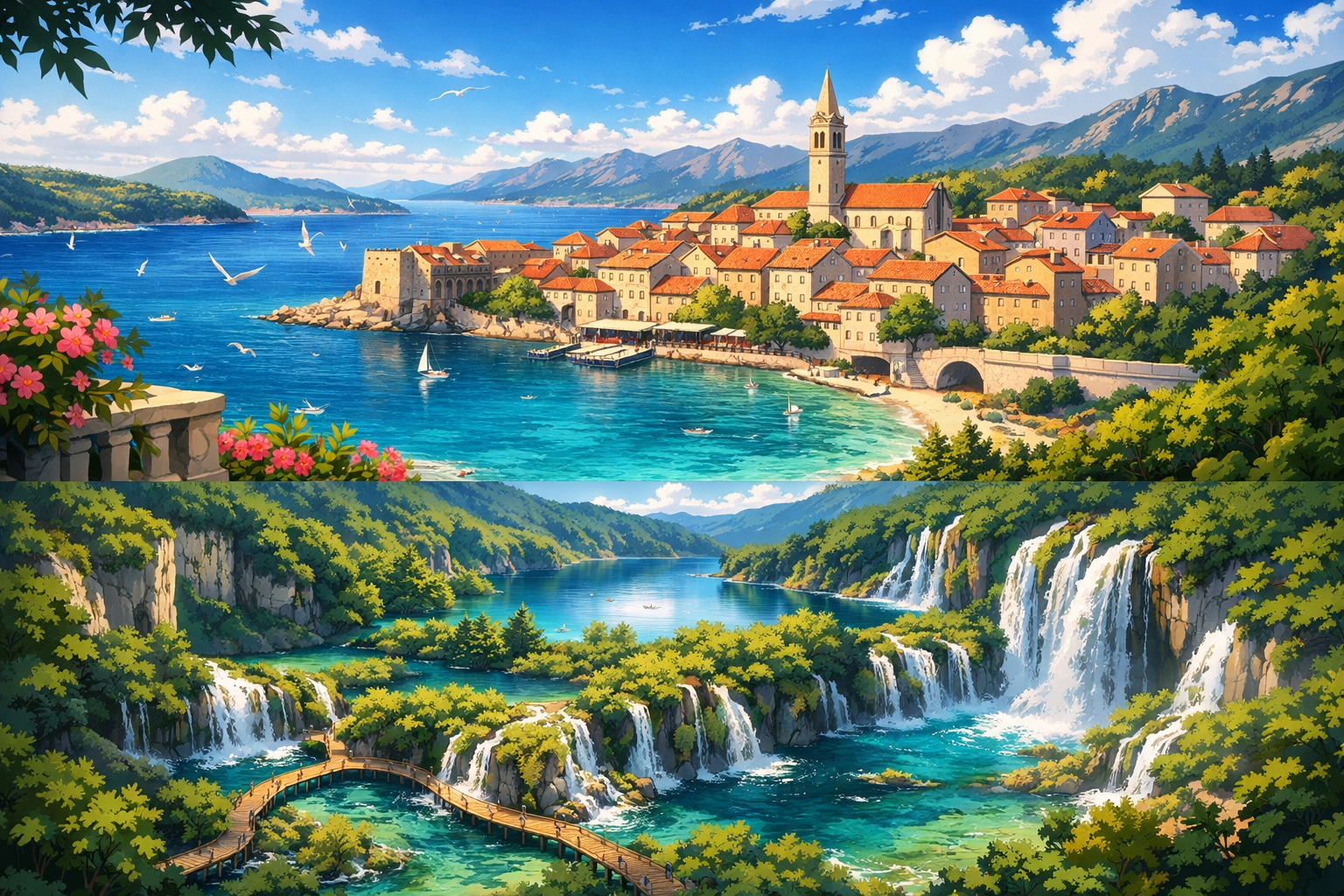
From café-lined Zagreb and the emerald cascades of Plitvice to Zadar’s sunsets and Šibenik’s gateway to Krka, Croatia unfolds in vivid layers. Drift through Roman Split and medieval Trogir, island-hop to Hvar and Korčula, and end on Dubrovnik’s storied walls above a glittering Adriatic.

🧭 DAY-BY-DAY ROUTE

Ready-made country and city routes with daily plans, sights, transport and accommodation. Buy PDF guides for independent travel.

🧭 DAY-BY-DAY ROUTE


Day 1 — Zagreb: Upper Town (Gradec) and Kaptol

  • 🚶 Start getting to know the capital with the funicular (the shortest in the world, operating since the 1890s), which will take you up to the viewpoints of the Upper Town. Narrow streets with gas lamps, the colorful roof of St. Mark’s Church, and the picturesque Tkalčićeva lined with cafés create the mood of old Zagreb. Head down to Dolac Market — the “belly of the city” — and to Ban Jelačić Square, and then to the cathedral on Kaptol: its slender spires are visible from many points in the center, and around it are calm gardens where it’s nice to catch your breath after the journey.


Day 2 — Zagreb: The Green Horseshoe and museum stories

  • 🚶 A walk along the “Green Horseshoe” — a ring of 19th-century parks and squares: Zrinjevac with its classical pavilions, Tomislav Square with the Art Pavilion, and the Botanical Garden — an oasis of calm amid trams and coffee shops. After that, a museum block in the Upper Town: the atmospheric Museum of Broken Relationships (address below in the “Museums and parks” section) with personal stories and objects it’s hard to tear yourself away from, and the Zagreb City Museum — to understand how this multi-layered capital took shape. In the evening — dinner in a traditional konoba and an easy stroll along the Sava riverbanks.

Day 3 — Transfer to Plitvice Lakes. Lower Lakes and the “Big Waterfall”

  • 🚆 Transfer: Zagreb → Plitvice Lakes by intercity bus (Arriva/other carriers): ≈ 2h 15m–2h 30m. Exit at Entrance 1 (Rastovača) or Entrance 2 (for routes around the Upper Lakes).

  • 🚶 Devote your first walk to the Lower Lakes: turquoise basins, boardwalks over emerald water, and the roar of the “Big Waterfall.” The paths are laid out so you literally “float” through a green labyrinth among mosses and travertines; every few meters there’s a new angle and the continuous music of water.

Day 4 — Plitvice Lakes: Upper Lakes and a ride across Lake Kozjak

  • 🚶 In the morning — the Upper Lakes: a network of emerald basins and mini-cascades where the water seems to run over glass. Take the electric boat across Lake Kozjak — a mirror-smooth surface with fir slopes all around. The walking loops of the routes (A–K) let you choose your pace: from 3–4 hours to a full day. We recommend starting at park opening to stay “ahead of the crowds,” and don’t forget unhurried pauses on the wooden platforms — the best way to feel the park’s breathing.

Day 5 — Transfer to the Adriatic: Zadar. The Forum, the Sea Organ, and sunsets

  • 🚆 Transfer: Plitvice Lakes → Zadar by bus: ≈ 2–2h 30m. From the bus station — a short ride to the old-town peninsula.

  • 🚶 Zadar is a city of light and wind. The Roman Forum by the Cathedral of St. Anastasia — stone slabs and columns with two thousand years under your feet. Right at the edge of the Adriatic you’ll hear the Sea Organ: steps with resonators “sing” from the incoming waves; and nearby is “Greeting to the Sun” — a circular installation of solar panels that at night turns into a light meditation. The sunset here is a show Zadar is beloved for by photographers.

Day 6 — Zadar: ancient glass and a walk along the bastions

  • 🚶 Morning — at the Museum of Ancient Glass: live glassblowing demonstrations, Roman vessels, jewelry, and rare finds, and from the windows — a view of the waterfront. Then — the Archaeological Museum (the region’s history from prehistory to the Middle Ages). Walk along the Venetian fortifications and narrow streets to the Market Square, and in the evening head back to the sea — to listen to the “organ” under the stars.

Day 7 — Šibenik: St. James’s Cathedral and the stone poetry of the old town

  • 🚆 Transfer: Zadar → Šibenik by bus: ≈ 1h 10m–1h 30m.

  • 🚶 Old Šibenik is a granite labyrinth of stairways and lanes where houses lean on one another, and over the main square reigns St. James’s Cathedral (UNESCO): the only cathedral in Europe built entirely of stone slabs and vaults without binding mortar. Look for the portraits of 15th-century townspeople on the facade — the stonemasons granted them eternal life. In the evening — dinner on the waterfront with views of boats and the shimmering St. Michael’s Fortress.

Day 8 — Krka National Park: cascades, Visovac Monastery, and boats

  • 🚐 Enter via Lozovac (parking + shuttles) or by boat from Skradin. The Skradinski Buk boardwalk route is a classic: dozens of flowing “curtains,” mills, and viewing bridges. Important: swimming at Skradinski Buk has been prohibited since 2021 — the ecosystem and travertines are carefully protected. Round out the day with a boat trip to the monastery on Visovac Island and to Roški Slap — there you can see how the river carves loops through the limestone.

Day 9 — Split: Diocletian’s Palace and life on the Peristyle

  • 🚆 Transfer: Šibenik → Split by bus: ≈ 1h 45m–2h.

  • 🚶 Diocletian’s Palace is not a “ruin” but a living city: in the basements there are arcades where antiquity echoes, in the evenings music plays on the Peristyle, and in the imperial mausoleum there is the Cathedral of St. Domnius with a bell tower that’s worth climbing for a panorama of rooftops and the blue bay. Narrow streets open into tiny courtyards, galleries, and a fish market with the morning catch — feel the pulse of Dalmatia’s seaside capital.

Day 10 — Split: Marjan and the master Ivan Meštrović

  • 🚶 In the morning — hike up Marjan Hill: pine trails, salt in the air, and viewpoints over Split, Brač, and Šolta. Then — the Ivan Meštrović Gallery: marble and bronze silhouettes, austere beauty, and Adriatic light in large windows. Afterward — the beaches at the foot of Marjan for a lazy hour by the water.

Day 11 — Trogir (UNESCO): Radovan’s portals and Kamerlengo Fortress

  • 🚐 Half a day in Trogir (easy from Split by bus/boat): a stone island-town with the Romanesque-Gothic Cathedral of St. Lawrence, the famous Radovan Portal, and shady courtyards. Walk along the waterfront to Kamerlengo Fortress—the harbor view is especially beautiful at sunset. In the evening—return to Split.

Day 12 — Hvar: Fortica (Španjola) Fortress and St. Stephen’s Square

  • ⛴️ Transfer: Split → Hvar (Jadrolinija/Krilo catamaran): ≈ 1h–1h 20m. The port is steps from the center.

  • 🚶 Hvar—light and azure. Climb the conifer trail up to Fortica (Španjola) Fortress: from the bastions—a scattering of the Pakleni Islands and white sails. Below—the sun-glittering Riva promenade and the huge St. Stephen’s Square with the Arsenal and Europe’s oldest public theater (1612). Evening—in one of the bars on the Riva: boats, laughter, and a gentle breeze.

Day 13 — Korčula: St. Mark’s Cathedral and “fishbone” streets

  • ⛴️ Transfer: Hvar → Korčula (Krilo/Jadrolinija catamaran): ≈ 1h 20m–2h.

  • 🚶 Korčula—the “little sister” of Dubrovnik: the regular street plan, radiating like rays, channels the wind away, and at the top is St. Mark’s Cathedral with a carved portal and bell tower. The City Museum has tapestries, maritime relics, and furniture of the town’s patricians; on the fortress wall—terraces with views of the azure Pelješac Channel.

Day 14 — Dubrovnik: the walls, the Rector’s Palace, and an evening on the Stradun

  • ⛴️ Transfer: Korčula → Dubrovnik (Krilo catamaran): ≈ 2–2h 30m.

  • 🚶 Dubrovnik—a stone symphony. Walk the city walls: even battlements, sea bastions, and courtyards below; step into the Rector’s Palace—carved loggias and halls with artifacts of the Republic of Ragusa; toward evening—head to the Stradun: a centuries-polished limestone “main street” with the soft golden glow of lanterns. If you still have energy—a short trip to Trsteno Arboretum: ancient statues, fountains, and a sea panorama.

Flight tickets

eSIM for travel

Buy PDF guide

Buy PDF guide — 29.99 USD

PDF — 29.99 USD