
Buy PDF guide

Buy PDF guide — 8.57 USD

PDF — 8.57 USD

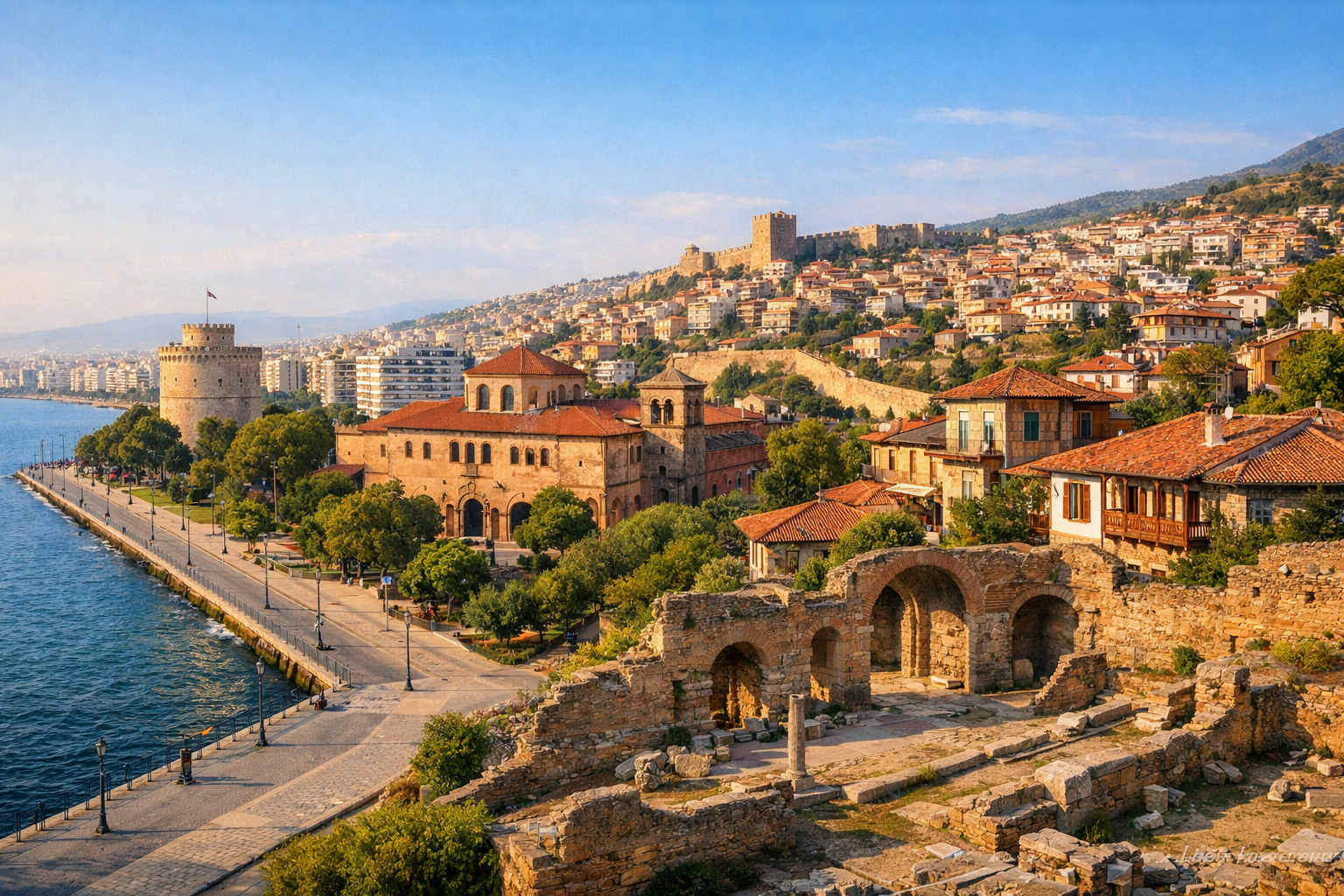
Greece, Thessaloniki. Affordable city tour along the waterfront, Byzantine churches, markets, the upper town, and archaeological sites.

Greece, Thessaloniki. Affordable city tour along the waterfront, Byzantine churches, markets, the upper town, and archaeological sites.

Explore Thessaloniki with an affordable city tour that moves from the lively waterfront to Byzantine churches, colorful markets, and the hilltop streets of the Upper Town. Along the way, discover layers of history in its remarkable archaeological monuments and the relaxed energy that makes Greece’s second city so inviting.

🧭 DAY-BY-DAY ITINERARY

Ready-made country and city routes with daily plans, sights, transport and accommodation. Buy PDF guides for independent travel.

🧭 DAY-BY-DAY ITINERARY


Day 1 — Waterfront, White Tower, and city center

  • 🚍 If you arrive at Macedonia Airport (SKG), the most budget-friendly way to get to the center is by city bus. The trip to downtown usually takes about 40–50 minutes, and the airport route goes through the city toward the railway station and bus terminal. For the first day, it’s best not to take a taxi unless necessary: a taxi from the airport to the center usually costs around 12–15 €, while the bus is noticeably cheaper. For a budget base, it’s better to stay in the central part of the city so you can do most of the route on foot and spend as little as possible on transport.

  • 🚶 Start getting to know Thessaloniki with a walk along the seafront — it’s one of the most pleasant and at the same time free ways to feel the city. The promenade here is long, open to the wind and the sea light, with a wide pedestrian zone, bike lane, benches, and a constant flow of locals. In the morning it feels almost meditative: fishermen by the water, runners, students with takeaway coffee, seagulls over the Thermaic Gulf. Closer to evening, the space fills with golden light, and the city seems to reveal its most beautiful facade — the one that makes Thessaloniki feel at once Balkan, Mediterranean, and very alive.

  • 🏛️ The White Tower is the city’s main symbol and the most recognizable point on the shore. Even if you decide to save money and just look at it from the outside, the place is already worth visiting: the tower stands dramatically by the sea and serves as an ideal starting point for a walk through the center. Inside there is a museum exhibition telling the story of the city from antiquity to later eras. A ticket here is usually inexpensive, approximately around 8 €, so if you want, you can include it in your budget without making the trip much more expensive.

  • 🚶 From the White Tower, it makes sense to walk along Aristotelous Square and then through the central streets toward the sea and back. This is the heart of the city — not museum-like, but everyday life: with early 20th-century facades, busy intersections, street cafés, and the feeling that Thessaloniki lives more than it poses. If you want to stay within a budget, it’s better to plan lunch not on the first line by the water, but deeper into the blocks: there you’ll more often find inexpensive gyros spots, bakeries, and small places with homemade dishes. A realistic range for a snack or simple lunch is about 5–12 € per person.

  • 🌇 In the evening, it’s worth returning to the sea again and walking along the waterfront toward the sunset. It’s a free “viewpoint” several kilometers long, where the city is felt best precisely in motion. The first day is intentionally kept easy: minimum expenses, minimum complicated logistics, maximum walking after the journey. This pace helps you avoid overloading yourself and calmly adapt to the heat, humidity, and rhythm of the city.


Day 2 — Byzantine churches and the Galerian complex

  • 🚶 Dedicate the second day to Byzantine Thessaloniki — this historical dimension is exactly why the city is so valued by lovers of architecture and ancient Christian heritage. In and around the center, the monuments are located quite compactly, so the route is easy to do on foot, only occasionally using a bus when tired. It’s best to start in the morning, before the stone heats up and while the church spaces still preserve their special coolness and silence.

  • ⛪ The first key point is the Rotunda, one of the city’s most impressive and unusual monuments. It is a massive round structure from the early Roman period, later turned into a Christian church, and then it passed through different eras and functions. Inside, what impresses most is the dome space, the ancient monumentality, and the feeling of transition between worlds — pagan, early Christian, Byzantine. Nearby stands the Arch of Galerius, so this is an especially good place to see how antiquity and Byzantium literally layer over one another in Thessaloniki.

  • 🏛️ From the Rotunda, it’s convenient to walk to the Arch of Galerius, and along the way to look at fragments of the late Roman city as part of the everyday environment rather than as an isolated museum. This is a strong feature of Thessaloniki: archaeology here has not been moved outside life, it is built into it. Walking among modern houses, shops, and intersections, you constantly come across traces of the imperial past, and the city begins to feel like a huge multilayered historical landscape.

  • ⛪ Then head to the most important Byzantine churches in the center — above all, the Church of Saint Demetrios and Hagia Sophia. Even if your goal is not a detailed art-historical study, these places give a powerful emotional understanding of why Thessaloniki is considered one of the main centers of Byzantine heritage. What matters here is not only the mosaics, crypts, vaults, and historical details, but also the atmosphere itself: half-light, oil lamps, old stone, the quiet footsteps of visitors. Entry to active churches is usually free, which makes such a day especially worthwhile for budget travel.

  • 🍽️ For lunch, it makes sense to stop in the area between Egnatia and the central markets: it is more convenient and cheaper than returning to the waterfront. For economical travel, bakeries with spanakopita and bougatsa, small souvlaki spots, and fast-casual canteens are good options. A realistic food budget for this day is about 10–20 € total, if you avoid tourist restaurants and focus on simple local cuisine.

  • 🏛️ If you want to add one paid but very worthwhile site, include the Museum of Byzantine Culture. This is not just a “must-see checkmark,” but a genuinely strong place with a deep exhibition on daily life, art, burial customs, church life, and the urban structure of the Byzantine world. A ticket costs approximately around 10 €, and the museum is especially good for those who want not just to walk through churches, but to understand the context of what they are seeing.

Day 3 — Markets, the Roman Agora, and affordable city food

  • 🧺 The third day is best devoted to the “living” urban Thessaloniki — markets, street food, shopping quarters, and ancient ruins that appear literally around the next corner. This is a very budget-friendly day: most of the impressions here are free, and the main expenses are only food, coffee, and, if you wish, one museum or archaeological site.

  • 🚶 Start the morning with Modiano Market and the Kapani area. Even after waves of tourist popularity, these places remain not a decoration, but part of real urban life. Here you hear the voices of vendors, the smells of spices, olives, cheese, fish, pastries, and coffee mix into a dense Mediterranean-Balkan air, and the rhythm of the space itself invites not haste but attentive wandering. The markets are also convenient for a budget breakfast: a pie, coffee, and something sweet often cost noticeably less than a restaurant breakfast.

  • 🍅 Thessaloniki’s markets are also great because they let you save money without feeling like you’re economizing. Instead of an expensive café, you can put together a very simple and tasty set for yourself: pastries, fruit, local cheeses, olives, water. If your hotel has a mini-fridge, this is especially convenient. For a short budget tour, this tactic helps noticeably reduce the total cost of the trip without sacrificing the quality of impressions or safety.

  • 🏛️ After the markets, head to the Roman Agora — one of the city’s key archaeological sites. Here you can especially feel the scale of ancient Thessaloniki as a major urban center. The ruins of the forum, the open spaces, and the remains of public buildings create not the effect of a “separate archaeological park,” but the sense that the modern city continues to stand on top of the old one. This is one of those points where you understand the multilayered nature of Thessaloniki especially clearly: the ancient foundation, the Byzantine spiritual vertical, and modern everyday life literally coexist here side by side.

  • 🏺 If you want to go deeper specifically into the ancient theme, the Archaeological Museum of Thessaloniki is a good addition. It is one of the main museums of northern Greece, with a strong collection on Macedonia and the ancient history of the region. A ticket costs approximately around 10 €, so the museum is best seen as an optional paid highlight: if the budget is very tight, you can limit yourself to the agora and external archaeological sites; if you have a little room, the museum is truly worth the time.

  • 🌆 Spend the evening on an unhurried walk through the central streets without a strict goal: you can return to Aristotelous Square, drop into a bookshop, buy inexpensive sweets, or head out to the sea again. The point of the third day is not the number of completed sights, but to experience the city from within, feel its everyday rhythm, and preserve the budget before the final ascent to the Upper Town.

Day 4 — Upper Town, walls, fortress, and panoramas

  • 🏞️ It makes sense to dedicate the final day to Ano Poli — the Upper Town, which differs most from the lower center in atmosphere. Here Thessaloniki becomes quieter, steeper in relief, more contemplative, and almost intimate. Narrow streets, old houses, unexpected stairways, inner courtyards, and views over the gulf create the feeling of a city above the city. It is the ideal end to the route: instead of museum concentration — air, perspective, and a sense of space.

  • 🚍 You can do part of the climb by city bus to save energy and avoid a heavy uphill walk in the heat. This is a sensible compromise for budget travel: the bus is inexpensive, and it’s better to spend your energy on the walk through the upper quarters and along the walls themselves. From the upper points, it is then convenient to walk back down, gradually passing viewpoints and historical sites.

  • 🏰 The main goal here is the area of the fortress walls and Heptapyrgion. Even if the internal program of the site or access to certain zones changes, the area by the citadel and the adjoining fortifications offers one of the best panoramic views of Thessaloniki. From here, the whole logic of the city reads beautifully: the sea, the dense lower development, church towers, modern districts, and the line of the shore. This is one of the strongest visual moments of the whole trip — and at the same time almost free.

  • ⛪ In the Upper Town, it is also worth paying attention to small Byzantine monuments and monastery sites, including the area associated with the Church of Hosios David. This is not the ceremonial tourist Thessaloniki, but a quieter and deeper layer of the city, where historical continuity is felt especially clearly. If you’re lucky with the light and weather, this is where the most atmospheric shots of the trip are made: red roofs, old walls, stairways, and distant sea haze.

  • 🍽️ For the final lunch or an early dinner, it’s better to choose a simple local place away from the front line and away from the most touristy squares. In Ano Poli and on the way down to the center, you can find modest taverns and snack bars where lunch will cost approximately 8–15 € per person. If you need to hold the budget even tighter, the final day can be spent almost entirely without paid sites at all: bus up, long walk down, coffee with a view, an inexpensive snack, and departure.

  • ⚠️ This day is especially sensitive to the weather: in summer, ascents and descents in the heat can be tiring, and after rain, stone sections and steps may be slippery. Before heading out, it’s worth checking the forecast, taking water, a hat, and comfortable shoes. The Upper Town is not technically difficult, but it requires attention to your condition and pace. This is exactly where it is best to finish the route without rushing, leaving time for rest and packing before the journey.

Flight tickets

eSIM for travel

Buy PDF guide

Buy PDF guide — 8.57 USD

PDF — 8.57 USD