
Buy PDF guide

Buy PDF guide — 15.00 USD

PDF — 15.00 USD

Greece, Peloponnese. A budget road trip through Nafplio, Mycenae, Epidaurus, and small coastal towns with overnight stays in family-run hotels.

Greece, Peloponnese. A budget road trip through Nafplio, Mycenae, Epidaurus, and small coastal towns with overnight stays in family-run hotels.

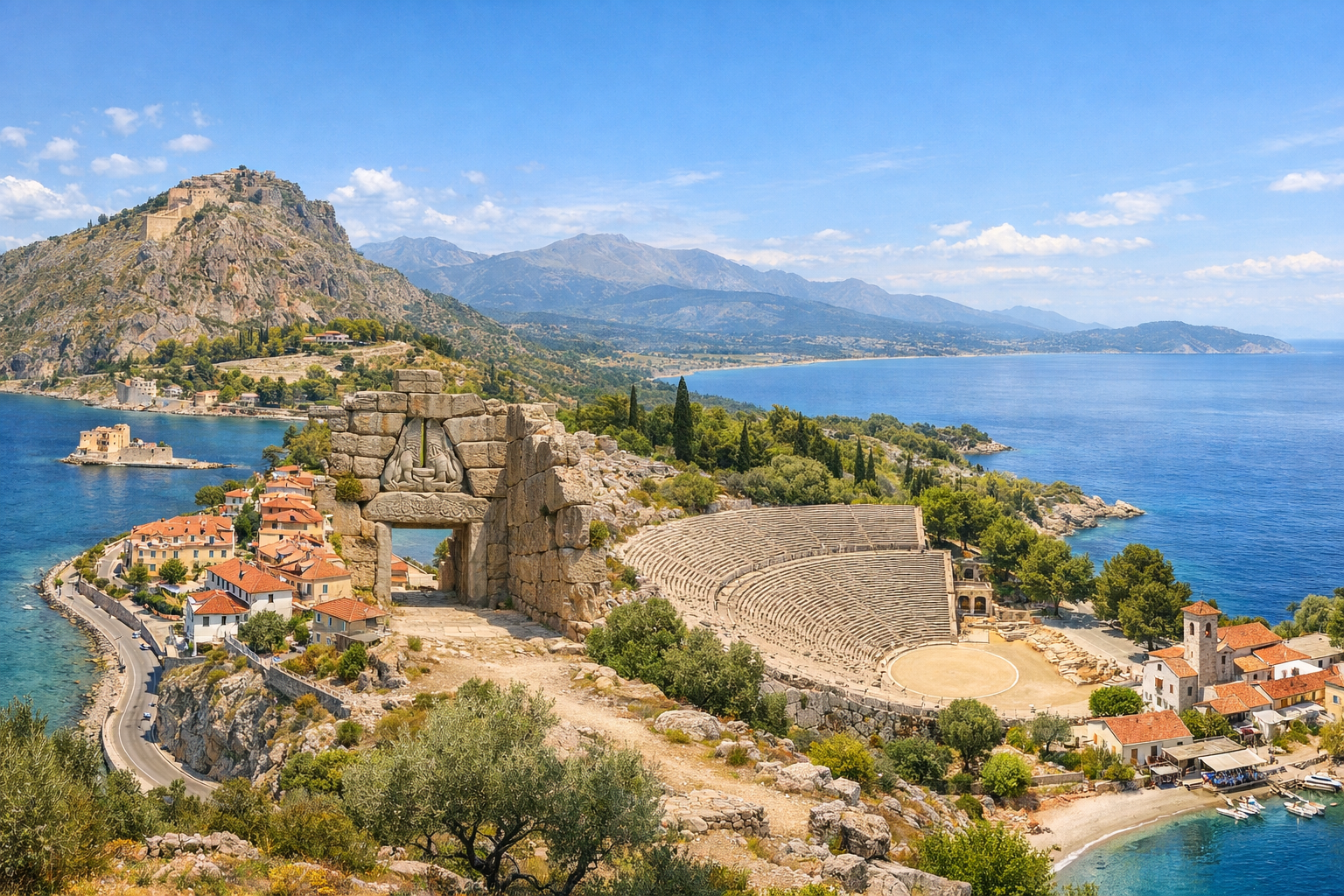
Discover the Peloponnese on a budget road trip filled with seaside charm, ancient ruins, and relaxed village life. From elegant Nafplio to the legendary stones of Mycenae and the remarkable theater of Epidaurus, this route pairs iconic history with easy nights in welcoming family-run hotels and quiet coastal towns like Tolo.

🧭 DAY-BY-DAY ITINERARY

Ready-made country and city routes with daily plans, sights, transport and accommodation. Buy PDF guides for independent travel.

🧭 DAY-BY-DAY ITINERARY


Day 1 — Transfer to Nafplio and first introduction to the town

  • 🚆 The most convenient way to start this budget route is by KTEL Argolida bus: from Athens to Nafplio, the trip takes about 2 hours 10 minutes. If you are arriving at Athens airport, the most economical and realistic option is to first get to the intercity bus station in Athens and only then take a bus to Nafplio. For the whole region, this is an important choice: unlike taking a taxi or renting a car, the bus noticeably reduces the budget and removes the stress of day one on unfamiliar roads.

  • 🚶 Nafplio is one of those towns that are ideal for slow budget travel: the old center is compact, many beautiful places are reachable on foot, and the atmosphere itself works better than any expensive guided tour. The former first capital of modern Greece welcomes travelers with the soft light of the Argolic Gulf, narrow streets with balconies, traces of the Venetian and Ottoman eras, and the feeling of a town that does not need to be “consumed” — it is enough simply to live through it step by step. On the very first evening, it is worth walking from the port to Syntagma Square, stopping by the facades of neoclassical houses, reaching the waterfront with views of the island fortress of Bourtzi, and ending the day with a free walk along Arvanitia — the coastal path where cliffs, sea, and sunset create an almost postcard-like scene with no entrance tickets or queues.

  • 🍽️ To save money on the first day, it is better to focus on simple family tavernas away from the main tourist strip by the water: look for gyros, souvlaki, baked vegetables, Greek salad, and daily specials. A realistic budget for a modest dinner is about 10–18 € per person, and for a quick snack 4–8 €.

  • 💤 Staying overnight in Nafplio makes sense as your base: from here it is easiest to make budget trips to Mycenae, Tiryns, and Epidaurus without changing accommodation every day or spending extra money on frequent transfers.


Day 2 — Nafplio: old town, Palamidi, and free views

  • 🚶 The second day is best devoted entirely to Nafplio itself, because this town reveals itself not through a race between sights, but through a combination of history, terrain, and a bright seaside rhythm. Start early in the morning, while the streets are still half-empty: at this time the old stone walls, arches, and steps look especially cinematic. Walking through the quarters near Acronafplia, Syntagma Square, and around the Archaeological Museum of Nafplion lets you feel how antiquity, Venetian fortification, and modern Greek history are layered here. It is a rare town where even a simple walk to coffee becomes a small sightseeing scene: one moment you emerge to a view of the gulf, the next you run into an old wall, and then you find a quiet courtyard where laundry is drying and you can hear cups clinking in a family café.

  • 🏛️ The main paid highlight of the day is Palamidi Fortress, rising above the town on a hill. This is a powerful Venetian fortress from the early 18th century, reached either by road or by the famous staircase. The climb requires water, a hat, and moderate fitness, especially in the hot season, but at the top you get that panoramic view people come for: the red roofs of Nafplio, the harbor, Bourtzi, the curve of the coastline, and the blue expanse of the sea come together into a complete picture. For a budget itinerary, this is a good one-ticket investment: instead of a set of scattered paid entertainments, you get a historic site, a viewpoint, and a full walk.

  • 🧺 After the climb, it is better to plan a long break for rest, because the route should be not only cheap but also realistic. The smartest option is lunch in a bakery or small café: pies, spanakopita, coffee, water, and fruit will cost around 6–12 €. In the evening, you can head back to the sea and walk along the waterfront without extra strain, saving your energy for the archaeological trips of the following days.

Day 3 — Mycenae and Tiryns: the Bronze Age without long transfers

  • 🚌 From Nafplio, it is convenient to head toward Mycenae by KTEL Argolida buses via Argos/Fichti; with a transfer or a short local connection, the trip usually takes about 45–70 minutes depending on the specific service and the season. This is not the most frequent or the most “ideal” public transport, so for a budget route it is especially important to allow extra time and check the current schedule the evening before.

  • 🏛️ The archaeological zone of Mycenae is one of the strongest places in the entire Peloponnese. Here the journey suddenly stops being just a resort trip and turns into an encounter with deep antiquity: the Lion Gate, Cyclopean walls, the hilltop citadel, and the museum nearby create the impression of contact not just with ruins, but with the civilization from which much of Greek myth grew. It is here that the scale of the Bronze Age is felt most strongly: the stone seems too heavy for human hands, the air is dry and transparent, and the climb across the site makes you imagine how this place was at once a royal center, a fortress, and a symbol of power. In a budget trip, Mycenae is fully justified: it is one of the richest paid visits in the region, offering both museum context and a spectacular archaeological landscape.

  • 🏛️ On the way back, it makes sense to add Tiryns if the schedule and the heat allow. Tiryns is closer to Nafplio and far less crowded with tourists, yet its enormous walls and the remains of the ancient fortress make a very complete impression. It does not have the same “ceremonial” character as Mycenae, but it has a special harsh power of place: a broad archaeological outline, open sky, and a mass of stone that helps you see Argolis not only as a land of the sea, but as the heart of the early Greek world. If your energy is running low, Tiryns can be just a short stop, and if the weather is mild, a calm 45–60 minute walk.

  • 🍽️ For this day, it is best to bring water, fruit, pastries, and something salty from the supermarket. It is both cheaper and more practical than looking for food near the archaeological zones. A realistic budget for the whole day with this approach: transport 8–18 €, food 6–15 €, entrance tickets — according to the current rates of the sites.

Day 4 — Epidaurus: theater, Sanctuary of Asklepios, and a night by the sea

  • 🚌 A trip to Epidaurus is best done at an unhurried pace with an overnight stay in the area of Palaia Epidavros or Ancient Epidaurus: this makes the route much more comfortable and avoids an expensive private return transfer in a single day. Bus connections in Argolis do exist, but they do not always fit well with museum timing, so an overnight stay in a family hotel in Epidaurus is both a budget-friendly and a very sensible strategy.

  • 🏛️ The Sanctuary of Asklepios at Epidaurus and its famous ancient theater are among the highlights of all mainland Greece. This is not just “another theater,” but a place where architecture, landscape, and the idea of healing form one unified space. The theater is known for its almost perfect acoustics and astonishing harmony of proportions, but what truly impresses is not only it: the whole archaeological complex makes you imagine Epidaurus as an ancient healing center where people came for hope, ritual, and recovery. Among the pines and dry slopes, a very special sense of clarity appears here: the lines of the amphitheater, the light, the smell of heated grass, and the open horizon seem almost designed to make you slow down and simply sit in silence on the stone rows. For budget travel, this is one of those rare places where the high cultural value fully justifies both the journey and the ticket.

  • 🌊 After the main archaeological part, it is pleasant to go down toward Palaia Epidavros, where the rhythm changes immediately: instead of monumental antiquity, you get a quiet bay, fishing boats, a small waterfront, simple tavernas, and the feeling of a Greek summer village without excessive gloss. If you still have time and energy, you can walk to the Little Theatre of Epidaurus or simply swim by the shore. This transition from great history to a very human seaside evening makes the day especially complete.

  • 💤 For the night in Epidaurus, it is best to choose a small family hotel or guesthouse. An approximate budget for a simple room with good reviews usually falls in the range of 55–95 € per night for two, depending on the season and booking conditions.

Day 5 — Little Epidaurus, the coast, and transfer to Tolo

  • 🚶 It is worth making the fifth day lighter and more sea-focused so the route does not become overloaded with nonstop archaeology. Morning in the area of Ancient Epidaurus is best started with a slow walk along the water: the scale here is completely different from Nafplio. Not a grand urban facade, but a gentle shore, boats, quiet streets, the smell of salt, and the chance simply to live at the pace of a small coastal settlement. If the season and weather allow, a morning swim is a free and very valuable addition to the route, especially after several intense historical days.

  • 🏛️ The Little Theatre of Epidaurus is an intimate and very atmospheric place, not as grand as the large theater, but more personal in perception. It feels almost like a secret find for those who love archaeology not only for scale, but also for nuance. Here it is easier to imagine the everyday side of the ancient world and to see how the cultural life of the ancient town was woven into the coastal terrain. Its small size does not make the impression weaker — on the contrary, it makes it closer and quieter.

  • 🚌 After lunch, it makes sense to head back toward Nafplio and continue on to Tolo — a compact seaside resort that works well for a budget-friendly end to the trip. The public transport transfer may require a connection through Nafplio, so do not plan an overly packed schedule for this day. Tolo is appealing because here you can get sea and sunset more cheaply than in more hyped island destinations: accommodation is usually simpler, and the beach is literally right there.

  • 🌅 In the evening in Tolo, the simplest plan is enough: a walk along the beach, a swim, an inexpensive dinner, and an early rest. The place does not require a complicated program — its strength is in easy access to the sea, a relaxed atmosphere, and the chance to breathe out before the final days.

Day 6 — Tolo and surroundings: a budget day by the water

  • 🚶 Tolo is a good example of how in the Peloponnese you can have a truly economical day without feeling that you have “cut corners too much.” The main resource here is the sea, and it is free. A long sand-and-pebble beach, low-rise buildings, boats by the shore, and views of the little islands create a soft, very vacation-like backdrop. This day is best devoted to swimming, reading, short walks along the promenade, and a relaxed lunch in a family taverna rather than chasing new checkmarks on the map.

  • ⛵ If you want, you can add an inexpensive local activity: a short walk along the shore to quieter stretches, watching the boats, a ride on a local boat in season, or simply a long walk at sunset. For those traveling without a car, this is especially valuable: the day remains full and beautiful without the need to rent anything or overpay for a transfer.

  • 🍽️ This is one of the most convenient days for strict budget control. Breakfast can be put together from supermarket products, for lunch you can take an inexpensive dish of the day, and in the evening choose a taverna slightly away from the front line. A realistic budget for such a day often fits within 12–25 € per person excluding accommodation.

  • 💤 A second night in Tolo or the surrounding area helps avoid a jerky pace. If you want to reduce the number of bases, you can return to Nafplio in the evening, but in terms of rest and logic, one or two nights by the sea are exactly what makes the whole 7-day route livelier and less tiring.

Day 7 — Return to Nafplio and departure for Athens

  • 🚌 The final day is best planned without unnecessary risk: return calmly from Tolo to Nafplio in the morning if you stayed by the sea, leave enough time for breakfast, and only then take the KTEL Argolida bus to Athens. For budget travel, this is the most reliable scenario, because it reduces the chance of needing expensive urgent taxis if something does not go according to plan.

  • 🚶 If the schedule allows a few hours before departure, use them for a calm farewell to Nafplio: one more walk along the waterfront, a coffee with a view of Bourtzi, a quick stop at the market or bakery for edible souvenirs for the road. It is a good way to end the trip in exactly the register it should have: without rush, without expensive attractions, but with a rich sense of place.

  • 📌 Roughly, the whole itinerary with early booking and a frugal style can be planned as budget-friendly: accommodation in simple family-run hotels around 55–95 € per night for two, intercity and local buses totaling about 35–70 € per person for the whole trip, meals with a moderate approach around 15–30 € per day per person, and entrance tickets separate at the current rates of the main archaeological zones. The final total depends heavily on the season, but this route is precisely what allows you to see the key parts of Argolis without renting a car and without unrealistic long transfers.

Flight tickets

eSIM for travel

Buy PDF guide

Buy PDF guide — 15.00 USD

PDF — 15.00 USD