
Buy PDF guide

Buy PDF guide — 15.00 USD

PDF — 15.00 USD

Greece, the island of Crete. An affordable route through Heraklion, Rethymno, and Chania with bus transfers, beaches, and accommodation in small apartments.

Greece, the island of Crete. An affordable route through Heraklion, Rethymno, and Chania with bus transfers, beaches, and accommodation in small apartments.

Crete is an easy, affordable island escape, with a simple route from Heraklion to Rethymno and Chania by bus. Along the way, you get lively old towns, long beach days, and relaxed stays in small apartments that make the trip feel local and easy.

🧭 DAY-BY-DAY ITINERARY

Ready-made country and city routes with daily plans, sights, transport and accommodation. Buy PDF guides for independent travel.

🧭 DAY-BY-DAY ITINERARY


Day 1 — Heraklion: the old center and the waterfront

  • 🚍 After landing in Heraklion, it is wiser not to take a taxi unless necessary, but to get to the center by city bus from the airport: this is the most budget-friendly and realistic start to the route. Check into a small city hotel or apartment within walking distance of the center so you do not spend extra money on transport. On the first day, do not overload the plan: after the journey, it is better to leave time for rest, a short walk, and calm acclimatization to the hot Cretan rhythm.

  • 🚶 Heraklion is often underrated as a “transit” city, but it has a strong character: Venetian walls, lively squares, a market, old stone facades, and the closeness of the sea create the feeling of a real Mediterranean city rather than a museum set. Start at Lions Square and the area around Morosini Fountain, then walk to the Loggia, the Basilica of Saint Titus, and down to the Venetian harbor. The route is almost entirely on foot, free, and very logical: you gradually move from the dense urban fabric to sea air, fortress forms, and the long waterfront line.

  • 🌅 In the evening, head to the outside of Koules Fortress and take a walk along the water. Even without expensive excursions, this is one of the most atmospheric moments of the trip: fishing boats, pinkish light on the stone, sea wind, and the feeling that Crete reveals itself right away not through resort gloss, but through history and everyday life. For dinner, look for simple family tavernas or gyros/souvlaki spots away from the most touristy facades: a rough food budget for this day is about €15–25 per person with a very moderate approach.


Day 2 — Heraklion: Knossos and the Archaeological Museum

  • 🚍 In the morning, take public transport to Knossos — this is the key historical site of the whole region and one of the few paid attractions on the route where it really is worth not saving too aggressively. It is best to plan the trip early, while it is not yet so hot and before groups fill the site. The archaeological site itself is so closely tied to the image of Minoan civilization that, even with partial reconstruction, it makes a strong impression: the labyrinth of courtyards, ceremonial zones, legends of the Minotaur, and the oldest palace culture of the Aegean world are perceived here with surprising vividness.

  • 🏛️ After returning to the city, devote the second half of the day to the Heraklion Archaeological Museum. This is one of the strongest museum stops of the whole trip: it is here that Knossos gains meaning and depth. Without the museum, the ruins may remain just stone under the sun, but with the museum the route comes together into a complete story — from frescoes and ritual objects to the famous artifacts of Minoan Crete. For budget travel, this is an especially successful combination: one bus trip and one major museum make for a rich day without the need for expensive tours.

  • 🍉 In the evening, save your energy for a slow rest, a light dinner, and an early night, because the route will then move westward. If you want another calm stop without serious spending, you can walk to the city waterfront or sit in the market area with coffee and Cretan pastries. The estimated budget for the day: the bus to Knossos and back, plus entrance tickets and simple food, usually fit into a moderate daily range, but the final amount depends on the season and ticket category.

Day 3 — Transfer Heraklion → Rethymno: old town and beach

  • 🚌 A morning transfer to Rethymno by intercity bus is the best budget way to connect the route. According to current schedules, there are several departures a day on the Heraklion — Rethymno — Chania line, so you can choose a convenient morning without rushing. Travel time is usually about 1–1.5 hours to Rethymno, which makes this segment short and comfortable even without a car.

  • 🏘️ Rethymno is especially good for the slow traveler: it is more compact than Heraklion, visually more romantic, and at the same time not as expensive as many more “postcard-perfect” places on the island. After checking into a small hotel or apartment in the old town, go for a walk through the narrow streets, where Venetian facades, wooden balconies, arches, and Ottoman traces create the feeling of a layered city suspended between East and West. It is pleasant here not only to see the sights, but also simply to wander without a clear plan, peeking into courtyards and emerging now onto small squares, now into bright passages leading to the sea.

  • 🌊 Toward evening, go to the long city beach of Rethymno. Its big advantage for a budget route is that it is located right by the city, does not require a separate expensive transfer, and lets you combine a cultural walk with time by the water in one day. You can choose a free section of the beach, take a towel, and simply spend a few hours by the sea. It is worth ending the day with a walk to the Venetian harbor: in the sunset light, Rethymno looks especially soft, and the atmosphere here is more intimate than in the island’s larger cities.

Day 4 — Rethymno: Fortezza, fountains, and a slow city day

  • 🚶 This day is convenient to make almost entirely on foot and therefore especially economical. Start with the Fortezza on Paleokastro hill — the city’s main symbol. The Venetian fortress, built to defend against the Ottoman threat, rises above Rethymno like a stone landmark from which the structure of the city itself can be clearly read: the sea, old quarters, port, and long beach line. Even if you have already seen European forts, what matters here is not only the site itself but also its position — it is a viewpoint, a historical framework, and the best place to understand the scale of old Rethymno.

  • ⛲ After the fortress, go down into the old town to the Rimondi Fountain on Platanou Square. This is one of those small but very characteristic details that make the walk feel alive: not a loud “must-see,” but a real part of the city’s memory. Then you can walk through streets with arches and old doors, stop by the Loggia, Porta Guora, and simply give yourself time to be in the rhythm of the city without chasing a checklist. For a week-long budget trip, a day like this is especially valuable: it requires almost no spending, but leaves one of the warmest impressions.

  • 🍽️ Spend the second half of the day either back on the beach or in the shade of a café with an inexpensive set lunch. In Rethymno, it is good value to choose daily menus, pastries, salads, gyros, and Cretan home-style dishes away from the port’s front row. In terms of budget, this day can be kept roughly within the range of €20–40 per person including economy-class accommodation, if you do not add expensive restaurants and sunbeds.

Day 5 — Transfer Rethymno → Chania: old harbor and city rhythm

  • 🚌 The transfer from Rethymno to Chania by bus takes about 1–1.5 hours and fits well into the logic of a route from east to west without backtracking or extra costs. Bus travel along Crete’s north coast has an important advantage: you do not need to think about parking, fuel, or the stress of driving in an unfamiliar place, and the highway between the island’s main cities is served regularly.

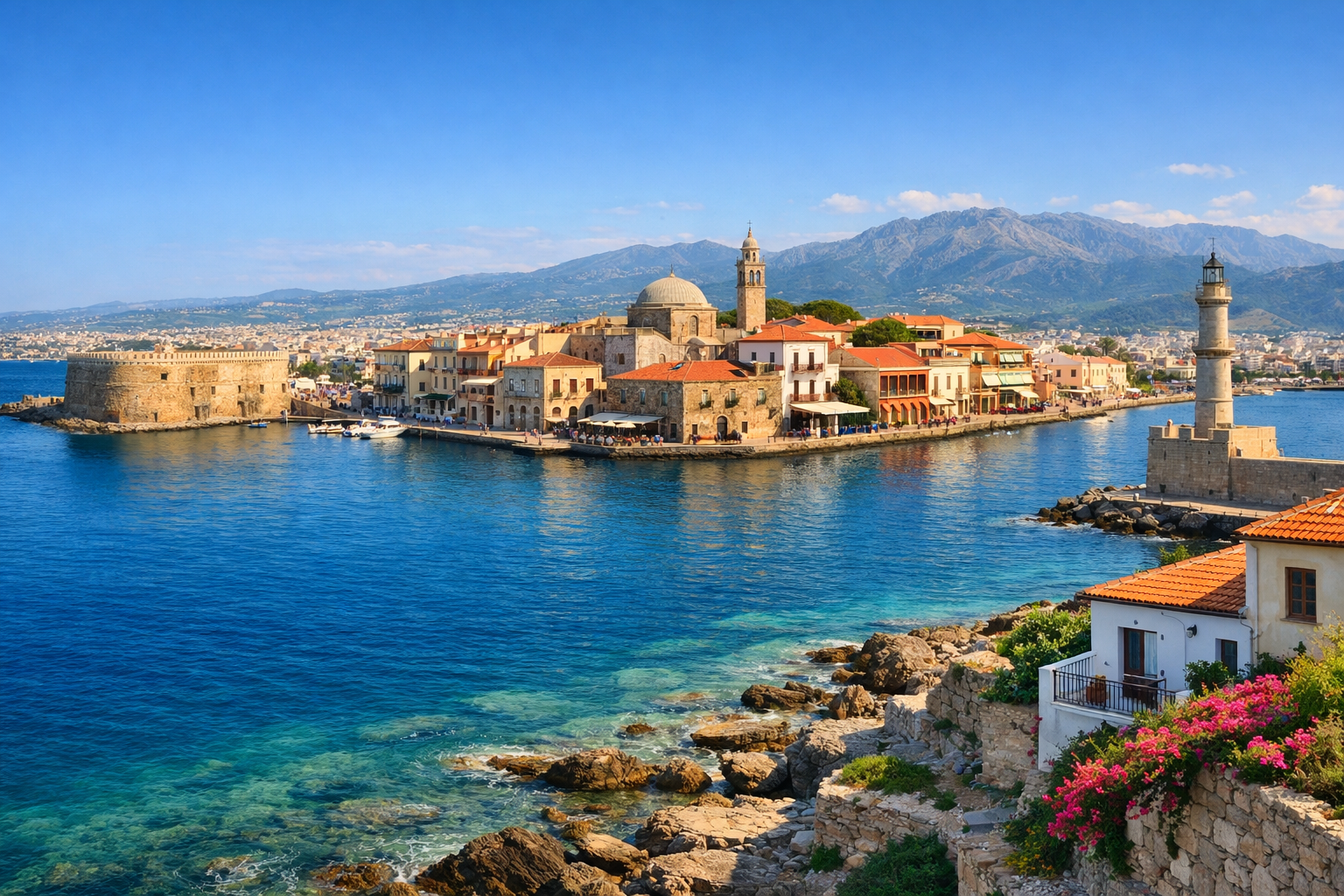
  • 🏛️ Chania is the most postcard-perfect of the three cities on the route, but with the right choice of accommodation it can also fit into a budget trip. It is better to stay not on the most expensive front line of the harbor itself, but in or near the old town so that you can still walk everywhere. After checking in, head to the Venetian port, the lighthouse, the Mosque of the Janissaries, and the waterfront. Here the layered nature of Crete is felt especially strongly: the Venetian layout of the city, Ottoman traces, the narrow passages of Topanas, stone walls, and the sea, which constantly draws your gaze back to the horizon.

  • 🌙 In the evening, do not hurry to leave the old harbor: in Chania, it is important not only to “see” the place, but to live the space. Street musicians, light on the water, the slow flow of people, and the illuminated lighthouse create the very picture for which many people travel to western Crete. To keep the budget under control, have dinner a little away from the most photogenic tables by the water: just a few streets from the harbor, prices are usually noticeably calmer, and the quality is often no worse.

Day 6 — Chania: Nea Chora beach and old quarters

  • 🏖️ For a budget beach day in Chania, it is best to choose Nea Chora — a city beach that can be reached on foot from the center, without spending money on long trips to “Instagram-famous” lagoons. This is an important decision precisely for an economical trip: you get the sea and swimming without renting a car, without excursion costs, and without losing half the day on the road. Come early in the morning, while the sun is softer and the beach is calmer, and then either stay on the free part of the shore or use beach facilities only if necessary.

  • 🚶 After the beach, return to the old town and walk through the districts that make Chania not just a beautiful postcard, but a living historical organism. Stop by Topanas, the streets around the Jewish quarter, the old stone houses, and quiet passages, where there is already less bustle than in the harbor itself. If you still have energy, you can walk to the Kum Kapi area for a different sea perspective: there is less Venetian theatricality here, but more of the feeling of ordinary city life by the water.

  • 🍋 A day like this balances the route well: after the museum-historical accents of Heraklion and Rethymno, it gives you proper seaside rest, while remaining logical and inexpensive. For food, focus on bakeries, coffee with pastries, souvlaki, mezze portions for two, and simple tavernas away from the waterfront itself. This helps keep the budget from swelling at the final stage of the trip.

Day 7 — Chania: museum finale and departure

  • 🏛️ It is best to keep the last day flexible around your flight time or onward transfer. If you have at least half a day, devote it to one cultural site and one more short walk. The most logical choice is the Archaeological Museum of Chania or a calm walk through the municipal garden and nearby areas if you want to end the trip without rushing. A museum finale works well because it gathers the island’s impressions into one whole: from antiquity to the urban landscape that you have already had time to feel on foot.

  • 🧳 If your flight is from Chania airport, leave extra time for the bus or transfer, especially in high season. If your return route goes through Heraklion, check intercity bus schedules in advance and do not place the museum visit too close to departure. In Crete, the transport logic is quite workable, but on a trip without a car it is important to be more conservative with connections and not rely on an “ideal” tight margin.

  • 🌿 As an emotional conclusion, this 7-day route works very honestly: without renting a car, without expensive excursions, and without pointless rushing, it shows three different faces of northern Crete. Heraklion gives historical depth, Rethymno offers coziness and Renaissance intimacy, and Chania provides maritime beauty and an atmospheric finale. With a moderate style of travel, the total budget can be kept at the level of an affordable city break, especially if you book accommodation in advance and choose food without focusing on tourist restaurants.

Flight tickets

eSIM for travel

Buy PDF guide

Buy PDF guide — 15.00 USD

PDF — 15.00 USD