
Buy PDF guide

Buy PDF guide — 8.57 USD

PDF — 8.57 USD

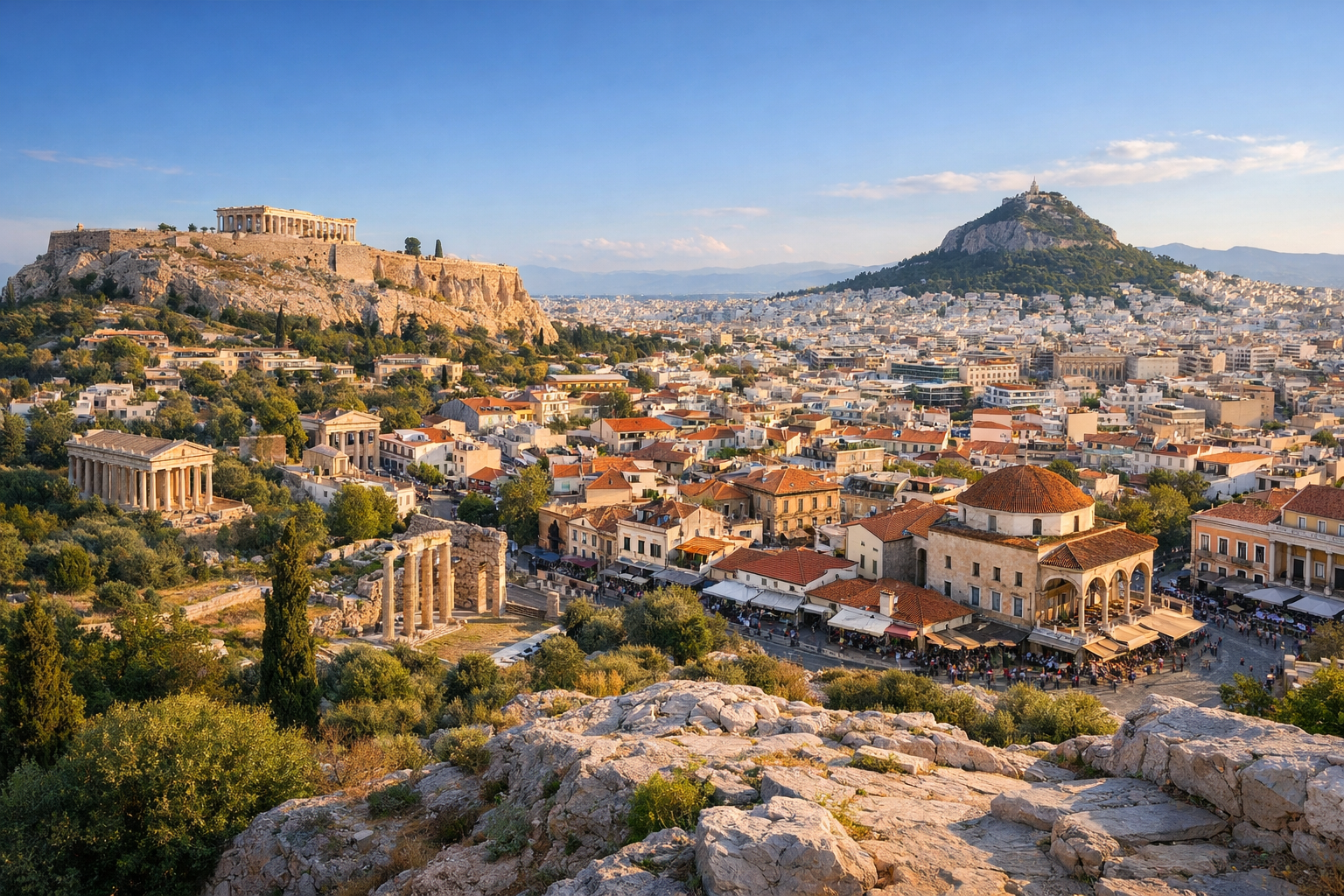
Greece, Athens. An inexpensive introduction to ancient monuments, the Plaka and Monastiraki districts, hills, markets, and free observation decks.

Greece, Athens. An inexpensive introduction to ancient monuments, the Plaka and Monastiraki districts, hills, markets, and free observation decks.

Athens is an affordable gateway to Greece, where ancient monuments rise above the lively lanes of Plaka and the bustling markets of Monastiraki. Climb the city’s hills and seek out free observation decks for sweeping views that make every wander feel unforgettable.

🧭 DAY-BY-DAY ROUTE

Ready-made country and city routes with daily plans, sights, transport and accommodation. Buy PDF guides for independent travel.

🧭 DAY-BY-DAY ROUTE


Day 1 — Athens: getting acquainted with Plaka, Anafiotika, and evening views

  • 🚆 If you are arriving in Athens, the cheapest and simplest way to get to the center is the Airport Express X95 to Syntagma Square or Metro Line 3 to Monastiraki/Syntagma, with one transfer if needed. The X95 bus runs 24/7, and the trip to the historic center usually takes about 60–80 minutes depending on traffic; the metro from the airport is usually faster and more predictable, about 40–50 minutes to the center. For a budget route, it makes sense to allow approximately €5.50 for the airport bus or about €9 for the metro; if your arrival and departure fit within 3 days of active travel, a tourist 3-day ticket including two airport trips may be worthwhile.

  • 🏨 After checking into an inexpensive hotel or hostel in the Monastiraki/Psiri area, do not rush to overload your first day with paid attractions. Start with a walk from Syntagma Square along Ermou Street toward the old town: this eases you into the rhythm of Athens without spending extra money on taxis or wasting time on complicated logistics. Plaka reveals itself best on foot — in narrow streets with stone staircases, neoclassical facades, flower-filled balconies, and the feeling that the modern noise of the capital fades away just around the next corner.

  • 🚶 Plaka is one of the most atmospheric and photogenic historic districts of Athens, spread out at the northeastern foot of the Acropolis. It is enjoyable to wander here without a strict plan: look at old houses, seek out tiny courtyards, climb the steps toward the Anafiotika quarter, and pause for an inexpensive takeaway coffee or gyros. Anafiotika is especially lovely in the second half of the day: this tiny white-and-blue quarter, as if transported from a Cycladic island, hides on the slope below the Acropolis and creates a rare sense of quiet, light, and almost island-like slowness for a metropolis.

  • 🌄 Closer to sunset, head up Areopagus Hill or Philopappos Hill. Both options are free and especially good for budget travel: there is no need to buy tickets for observation platforms, while the views are among the best in the city. Areopagus is more convenient and closer to the Acropolis, while Philopappos offers a longer walk among pines, rocks, and panoramic spots. From the hills it is especially beautiful to watch the golden light fall on the marble of the Acropolis while the city gradually lights up with a warm evening glow.

  • 🍽️ Dinner on the first day is best kept simple and inexpensive: look for small souvlaki places, bakeries, shops with spanakopita, koulouri, and local places away from the most touristy facades. A realistic food budget for such a day is about €12–20 per person in the format of “bakery breakfast + quick lunch + inexpensive dinner.” This lets you avoid overpaying for an “Acropolis view” on the very first evening while still staying in the liveliest heart of the city.


Day 2 — Athens: Monastiraki, the market, the Roman Agora, and Hadrian's Library

  • 🚶 The second day makes sense to devote to Monastiraki and the neighboring quarters, because transport costs are barely needed here: everything is within a short walking distance. Start at Monastiraki Square — one of the liveliest hubs in the center, where the city’s ancient layers literally stand side by side with the market, the metro station, street food, and constant urban movement. This is the place where Athens shows itself not as an open-air museum, but as a real, noisy, living southern metropolis.

  • 🛍️ Then head to the Monastiraki flea market area and the shopping rows along Adrianou and nearby lanes. It is interesting here not only to shop, but also simply to observe: windows with vinyl records, antique items, cheap souvenirs, old signs, fabrics, leather goods, trinkets, and street vendors create a rich, slightly chaotic picture of the city. For a budget traveler, this is also a practical zone: you can grab an inexpensive snack, buy water, fruit, small travel items, and stay on route.

  • 🏛️ Among paid sights, it is best on this day to choose 1–2 inexpensive monuments that are compact in terms of logistics, so you can preserve your budget. A good combination is the Roman Agora and Hadrian’s Library, which are easy to visit one after the other. The Roman Agora takes you into the era when the city was already living in a Roman rhythm: the Tower of the Winds, one of the most recognizable ancient monuments in the center, is especially striking here. Hadrian’s Library creates a different impression — more monumental and “imperial,” reminding you how strongly Emperor Hadrian transformed Athens and sought to make it the cultural capital of his time.

  • ⛪ After the ancient ruins, it is worth slowing down and walking toward the quieter parts of Plaka and in the direction of Mitropoleos Square. Such a transition is useful not only aesthetically, but physically as well: in the second half of the day, Athenian heat and stone surfaces are more tiring than they look on the map. Plan short breaks in the shade, water, and 20–30 minutes of rest. In reality, it is exactly this pace that makes a budget route comfortable and safe, without overheating or unnecessary rushing.

  • 🍢 It is best to finish the evening again in the Monastiraki or Psiri area. To save money, choose small taverns on side streets, lunch specials, portions for two, or a meze + salad format. Roughly speaking, a day with one or two archaeological sites, walking, and budget meals can fit into about €20–40 on top of accommodation, depending on whether you limit yourself to viewing some monuments from the outside or buy admission tickets.

Day 3 — Athens: the Ancient Agora, the Hill of the Nymphs, and free viewpoints

  • 🏛️ The third day should be the most “ancient” in content while still remaining moderate in cost. Start with the Ancient Agora of Athens — one of the city’s most important archaeological sites, where you especially feel not the ceremonial, but the civic history of antiquity. This was where the public life of classical Athens took place: trade, debates, political decisions, philosophical discussions, and everyday meetings. Against the backdrop of the Acropolis, this place feels more “earthbound,” and for that reason it often makes an even deeper impression than the most famous ruins.

  • 🏺 If you want to deepen the experience, set aside time for the Museum of the Ancient Agora in the Stoa of Attalos. This is a particularly good choice for a short budget trip: the museum fits right into the route, does not require long transfers, and helps tie together what you see in the open-air area. After visiting the archaeological zone, it is convenient to take an inexpensive coffee or snack break in the Thisseio area, where it is usually easier to find a calmer atmosphere than near the entrance to the Acropolis itself.

  • 🌄 After lunch, head up to the Hill of the Nymphs and the area of the National Observatory of Athens. This is one of the most pleasant free spots for a contemplative walk: pines, rocky paths, open areas with views of the Acropolis, the roofs of the center, and the folds of the city’s terrain. There is no feeling of a “must-see attraction” here, but there is a rare sense of space, air, and perspective. On a short route, it is precisely such free hills that make Athens memorable rather than just a checklist of sites.

  • 🚶 If you wish, connect the Hill of the Nymphs with a continued walk through Philopappos, or descend back to Thisseio. At a normal relaxed pace with stops for photos and rest, such a block takes 3–4 hours without overexertion. Ordinary comfortable shoes are enough, but not ones with completely smooth soles: in places the stone can be polished, and in heat or after humidity the paths may be slippery. Before the trip, it is sensible to check heat warnings and any temporary restrictions on visiting open archaeological zones.

  • 🌇 At sunset, you can once again choose your favorite free viewpoint — Areopagus, Philopappos, or the spots near Thisseio. It does not feel repetitive: the evening light changes the city completely. From above, Athens feels at once endless and very ancient, while the white neighborhoods around the historic core turn into a soft stone sea above which the illuminated Acropolis rises.

Day 4 — Athens: a museum finale, the Central Market, and departure

  • 🏛️ It is best to keep the last day flexible, depending on your flight or onward travel time. For a cultural finale, there are two realistic options. The first is the Acropolis Museum, if you want a modern museum space, clear navigation, and a strong connection with the monuments you have already seen from the outside. The second is the National Archaeological Museum, if you want a broader panorama of ancient Greek art and archaeology. For a budget trip, it is usually better to choose only one major museum so as not to inflate expenses or rush through the galleries.

  • 🏺 The Acropolis Museum is especially good as the final point of the route: after walks through Plaka, the hills, and archaeological zones, it gathers your impressions into a coherent whole. Not only the collection works powerfully here, but also the space itself with its views of the Acropolis. The National Archaeological Museum, by contrast, offers a more “encyclopedic” experience and suits those who want to see masterpieces from different periods and regions of Greece, not only the Attic context.

  • 🥬 If time allows and you want a more everyday urban touch, stop by the Central Municipal Market of Athens on Athinas Street. These are not idealized “postcard” Athens, but a working, noisy, real urban environment with meat, fish, and produce rows, shops with spices, olives, cheeses, and kitchen bustle. Even a short walk through the market helps you better feel the rhythm of the city and combines well with a final stroll between Monastiraki and Omonoia.

  • 🚌 For departure to the airport, allow extra time. From the center, the cheapest option is again the X95 from Syntagma or Metro Line 3. For the bus, it is wise to allow at least 2.5–3 hours before departure, especially during heavy traffic hours; for the metro as well, it is better not to leave everything until the last moment. If your suitcase is heavy or you are flying very early, an app-based taxi may be more convenient, but it is noticeably more expensive than public transport.

  • 💶 Overall, this 4-day route remains realistically budget-friendly: accommodation in a simple but central option — approximately from €35–90 per night for a budget room or a bed in a good hostel; food — about €12–25 per day with a moderate approach; city transport — from a few euros per day to a more выгодный travel pass; paid sights — optional, so you can control the final cost of the trip yourself. The main savings here come not from harsh austerity, but from the route’s compact geography, walkable logic, and the choice of places that really matter.

Flight tickets

eSIM for travel

Buy PDF guide

Buy PDF guide — 8.57 USD

PDF — 8.57 USD