
Day 1 — Old Town, Josefov, and the legends of the Golem
🚶 Start your route in the very heart of the Old Town, where Prague reveals itself not as a postcard capital, but as a layered medieval labyrinth. The morning hours are best devoted to a slow walk around Old Town Square and the neighboring lanes: here you can especially feel that very Gothic density of the city — towers, dark arches, narrow passages, stone paving, and houses whose facades seem to preserve traces of merchants, alchemists, rabbis, and wandering scholars. From the square it is easy to reach Týnská Street and the House at the Golden Ring — a place where the historical fabric of old Prague is especially tangible. This part of the route hardly requires transport: all key points are within a 5–15 minute walk, so the day feels atmospheric rather than tiring.
🚶 Next, head to Josefov — Prague’s former Jewish quarter, one of the city’s most powerful and deeply moving districts. It is worth setting aside at least 3–4 hours for a thoughtful visit to the Jewish Museum complex: the Maisel Synagogue, Pinkas Synagogue, Old Jewish Cemetery, and Old-New Synagogue are located in a very compact area, but emotionally this is one of the richest walks in all of Prague. Josefov is not just a quarter with beautiful architecture, but a space of memory, legends, and spiritual density, where literally every street points to the centuries-old history of Prague’s Jewish community.
🚶 The Old-New Synagogue is one of the main mystical points of the route. It is the oldest active synagogue in Europe, austere and almost severe in its Gothic beauty. It is precisely with this place that Prague’s most famous legend of the Golem is connected — the clay protector whom, according to tradition, Rabbi Judah Loew created to defend the Jewish community. The legend says that the remains of the Golem are supposedly hidden in the synagogue attic, and that is why the place is wrapped in a special tense silence. Even if you take this story as a myth, in Josefov it is felt almost physically: narrow streets, dim light, stone walls, and the gravestones of the Old Cemetery create a backdrop in which the boundary between history and legend seems unexpectedly thin.
🚶 After visiting Josefov, take a break for rest and an early dinner in the Old Town area. Virtually the entire route for the first half of the day is on foot; from Old Town Square to the Josefov quarter and back is usually a 10–15 minute calm walk between points. It is better to allow 1–1.5 hours for rest to save your energy for the evening and night part of the program, because it is after sunset that Prague becomes truly mystical.
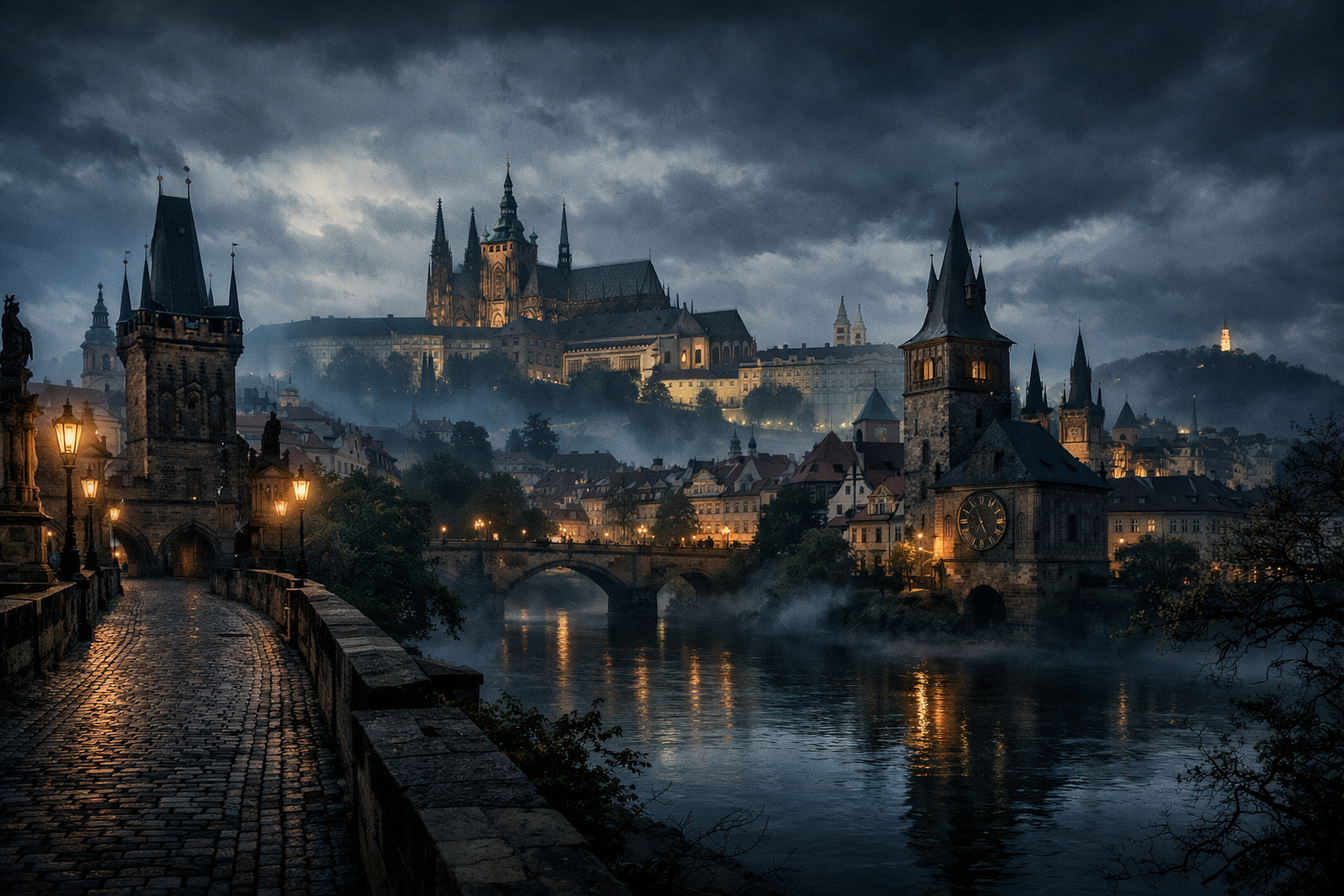
🌙 In the evening, set out on a long walk through the old lanes of the Old Town: Celetná, Týnská, Karlova, Husova, Jilská, and the network of nameless passageways between them are especially beautiful after 21:00, when the daytime groups disappear and the city begins to sound differently — with footsteps on the cobblestones, distant bells, and echoes from the arches. This is the perfect time for “Gothic Prague”: the towers look sterner, the house windows darker, and the lanterns pull not entire facades but fragments out of the darkness — a portal, a coat of arms, a vault, a stone cornice. It is best to finish the night walk by Charles Bridge on the Old Town side and at the Old Town Bridge Tower, one of the city’s most expressive Gothic towers. Allow 2.5–3 hours for the whole evening route at a very slow pace with photo stops and a short rest.