Buy PDF guide

Buy PDF guide — 29.99 USD

PDF — 29.99 USD

BOLOGNA

BOLOGNA

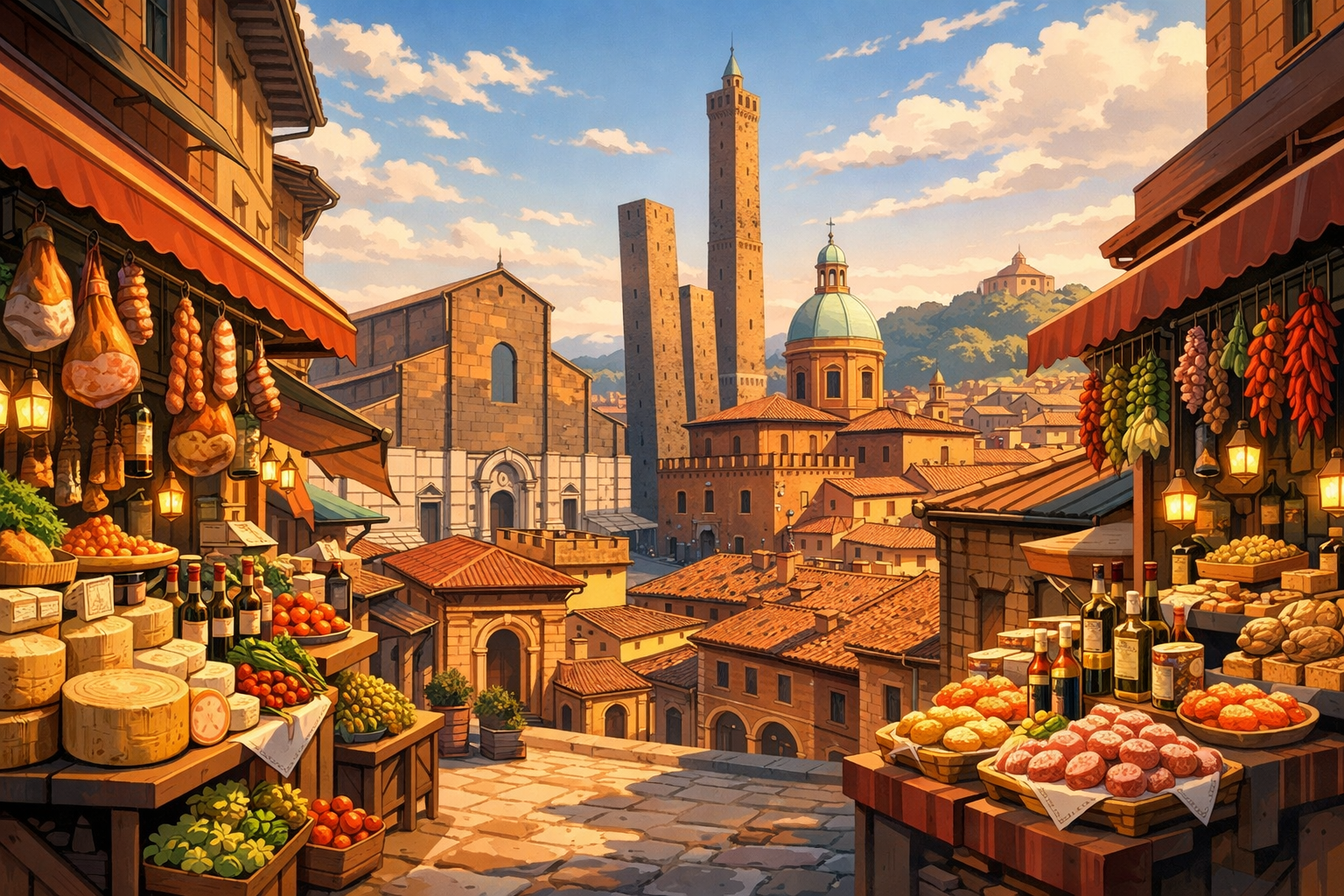
Stroll beneath miles of sunlit porticoes, past medieval towers and terracotta rooftops. Feast on rich ragù and mortadella in lively markets as Italy’s oldest university town hums with youthful energy.

🧭 DAY-BY-DAY ITINERARY

Ready-made country and city routes with daily plans, sights, transport and accommodation. Buy PDF guides for independent travel.

🧭 DAY-BY-DAY ITINERARY


Day 1 — Piazza Maggiore and the Quadrilatero: the “gateway” to gastronomic Bologna

  • 🚶 Start at Piazza Maggiore: the Gothic façade of the Basilica of San Petronio and the medieval pilgrims of the porticoes immediately set the city’s scale. Walk to the Neptune Fountain and turn into the Quadrilatero quarter—a network of narrow lanes between Piazza Maggiore and the Two Towers, where cheese shops, salumerie, bakeries, and pasta botteghe stand shoulder to shoulder. It’s easy to assemble your first tasting lunch here: slices of Mortadella IGP, 24–36-month Parmigiano, a little aceto balsamico, and a glass of local Pinot Grigio. In the evening, take a calm walk under the porticoes along Via dell’Indipendenza: the city is softly lit, and the arcades give a feeling of “shelter” even in windy weather.


Day 2 — Mercato delle Erbe and Via Belvedere: a market as a gastro-park

  • 🍅 In the morning, head to Mercato delle Erbe—the largest covered market in the center. In the historic hall under a high vault, you’ll find produce rows, fish and butcher stalls, pasta and cheese counters; in the wings—street-food corners with tortellini, tagliatelle al ragù, and torta di riso. Plan: an hour for “recon,” then lunch at the shared tables in the market’s food hall. Afterward, take a micro-expedition to Via Belvedere (a nearby street): here are cafés and bars for the proper afternoon “sospiro” (a small pause for coffee/aperitivo). By 16:00, return to the hotel for a short rest and head out again at sunset: the market stays open late, and the atmosphere becomes especially intimate in the evening.

Day 3 — Archiginnasio and the Archaeological Museum: science, anatomy, antiquity

  • 🏛️ Dive into university Bologna: in the Archiginnasio palace you’ll find the wooden Anatomical Theatre, coats of arms of student nations on the walls, and centuries’ whispers in the library halls. A couple of steps away is the Museo Civico Archeologico: Etruscan artifacts, Roman marbles, and a large Egyptian collection form the “skeleton” of ancient Northern-Central Italy. Between museums, drop into a café under the porticoes for a light lunch. In the afternoon, take an unhurried loop around Piazza Galvani and the bookshops; in the evening, taste Lambrusco di Modena or Sangiovese di Romagna with a cheese assortment.

Day 4 — The Two Towers and the Finestrella “window”: a city of verticals and canals

  • 🗼 Bologna’s symbols—the Asinelli and Garisenda towers—are currently surrounded by construction fencing: Porta Ravegnana square is closed for a long restoration to preserve the Garisenda, but the towers’ outlines are still clearly seen from Via Rizzoli and Via Zamboni. Take shots from different angles, then walk to the Finestrella di Via Piella—a small “window” onto the old Moline canal. Today’s route is short and visually rich; leave time for a leisurely aperitivo in the Quadrilatero and an early dinner: tomorrow is “contemporary art.”

Day 5 — MAMbo and the Manifattura delle Arti: industrial brick and modernity

  • 🖼️ The Manifattura delle Arti district stretches from former warehouses and brick buildings to green courtyards. The MAMbo museum is the main living venue for contemporary art. Afterward—coffee nearby and a 15–20 minute walk to the Central Station: a short everyday Bologna scene—passenger flows, underground passages, cafés with cornetto. In the evening, stroll along Via Ugo Bassi back to Mercato delle Erbe: the market is especially cozy at night.

Day 6 — The Pinacoteca and university Via Zamboni: Bolognese painting

  • 🎨 Pinacoteca Nazionale di Bologna is a classic collection of the Bolognese school (Carracci, Guido Reni, Guercino). The galleries have measured lighting and an “acoustics of silence,” ideal for contemplation. Afterward, step into the Alma Mater quarter: under the long porticoes of Via Zamboni—secondhand book spots, espresso aromas, and the young speech of students. End the day at the Palazzo Poggi Museum: science cabinets, wax anatomical models, and “museum time” that flows differently.

Day 7 — San Petronio and the “big porticoes” of the center

  • ⛪ Dedicate the morning to the Basilica of San Petronio: the unfinished brick façade, the meridian line on the floor, chapels—each with its own story. Then take a slow loop through the central porticoes: from Palazzo d’Accursio to Palazzo dei Banchi, then toward Piazza Santo Stefano (the “Seven Churches” complex). A day “with history without overload”: more air, photos, and short “taste” stops.

Day 8 — San Luca: climb under 666 arches or take the San Luca Express train

  • ⛰️ Bologna’s iconic experience is the journey to the Sanctuary of the Madonna di San Luca. Options: 1) on foot from the Meloncello Arch—≈ 2.2 km uphill under the porticoes (round trip with breaks takes 3–4 hours); 2) TPER bus (with a transfer to a minibus to the top) or the tourist San Luca Express train from the center. At the top—views over the city and hills, a place for contemplation. In the evening, it’s better to plan a simple dinner and an early rest.

Day 9 — Giardini Margherita and Le Serre: a green reset

  • 🌿 The main city park is Giardini Margherita: alleys, a pond, morning runners. Grab a takeaway coffee and have a picnic with tilsit cheeses and fruit-and-veg loot from the markets. Drop by Le Serre dei Giardini—a space in former greenhouses with cultural activities and a gastronomic tilt. A day about “few points—lots of rest.”

Day 10 — Bologna’s music: Palazzo Sanguinetti

  • 🎼 The International Museum and Library of Music in Palazzo Sanguinetti features manuscripts, instruments, and portraits of kapellmeisters. Afterward, walk along Strada Maggiore to the Basilica of Santo Stefano. At lunch—a “pasta break”: tagliatelle al ragù or tortellini in brodo; in the evening—a wine bar with a glass of Pignoletto.

Day 11 — Culinary diary: watching the “sfogline” and trying it yourself

  • 🍝 Dedicate the morning to pasta botteghe: how the “sfogline” roll out the thinnest egg “sfoglia,” how they fold tortellini and tortelloni. If you wish, sign up for a short masterclass at one of the schools/labs (plan 2–3 hours). After lunch—walk under the porticoes with stops for gelato and coffee: Bologna has the perfect rhythm of “taste → step → view.”

Day 12 — Canals and “small discoveries”

  • 💧 Put together a short “canals and courtyards” loop: Finestrella di Via Piella, then courtyards around Via delle Moline and quiet lanes between Via dell’Indipendenza and Via Galliera. During the day—museum of choice (return to the Archiginnasio or MAMbo), and by evening—a gastro-loft at Mercato delle Erbe.

Day 13 — Free day: go back to where your “place” was

  • 🧭 Bologna loves “repeats”: return to your favorite market/street, buy gastronomic souvenirs (Parmigiano, balsamic vinegar, pasta di campo). Take one last “city loop” under the porticoes and stop by Piazza Santo Stefano at sunset.

Day 14 — Finale: late breakfast at the market and a farewell loop through the center

  • ☕ End the trip slowly: a late breakfast at the stalls, a short photo session by the towers (from safe points—Via Rizzoli/Zamboni), one last espresso in Piazza Maggiore. Take the main thing with you—the rhythm of Bologna, where porticoes lead, markets feed, and museums bring you back to history without haste.

Flight tickets

eSIM for travel

Buy PDF guide

Buy PDF guide — 29.99 USD

PDF — 29.99 USD