
Buy PDF guide

Buy PDF guide — 25.71 USD

PDF — 25.71 USD

LUXEMBOURG

LUXEMBOURG

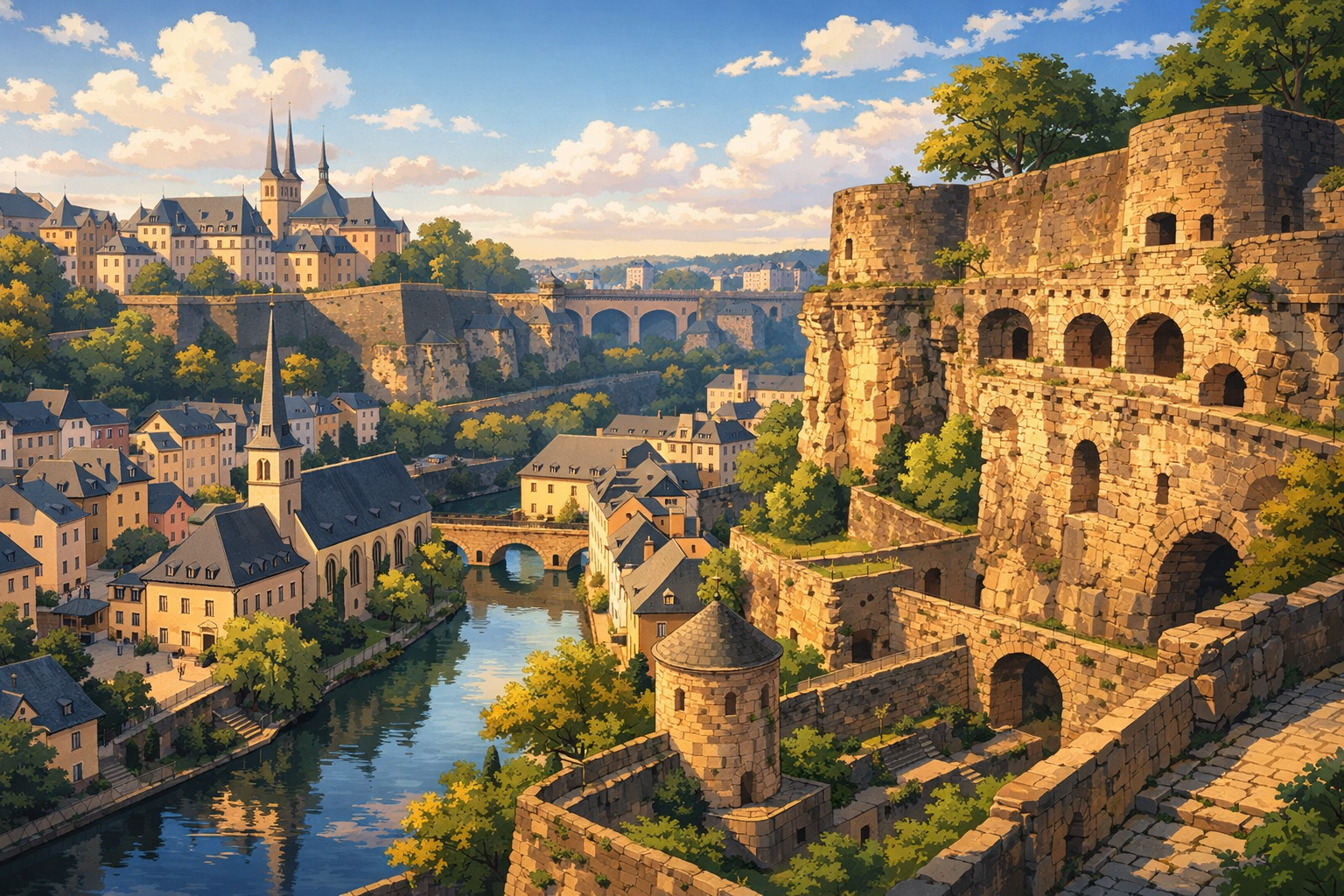
Luxembourg blends cliff-top history with modern flair: explore Luxembourg City’s Old Town and Bock Casemates, amble through Grund and Pfaffenthal, then head to Kirchberg’s forts and museums. Beyond the capital, discover Vianden’s hilltop castle, Echternach’s Roman villa, the mossy gorges of the Mullerthal near Beaufort and tranquil Clervaux, with Trier’s Roman monuments just over the border.

🧭 DAY-BY-DAY ITINERARY

Ready-made country and city routes with daily plans, sights, transport and accommodation. Buy PDF guides for independent travel.

🧭 DAY-BY-DAY ITINERARY


Day 1 — Arrival in Luxembourg: the “balcony of Europe” and a first look at the fortress

  • ✈️ Transfer from Findel Airport (LUX): tram T1 from “Findel – Luxembourg Airport” to the center (Hamilius/Place de Paris), runs every ~8–10 minutes; travel time 25–35 minutes. Public transport throughout the country is free (2nd class).

  • 🚶 Evening walk along the Chemin de la Corniche — the famous “most beautiful balcony in Europe.” From the height of Roman and early medieval terraces you can read the Alzette and Pétrusse valleys, the arches of the bridges, and the silhouette of the Bock — the very rocky promontory where the city began.

  • ☕ A short break in Ville Haute: Place d’Armes and Place Guillaume II — a compact “city stage” with the town hall, arcades, and gentle evening lighting.


Day 2 — Bock: the Casemates and the origins of the “impregnable” fortress

  • 🎟️ Morning slot for the Bock Casemates (Montée de Clausen): 45–60 minutes of underground passages, gun embrasures and viewing windows. A key perspective is the junction of carved galleries with the natural Bockfels rock: engineering embedded directly in geology.

  • 🚶 Walk the Bock ridge and viewpoints along the Corniche: reconstruct the layout of bastions and curtain walls; try to “read” the city as a system of terraces and defensive layers (Spanish, Burgundian, French periods).

  • 🍽️ Afternoon break and an unhurried loop down into the Grund district (Grund): cobbled lanes, river reflections, and the silhouette of Neimënster Abbey against sheer walls — a rare example of dialogue between monastic architecture and fortification.

Day 3 — Pétrusse: back underground and the city’s “principle of layers”

  • 🎟️ Pétrusse Casemates (Place de la Constitution): a new exhibition with light-and-sound effects and 45-minute routes reveals the evolution of defenses in the soft sandstone of the Pétrusse valley. Compare the rock type with the engineering solutions.

  • 🚶 The Pétrusse ravine as an open-air park-museum: the Adolphe Bridge, viaducts, and bastions read in perspective as a single “fortification theater.” Return to Ville Haute by the Saint-Esprit lift (for evening light).

Day 4 — Old Town museums: from archaeology to urban memory

  • 🏛️ Lëtzebuerg City Museum (14, rue du Saint‑Esprit): the evolution of the “rock city” — models, panoramas and sections showing how districts grew on the plateau and ledges, and how defense shaped street profiles.

  • 🏛️ MNHA — National Museum of History and Art (Marché‑aux‑Poissons): archaeology of Greater Luxembourg and neighboring Roman territories, collections of sculpture and medals — an ideal “key” to tomorrow’s fortification day.

Day 5 — Kirchberg: forts, Dräi Eechelen, and links to the modern city

  • 🚋 Take the funicular from Pfaffenthal–Kirchberg station up to the Kirchberg plateau and walk to Fort Thüngen.

  • 🏛️ Musée Dräi Eechelen (Fort Thüngen): a fortification museum in the “three acorns” — a chronicle of fortifications and identities. From the terraces — views of the valleys and the Old Town; it’s useful to compare redoubt plans with today’s street network of Kirchberg.

  • 🌿 Dräi Eechelen Park → descent to Pfaffenthal: a vertical cross-section that makes it clear why the city is “multi-level” — architecture as work with relief.

Day 6 — Grund and Neimënster: a monastery at the foot of the walls

  • 🏛️ Abbaye de Neimënster (28, Rue Münster): courtyards and galleries of the cultural center in a former Benedictine abbey — an image of “life by the fortress.” The interiors emphasize the mass of the valley walls and the coolness of the river.

  • 🚶 The Grund and Clausen districts along the Alzette: intimate footbridges, ribbons of embankments, a “low-level” view of the bastions. In the evening — a panorama from the Corniche in warm light.

Day 7 — Vianden: the castle-lord of the valley (day trip)

  • 🚌 Travel: Luxembourg Gare → Ettelbruck (train, ~30–40 min) → bus 570 to Vianden (~30–40 min). Total 1h15–1h30. Transport in Luxembourg is free.

  • 🏰 Vianden Castle (Montée du Château): a restored castle complex on the ridge above the Our — a visible evolution from Romanesque to Gothic. Look for “stone” scenarios of power: courtyard–curtain wall–keep, a sequence of climbs and views.

  • 🍽️ Lunch in the lower town and return the same way. In the evening — rest.

Day 8 — Echternach: a Roman villa and an abbey town

  • 🚌 Travel: RGTR 110/111 from Luxembourg to Echternach (~50–60 min).

  • 🏛️ Roman villa by Lake Echternach (MNAHA): the estate plan, baths, heating, service wings — an excellent “live drawing board” of ancient architecture beyond ruins.

  • ⛪ The abbey square and old center of Echternach: the stone fabric of facades and modest building heights — a counterpoint to “fortress” Luxembourg.

Day 9 — Mullerthal and Beaufort: ruins and sandstone romance

  • 🚌 RGTR 111/110 toward Beaufort (~1h10–1h20).

  • 🏰 Beaufort Castles (Rue du Château, L‑6313): medieval ruins plus a Renaissance residence—how functions and “lifestyle” changed in one place. On the way: short Müllerthal trails among rock “organs”.

Day 10 — Clervaux and Esch-sur-Sûre: castles and scenic panoramas

  • 🚆 CFL Line 10 to Clervaux (~1h15–1h30).

  • 🏰 Château de Clervaux: the castle courtyard, museum exhibitions, and the legendary photo collection “The Family of Man” (in the interiors—layering of the stone shell and a contemporary museological narrative).

  • 🚌 Optional: a short detour to Esch-sur-Sûre (ruins and a panorama of the river loop), then return to Luxembourg.

Day 11 — Trier (Germany): an “ancient day” on the Moselle

  • 🚆 CFL Line 30 to Trier Hbf (~50–60 min; the segment outside Luxembourg is paid).

  • 🏛️ Porta Nigra, the Imperial Baths, the Basilica of Constantine: the stone might of Roman Augusta Treverorum and the “textbook” set of Late Antique architecture—perfect context for what you saw at the MNHA and at the Roman villa in Echternach.

  • 🍷 A short break in Trier’s old town and return to Luxembourg.

Day 12 — Finale in Luxembourg: Villa Vauban and the “assembly point”

  • 🏛️ Villa Vauban (18, av. Émile Reuter): an intimate museum in a city park—a dialogue between a bourgeois residence and contemporary exhibition-making.

  • 🚶 A final loop through favorite spots in the Old Town: the Corniche in the light of sunset, a view of the Bock and the Alzette valley—an architectural line “Romans → medieval fortress → modernization and museification” comes together into a coherent story.

Flight tickets

eSIM for travel

Buy PDF guide

Buy PDF guide — 25.71 USD

PDF — 25.71 USD