
Buy PDF guide

Buy PDF guide — 8.57 USD

PDF — 8.57 USD

The Hessian Brothers Grimm Fairy Tale Road

The Hessian Brothers Grimm Fairy Tale Road

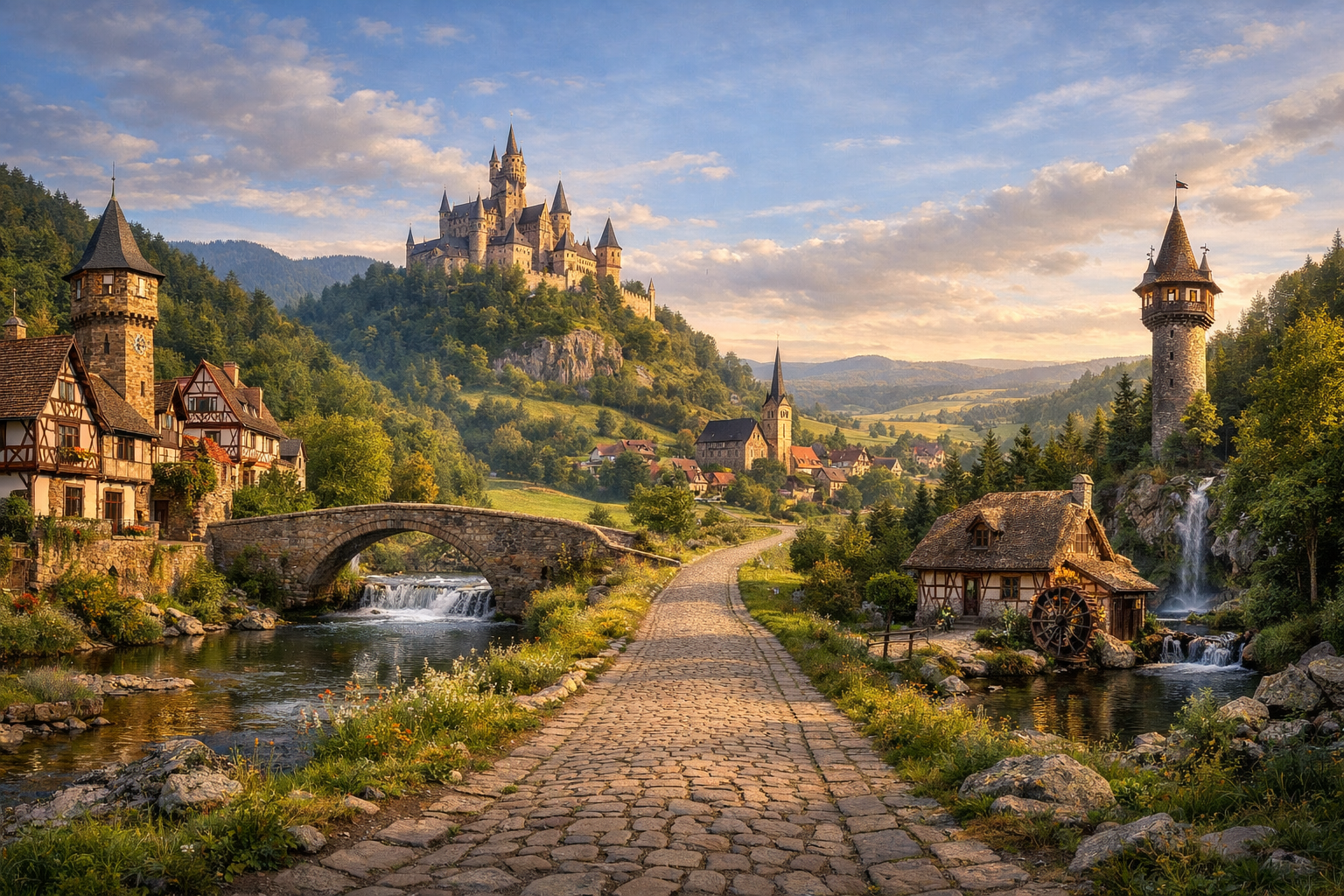
Follow the Hessian stretch of the Brothers Grimm Fairy Tale Road from Frankfurt to Kassel, where medieval towns, half-timbered streets, and storybook landscapes bring old legends to life. From Hanau and Steinau to Marburg, this route blends culture, history, and a touch of magic in the heart of Germany.

🧭 DAY-BY-DAY ROUTE

Ready-made country and city routes with daily plans, sights, transport and accommodation. Buy PDF guides for independent travel.

🧭 DAY-BY-DAY ROUTE


Day 1 — Hanau: the birth of the route and a fairy-tale start

  • 🚆 Arrival at Frankfurt Airport and transfer to Hanau — the most realistic start for a short route along the Hessian section of the Fairy Tale Road. By train, the journey from the airport area to Hanau usually takes about 25–40 minutes depending on the connection, and by car about 30–40 minutes without serious traffic. If your flight arrives early, it’s convenient to leave your luggage at the hotel right away and not overload the day with long transfers.

  • 🚶 Hanau is not just another German town, but the official starting point of the German Fairy Tale Route and the birthplace of Jacob and Wilhelm Grimm. It is here that you feel especially strongly that the Grimms’ fairy tales grew not out of abstract literature, but out of the living German landscape, urban memory, folk speech, and family history. Begin your walk at Neustädter Marktplatz, where the national monument to the Brothers Grimm stands. This is a symbolic starting point: around you are city life, shops, cafés, trams, and buses, and in the center of the square it feels as if a door opens into a world of childhood memories, legends, and folklore.

  • 🏰 Then head or walk to Schloss Philippsruhe, home to the Historisches Museum Hanau and the interactive GrimmsMärchenReich. This visit is especially good on the first day because it gently introduces the theme: here you get the Grimm family history, museum context, and the very feeling of a fairy-tale theater. The baroque palace on the banks of the Main looks elegant and bright, while inside the fairy tale unfolds not as a dry chronicle, but as a journey through images — with princesses, witches, giants, forests, and familiar motifs from childhood. For adults, it is also a great way to see how modern Germany works delicately and intelligently with its cultural heritage.

  • 🌆 In the evening, leave time for a calm walk through Hanau-Steinheim or the central quarters. After the museum, it’s best not to plan an overly packed program: the first day is better made atmospheric rather than rushed. Dinner, an early rest, and an overnight stay in Hanau are also logical because the next day it is convenient to continue east along the route to Steinau an der Straße, where the Brothers Grimm spent part of their childhood.


Day 2 — Steinau an der Straße: the childhood town of the Brothers Grimm

  • 🚆 Transfer: Hanau → Steinau an der Straße — by regional train usually about 45–60 minutes, by car around 45–55 minutes. It’s best to leave in the morning so you arrive without rushing and can devote almost a full day to the town.

  • 🚶 Steinau an der Straße is one of the most important points on the entire fairy-tale route in Hesse, because here the story of the Brothers Grimm becomes truly domestic and grounded. If Hanau is the place of birth and the symbolic start, then Steinau is the town of their childhood, family memory, and first impressions, from which a love for folk speech, oral stories, and the quiet magic of everyday life may later have grown. The town itself looks as if it were created by set designers for a historical film: half-timbered houses, towers, old gates, small squares, a calm rhythm, and a very human scale.

  • 🏛️ The main stop of the day is Brüder Grimm-Haus. This place is especially valuable not only for fairy-tale fans, but also for those who want to understand the Grimms themselves not as bronze figures from a textbook, but as living people. The museum tells about the family, the childhood years, and the everyday life and environment in which the future philologists, collectors of fairy tales, and language researchers grew up. It’s important not to rush here: the whole point of the visit is to catch the link between a quiet provincial town and the enormous cultural influence the brothers would later have across Europe.

  • 🏰 After that, you should definitely see Schloss Steinau. This castle is not a “fairy-tale castle” in the Disney sense — and that is exactly why it is so interesting. It is at once defensive, Renaissance, and historically very dense. From the outside it seems severe and composed, while inside it opens up as a space of power, daily life, and ideas of status. Today its museum spaces complement the Grimm theme well: after the family museum, the castle broadens the perspective and shows the world in which old Germany lived and developed — with its roads, administration, houses, churches, and layered culture.

  • ☕ Spend the rest of the day on a leisurely walk through the old town. In Steinau, you do not need to look for dozens of stops: the atmosphere itself does the work here. This is that rare case where the route benefits from pauses — stopping at a café, sitting in the square, strolling quiet streets, looking at the details of doors, windows, and signs, and feeling how deeply the Brothers Grimm fairy tales are rooted in the real German urban landscape. An overnight stay in Steinau or a return to a larger base are both possible, but for the logistics of a short route it is more convenient to continue on toward Marburg.

Day 3 — Marburg: university, medieval streets, and the Grimms’ youth

  • 🚆 Transfer: Steinau an der Straße → Marburg — with train changes the journey usually takes about 2 h 30 min – 3 h 15 min, by car about 1 h 50 min – 2 h 20 min. For a 4-day route, this is the longest transfer, so it’s best to leave earlier after breakfast and not plan extra stops for the morning.

  • 🚶 Marburg sharply changes the mood of the journey. After intimate Steinau, you arrive in one of Germany’s most picturesque university towns: here there are hills, stairways, tiled roofs, a labyrinth of old streets, and a sense of intellectual old Europe. For the story of the Brothers Grimm, Marburg matters as the place of their studies and youth, where fairy tale begins to turn into scholarship: here philology, law, library culture, manuscripts, debates, reading, and the formation of the inner instrument with which folklore would later be not merely recorded, but interpreted, all come together.

  • 🏘️ The best way to get to know Marburg is on foot through the Oberstadt. The narrow streets rise upward almost theatrically, the houses stand close together, the facades lean slightly toward one another, and at every turn a new view opens onto towers, stairways, and red roofs. This city does not demand “checkmarks”; it demands presence. In Marburg, it is easy to imagine how the young Grimms lived in a world where books and conversation were no less important than roads and state service.

  • ⛪ Be sure to include Elisabethkirche in your day — one of the most important Gothic churches in Germany. Even if your trip is focused on fairy tales, this church gives an important emotional context to the whole of Hesse: strict verticality, pale stone, almost musical architecture, and a sense of medieval depth. It is not an entertainment stop, but a place where the European length of time is felt especially well. Afterward, you can go higher up to Landgrafenschloss Marburg for views over the city and a better understanding of how its whole relief is arranged.

  • 🌙 It’s best to make the evening in Marburg a gentle one: dinner in the old town, a short walk after sunset, and rest. After a full day and a long transfer, there is no need to try to squeeze in too much. In this route, Marburg plays the role of a bridge between the “childhood of the fairy tale” and its “intellectual maturity,” so here atmosphere is more valuable than the number of doors visited.

Day 4 — Kassel: the summit of the Grimm route

  • 🚆 Transfer: Marburg → Kassel-Wilhelmshöhe — usually about 1 h – 1 h 20 min by train and approximately 1 h 15 min – 1 h 30 min by car. This is a comfortable final transfer that allows you not to get up too early and still spend almost a full day in Kassel.

  • 🏛️ Kassel is the culmination of the entire 4-day trip through Grimm-related Hesse. It was here that the Brothers Grimm lived and worked for a long time, and here the scale of their legacy is especially tangible, while the fairy-tale theme goes far beyond children’s literature. The main stop on the route is GRIMMWELT Kassel, the largest modern exhibition center dedicated to the life, work, and influence of the Brothers Grimm. This is not a museum in the old sense, where you simply look at display cases, but a thoughtfully designed cultural space in which fairy tales, language, manuscripts, the dictionary, scholarly work, and visual culture are brought together into a single narrative.

  • ✨ What is especially impressive at GRIMMWELT is the way myth and academic precision exist side by side. Here you can go far beyond the image of “collectors of fairy tales” and see the Grimms as language researchers, editors, scholars, and people of enormous discipline and cultural scale. After Hanau, Steinau, and Marburg, this visit works almost like the final chapter of a book: everything that until now was felt intuitively here receives form, structure, and historical depth.

  • 🌳 If you still have time and energy, round out the day with a walk through Bergpark Wilhelmshöhe, or at least part of this famous park landscape. This is no longer a direct “Grimm” plotline, but it is the ideal ending for a trip through Hesse: forested slopes, architectural perspectives, water cascades, long avenues, and a sense of romantic Germany from which legends, forest motifs, and the whole visual world of the European fairy tale grow so naturally.

  • ✈️ In the evening, you can continue onward through Germany or return to Frankfurt the next day. If you want to finish the tour without stress, it makes sense to stay overnight in Kassel. That way the route ends not in a rush, but at the right pace — with the feeling that you have traveled not just through a list of places, but through an entire cultural arc: the birth, childhood, studies, and mature legacy of the Brothers Grimm.

Flight tickets

eSIM for travel

Buy PDF guide

Buy PDF guide — 8.57 USD

PDF — 8.57 USD