
Buy PDF guide

Buy PDF guide — 4.28 USD

PDF — 4.28 USD

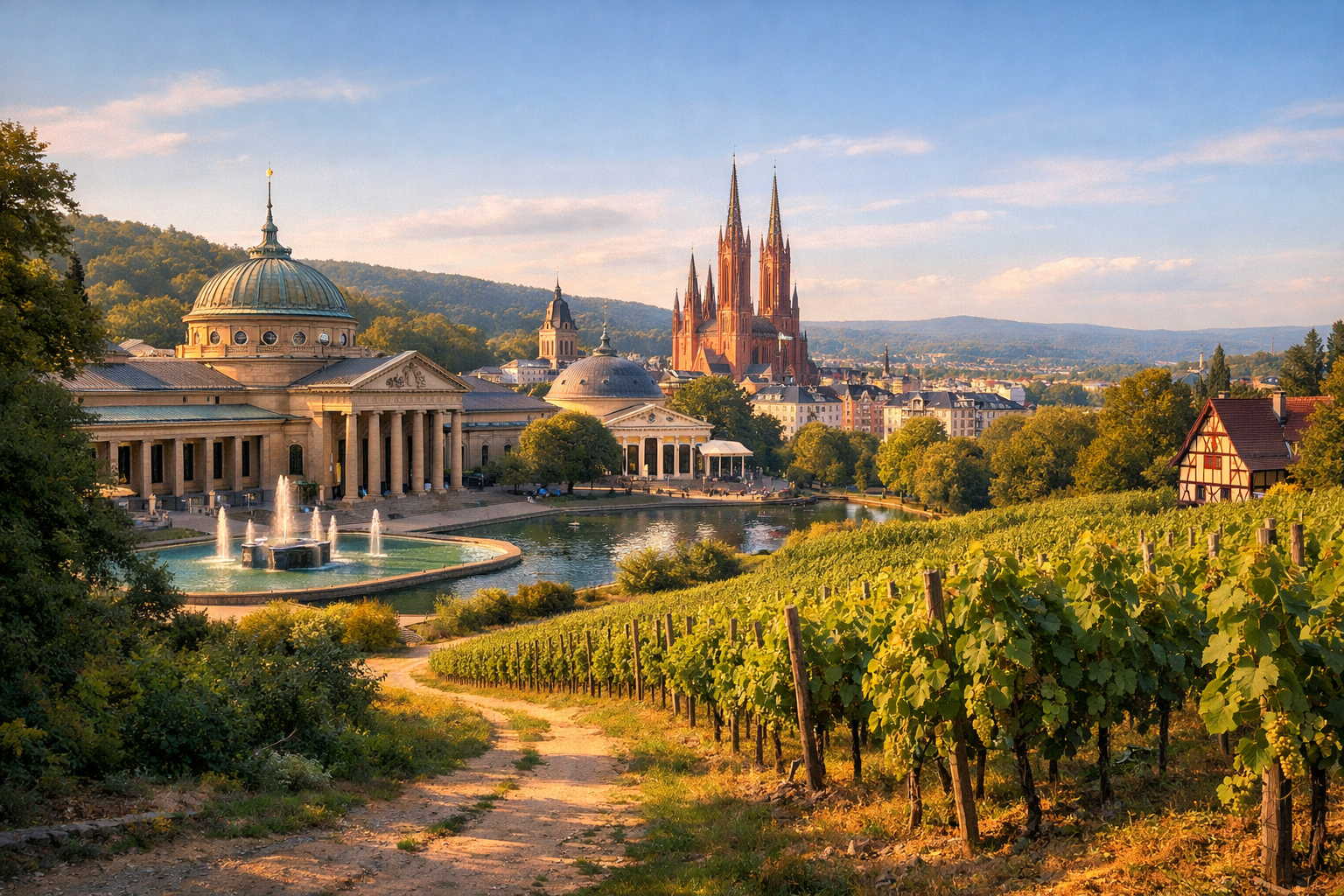
HESSE - Wiesbaden thermal baths architecture and wine routes

HESSE - Wiesbaden thermal baths architecture and wine routes

Hesse blends elegance and ease, from Wiesbaden’s grand thermal baths and stately facades to the vine-covered hills along the Rhine. Follow the route to Eltville and Kloster Eberbach for a taste of refined wine country, where historic charm and vineyard views go hand in hand.

🧭 DAY-BY-DAY ITINERARY

Ready-made country and city routes with daily plans, sights, transport and accommodation. Buy PDF guides for independent travel.

🧭 DAY-BY-DAY ITINERARY


Day 1 — Wiesbaden: thermal baths, spa architecture and Neroberg panoramas

  • 🚶 Start the day in the historic center of Wiesbaden — one of the most elegant spa towns in Germany, where the feeling of a “19th-century European spa” has survived not as a stage set, but as a real urban fabric. The city developed for centuries around hot springs, and that is exactly why thermal culture, grand architecture and an unhurried walking rhythm come together here so naturally. The best place to begin is the area around the Kurhaus and Kurpark. The neoclassical Kurhaus, with its ceremonial façade, columns and festive symmetry, sets the tone for the whole walk: here Wiesbaden looks not just like a tidy German city, but like a true aristocratic stage for leisure, concerts and social life. Right next to it stretches Wilhelmstraße — a wide and elegant street often called the local “Rue”: shop windows, façades, old trees and expensive hotels create the feeling of an old European spa capital.

  • 🚶 Next, it is convenient to walk to Marktkirche and Markt square, then stop by sam — Stadtmuseum am Markt. It is a good way to feel that Wiesbaden is not only a city of baths and beautiful façades, but also a place with a long urban biography: from Roman traces and the spa era to its modern capital role in Hesse. After the museum, the route logically continues to Museum Wiesbaden, where art and natural history are combined in one major museum complex. If you want to strengthen the architectural thread of the day, you can also add Museum Reinhard Ernst: this is a completely different Wiesbaden — contemporary, clean-lined, museum-focused and international, with a bright emphasis on abstract art and a striking new building.

  • 🚋 In the second half of the day, head to Nerobergbahn — the famous funicular to Neroberg. This is not just transport, but one of the city’s most charming attractions: the historic water-ballast railway is already a rarity in itself, and the ascent up the green hillside feels like a short journey into another era. At the top, Wiesbaden opens up in panoramic form: rooftops, domes, green expanses and the strict geometry of the spa town are especially beautiful when seen from above. It is worth allowing relaxed time here for viewpoints, a short walk on the hill and a coffee break or simply some rest in the fresh air, so that the route does not turn into a race between locations.

  • 🛁 Devote the evening to the thermal baths. For a classic, almost “ritual” experience, Kaiser-Friedrich-Therme is the better choice — an atmospheric urban thermal complex in the historic center, where the architecture, mosaics, steam zones and the very logic of the space refer to the Roman-Irish bathing tradition. This is not a water park or a family pool, but an adult relaxation space where the main thing is silence, warmth and a gradual shift from city mode into a state of rest. It is important to keep seasonality in mind: Kaiser-Friedrich-Therme has a summer break, so Thermalbad Aukammtal is a good current backup option for the same evening. This is a more modern thermal complex with a stronger emphasis on swimming, water and recovery, convenient if you want not only to lie in the warmth but also to enjoy a longer spa pause without the strict historic atmosphere. After the baths, the ideal end to the day is an early dinner in the center without overloading the evening with extra transfers.

  • 🚆 If you arrive via Frankfurt and check into Wiesbaden the same day, the drive from Frankfurt Airport to central Wiesbaden usually takes about 40 minutes; from Wiesbaden main station to central hotels, add about 10 more minutes by taxi or city bus.


Day 2 — Rheingau: Eltville, wine routes and Kloster Eberbach monastery

  • 🚆 Dedicate the morning to a short trip from Wiesbaden into the Rheingau — one of the most beautiful wine regions in Germany, and ideal for a 1-day outing without changing your base. The optimal plan is to take the train to Eltville am Rhein and build the rest of the route from there. The trip takes about 15–20 minutes, so the day is not lost to logistics and instead feels like a natural continuation of the Wiesbaden route: only instead of spa grandeur, a softer landscape appears — the Rhine, vineyards, small towns and old stone walls. Eltville is a very good gateway to the Rheingau: a compact, well-kept, almost intimate town with a promenade, an old castle and a reputation as the “city of roses.” It is pleasant not to rush here: walk through the historic center, look at Eltville Castle, go out to the river and give yourself time for a first wine or coffee without feeling that the plan is falling apart.

  • 🚶 A walk through Eltville works well as a contrast to Wiesbaden. If the capital of Hesse impresses with its façades and spa representational grandeur, the beauty here is much quieter: half-timbering, towers, flowers, river light and everyday wine culture. It is especially pleasant to pass the rose gardens and the waterfront, then choose one of the local spots for tasting Rheingau wines. The main hero of the region is Riesling, and it is especially easy here to understand why this grape is so closely tied to German river valleys: the wine turns out precise, fresh and mineral, while the landscape itself seems to prepare the palate in advance — slope, stone, water, air. Even if you are not planning a full tasting, a glass of local wine at lunch fits into the route very naturally.

  • 🚌 After lunch, head to Kloster Eberbach — one of the strongest places on the route and perhaps the day’s main point for combining architecture, history and wine. From Eltville, you can get here by bus 172, which goes to the “Kloster Eberbach” stop, or by car/car-sharing. The monastery itself lies in a picturesque side valley and makes a powerful impression already on the approach: massive walls, inner courtyards, Romanesque and Gothic austerity, the calm of stone and a sense of spatial depth. This is not a “pretty church for an hour,” but a large historical complex where it is truly worth spending at least 2–3 hours. Not only the architecture matters here, but also the atmosphere — cool vaults, passageways, monastic halls and the region’s winemaking history come together into a complete image of the Rheingau, where spiritual, agricultural and cultural traditions were inseparable for centuries.

  • 🍷 Kloster Eberbach is especially good because here the theme of wine stops being just gastronomy and becomes part of the place itself. The monastery is closely connected with the region’s winemaking heritage, and the trip here logically completes a route through the Rheingau: first you see a cozy wine town on the Rhine, then the more monumental, almost meditative core of this whole cultural zone. After visiting the complex, allow time for a calm tasting or a short pause in the courtyard, and only then return to Wiesbaden. This matters: if you leave too quickly, the place does not have time to “settle in.” In the evening, return to Wiesbaden for the night. This format creates a very coherent two-day trip: the first day is water, architecture and urban sparkle; the second is vineyard slopes, the Rhine and monastic depth.

  • 🚆 Transfer: Wiesbaden → Eltville am Rhein by regional train usually takes about 15–20 minutes. Eltville → Kloster Eberbach by public transport is easiest to plan via bus 172 from Eltville station; the monastery itself specifically recommends this option. The return trip to Wiesbaden from the Rheingau usually takes 35–60 minutes depending on connections.

Flight tickets

eSIM for travel

Buy PDF guide

Buy PDF guide — 4.28 USD

PDF — 4.28 USD