
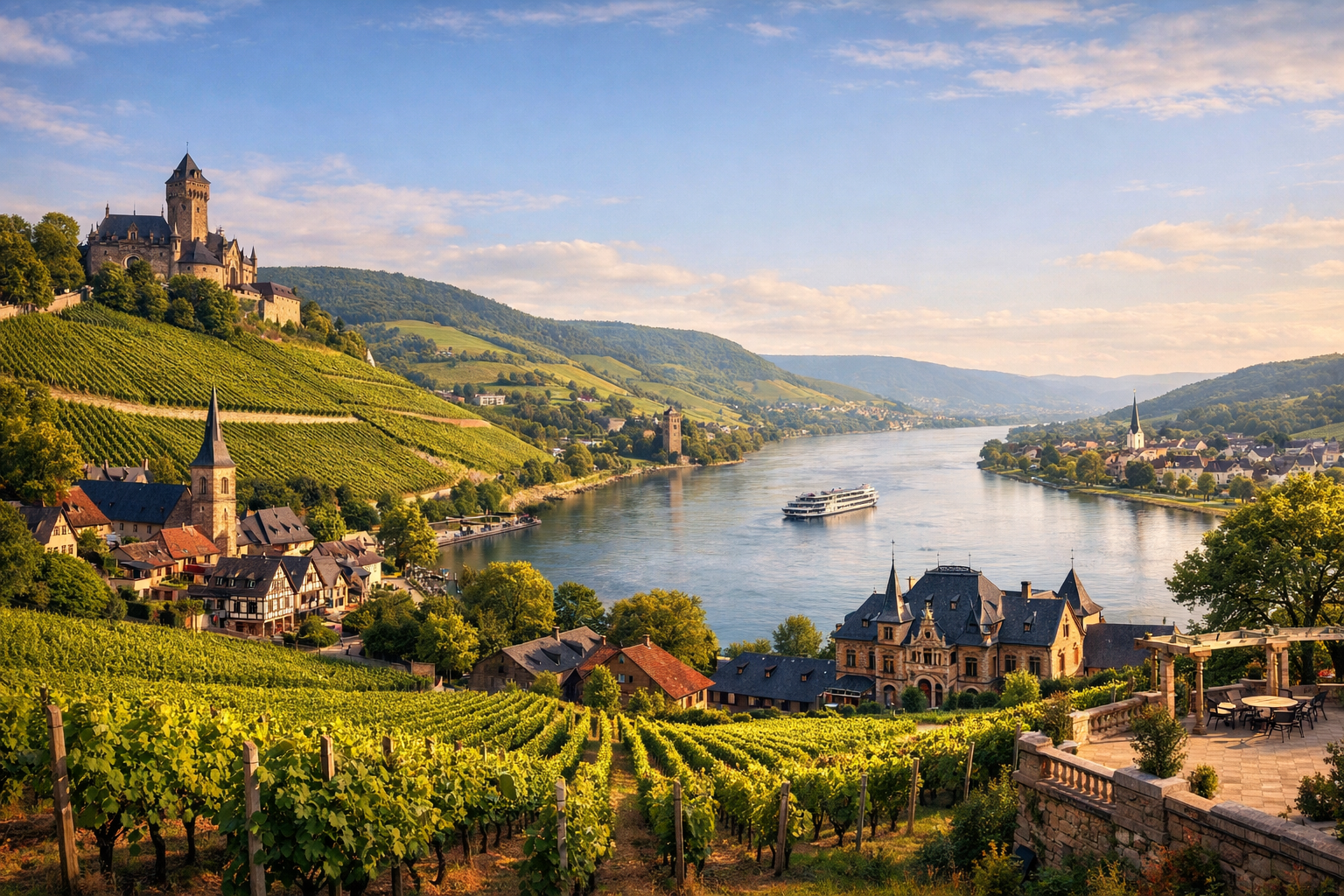
Day 1 — Eltville am Rhein and Kloster Eberbach: a gentle introduction to the Rheingau
🚆 Transfer: Frankfurt Airport → Eltville am Rhein. The most sensible option without a car is the S-Bahn S8/S9 or a regional train to Wiesbaden Hauptbahnhof, then a change to the RheingauLinie RB10 to Eltville. Including transfers and waiting time, allow about 1 hr 20 min – 1 hr 40 min. By taxi or private transfer, the trip usually takes about 45–60 minutes, though it can be longer during rush hour.
🚶 Eltville am Rhein is one of the most charming little towns in the Rheingau, where the atmosphere is not built around headline sights but grows out of the combination of the riverfront, vineyards, old towers, roses, and the calm light of the river. It feels made for the first day of a trip: there is no need to rush anywhere, only to give yourself time to fall into the rhythm of the region. The historic center is small and easy to explore on foot, and the town itself comes across as an elegant prelude to the whole wine-growing Rheingau. It is especially pleasant here to walk along the Rhine toward the Electoral Castle, look closely at the half-timbered facades, stop into wine bars, and catch that rare feeling when a cultural landscape does not put itself on display but opens up gently, through details. In summer and early autumn the town is especially lovely: the rose garden by the castle, the calm line of the river, the warmth of the stone, and the wine theme that can be felt here in literally everything.
🚖 From central Eltville, the easiest way to reach Kloster Eberbach is by bus with a transfer or by taxi; for a focused visit to the monastery, it is best to set aside a separate, unhurried part of the day. By car the drive takes about 10–15 minutes, while by public transport it is noticeably longer, so it is better not to postpone departure until late evening.
🚶 Kloster Eberbach is one of the most striking places in all of Hesse and, without exaggeration, the architectural heart of the Rheingau. This former Cistercian abbey, tucked slightly away from the river and surrounded by forests and vineyards, creates an almost cinematic impression: austere Romanesque and Gothic volumes, long passageways, stone vaults, inner courtyards, and a sense of powerful, concentrated silence. This is not a “postcard” location in the usual sense, but a place of depth and scale. It is especially easy to feel here how wine, monastic discipline, agriculture, and centuries of European history are interwoven in the Rheingau. A walk around the grounds should not be rushed: it is better to leave time not only for the halls and courtyards, but also for a pause in the garden area, the wine shop, or the local gastronomy. For the first day, this is an ideal balance: after the journey you do not overexert yourself, yet you immediately enter a space that sets the tone for the whole trip — noble, historic, and deeply Rhine-like.
💤 It is best to end the evening quietly: return to Eltville, stroll along the riverfront before sunset, have dinner with a glass of local Riesling, and go to bed without any late transfers. In this region, it is precisely this unhurried pace that makes the trip feel luxurious: the distances are short, but the impressions unfold better if you do not try to pack too much into a single day.