
Buy PDF guide

Buy PDF guide — 4.28 USD

PDF — 4.28 USD

HESSE - Marburg university town and old center

HESSE - Marburg university town and old center

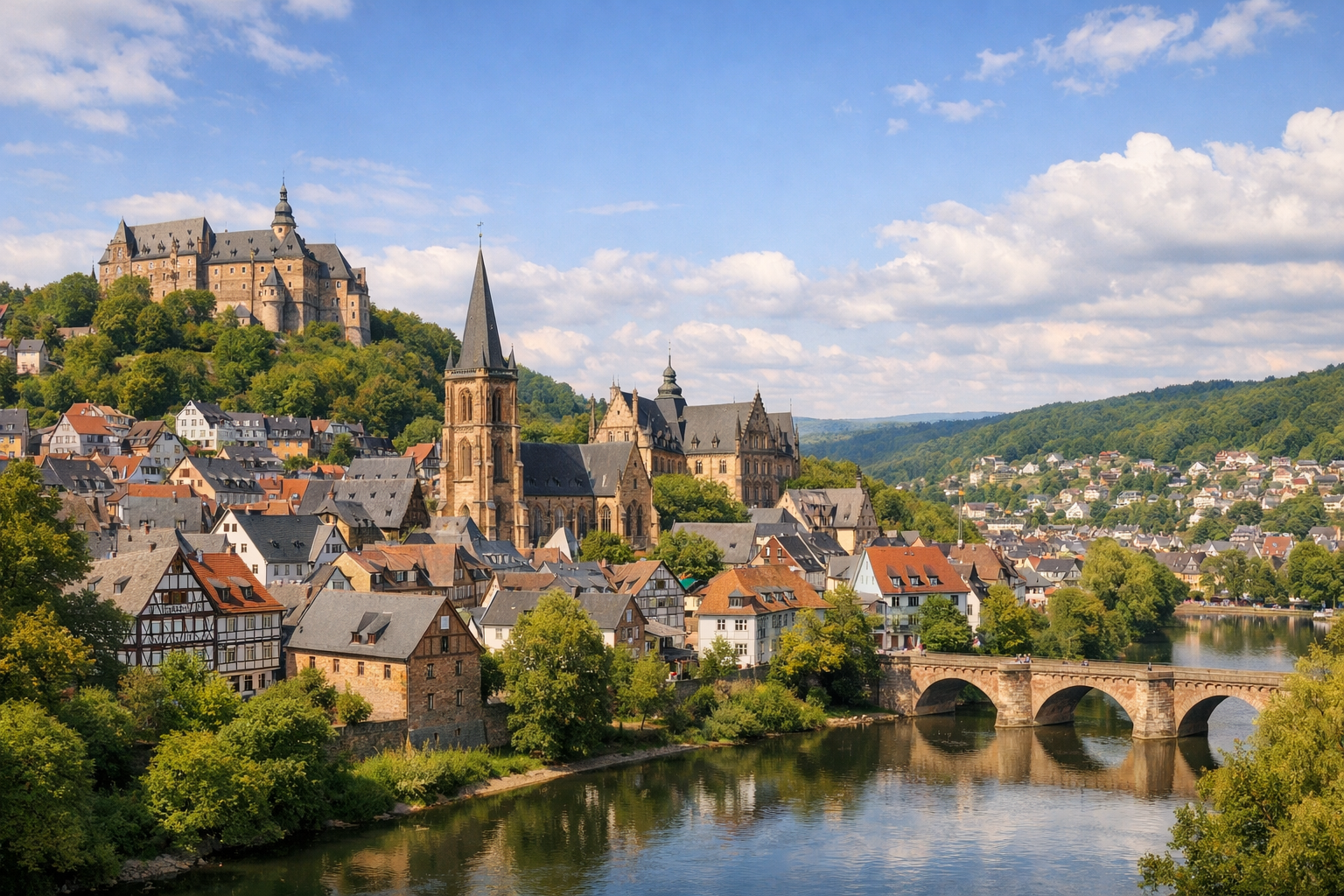
Marburg charms with its lively university spirit and beautifully preserved Upper Town, where steep lanes and timber-framed houses climb toward the hilltop castle. In the heart of Hesse, its old center feels intimate and timeless, inviting you to wander, linger, and take in the views.

🧭 DAY-BY-DAY ROUTE

Ready-made country and city routes with daily plans, sights, transport and accommodation. Buy PDF guides for independent travel.

🧭 DAY-BY-DAY ROUTE


Day 1 — Marburg: Elisabethkirche, the Lahn embankment and the old university center

  • 🚆 Arrival: from Frankfurt Airport to Marburg (Lahn) by train usually takes about 1 hr 20 min–1 hr 35 min with one transfer. From Marburg main station, it is convenient to reach the historic core by city bus in 8–12 minutes or take a taxi for 5–10 minutes, and if you want to feel the city’s rhythm right away, walk about 20–25 minutes down toward the center and the river.

  • ☕ Start the day calmly: after check-in, allow 30–45 minutes for rest and coffee, because Marburg is best experienced not in a rush, but as a city of layers — university, medieval, pilgrimage-related, and very much alive. This is one of those German towns where the panorama unfolds gradually: first you see the austere church towers, then the smooth surface of the Lahn, then a succession of half-timbered houses, stairs, arches and narrow paved passages, and only after that — the castle on the height, as if holding the whole city in its palm.

  • 🚶 The first major stop is Elisabethkirche, one of the most important Gothic churches in Germany and Marburg’s main spiritual symbol. It was around the cult of Saint Elizabeth of Thuringia that Marburg became a place of pilgrimage in the 13th century, and the church itself still creates an almost northern, very pure and composed impression. Inside, what you feel is not so much Baroque splendor as the power of verticality, stone and light: the high nave, strict lines, chapels, the tombs of the landgraves, and a space where you can hear your own footsteps. Some interiors may currently be restricted due to restoration work, so it makes sense to plan the route in a way that lets you calmly explore the accessible areas without expecting a long museum-style visit. Allow about 45–60 minutes for the visit, including the exterior and a short pause.

  • 🚶 From the church, it is pleasant to walk to the bank of the Lahn and then along the flatter part of town, giving yourself a gentle start before the climbs of the Upper Town. Here Marburg reveals itself as a true university town: not only in postcards, but in its living rhythm — bicycles, students, bookshop windows, small cafés, city buses, bridges across the river, and the feeling that the historic setting is not preserved in amber, but genuinely lived in. It is worth allowing 30–40 minutes for an unhurried walk along the embankment and the transition to the central streets.

  • 🏛️ Then head to the old university center and the area around the historic streets at the foot of Oberstadt. Marburg is the world’s oldest Protestant university town, and this academic aura is literally woven into the fabric of its streets. Do not expect a campus in the modern American sense: here the university is dissolved into the city itself. Lecture buildings, former noble houses, old academic structures and urban facades coexist so closely that the walk turns into reading a city biography. This place is especially good in the second half of the day, when the light becomes softer and street life more noticeable.

  • 🌿 If you still have energy, make a detour to Alter Botanischer Garten. This is not just a green breather, but a historically very fitting point for Marburg: the university garden here is connected with the city’s long scientific tradition. It is especially good as a place for a short pause between architecture sightseeing and the evening part of the route. It is worth stopping by for 20–30 minutes simply to catch your breath in the shade of the trees, rather than trying to “tick off one more box.”

  • 🌆 Dedicate the evening to a gentle introduction to the lower part of the center: dinner without rushing, a walk along the illuminated streets, and an early return to the hotel. In the evening, Marburg does not overwhelm with scale like a metropolis; on the contrary, it gathers into a cozy intimate picture: light in the windows of half-timbered houses, small squares, student conversations on terraces, and the silhouette of the castle above. This kind of end to the day works especially well before the more demanding uphill route of the second day. It is reasonable to leave 2–3 hours for the evening walk and dinner.


Day 2 — Marburg: Upper Town, Town Hall, market square, castle and panoramas

  • 🚶 It is best to start the second day earlier and devote it specifically to Oberstadt — the Upper Town, because this is the heart of that very “fairy-tale” Marburg people come here for. Narrow streets, stairs, half-timbering, unexpected passages, walls, small squares and the constant play of changes in elevation create the feeling that the city was not built according to a single plan, but grown over centuries. Here, not only the set of sights matters, but the very process of moving between them. Allow 1.5–2 hours for a morning walk through Oberstadt with photo stops and a short rest.

  • 🚶 Make sure to reach Rathaus and Marktplatz. Marburg’s Town Hall is not just a beautiful facade, but one of the main symbols of the city’s independence and political memory. The market square in front of it is considered the historic center of the Upper Town; it is here that you feel especially clearly that Marburg was not only ecclesiastical and academic, but truly urban, with its own legal, commercial and public life. The square is intimate but very expressive: half-timbered houses, facade details, a fountain, sculptures and a dense historic environment without unnecessary monumentality. This is the ideal point to sit for 20–30 minutes over coffee and simply watch how the medieval setting functions as an ordinary modern urban center.

  • 🚶 If you want to add more narrative to the route, you can walk part of Grimm-Dich-Pfad — a themed pedestrian route through the Upper Town connected with the world of the Brothers Grimm. The full route takes about 1 hr 30 min and covers around 2 km, but on a short two-day trip it is enough to choose the most atmospheric section for 30–45 minutes. This is an especially good option for those for whom simply “pretty houses” are not enough: here the walk gains a playful and literary layer, and Marburg itself begins to be perceived as a city of German Romanticism and fairy-tale memory, not just a university on a hill.

  • 🚡 After lunch, head to the main high point — Landgrafenschloss Marburg. The climb on foot from the old center usually takes about 15–25 minutes depending on pace and the chosen path; if you do not want to spend energy on steep sections, you can use a taxi or the tourist Schlossbahn, and then stroll around the upper part more leisurely. The castle itself is one of the strongest highlights of the whole trip: it literally reigns over the city and unites Marburg’s fortification, palace and museum history into one. Early Gothic spaces have been preserved here, including the famous Fürstensaal and chapel, while outside the sense of height and control over the landscape is especially impressive.

  • 🏰 It is best to set aside at least 1.5–2 hours for visiting the castle and the surrounding panoramic terraces. Even without delving into all the museum exhibitions, the place works on several levels at once: architecture, the history of Hesse, memory of the Reformation, and the view over red roofs, towers and the Lahn valley. In clear weather, it is especially easy to see from here how Marburg is arranged in terraces along the slope, and why photographers and lovers of old German towns are so fond of it. This is not a “separate castle outside the city,” but the true culmination of the entire urban composition.

  • 🏛️ If you still have interest in the museum side after the castle, you can complement the day with a visit to university collections. The most logical option is to focus on the museum spaces in the castle and check opening hours in advance. Separately, it is worth remembering that Mineralogisches Museum near Elisabethkirche is known for its strong collection, but may currently be closed to regular visitors for technical reasons; at the same time, part of the mineralogical theme is represented in the castle. It is better to keep this nuance in mind in advance so as not to build the day around a closed door.

  • 🚆 End of the tour: after a late lunch or early dinner, head down toward the center and the station with a time buffer. From the old town to Marburg (Lahn) Hbf it is usually 10–15 minutes by bus, 5–10 minutes by taxi, or about 20–25 minutes on foot. If you are leaving for Frankfurt Airport, it is reasonable to allow about 1 hr 30 min of pure travel time to Frankfurt (M) Flughafen Fernbahnhof, plus at least 20–30 minutes extra for the transfer and finding your way.

Flight tickets

eSIM for travel

Buy PDF guide

Buy PDF guide — 4.28 USD

PDF — 4.28 USD