
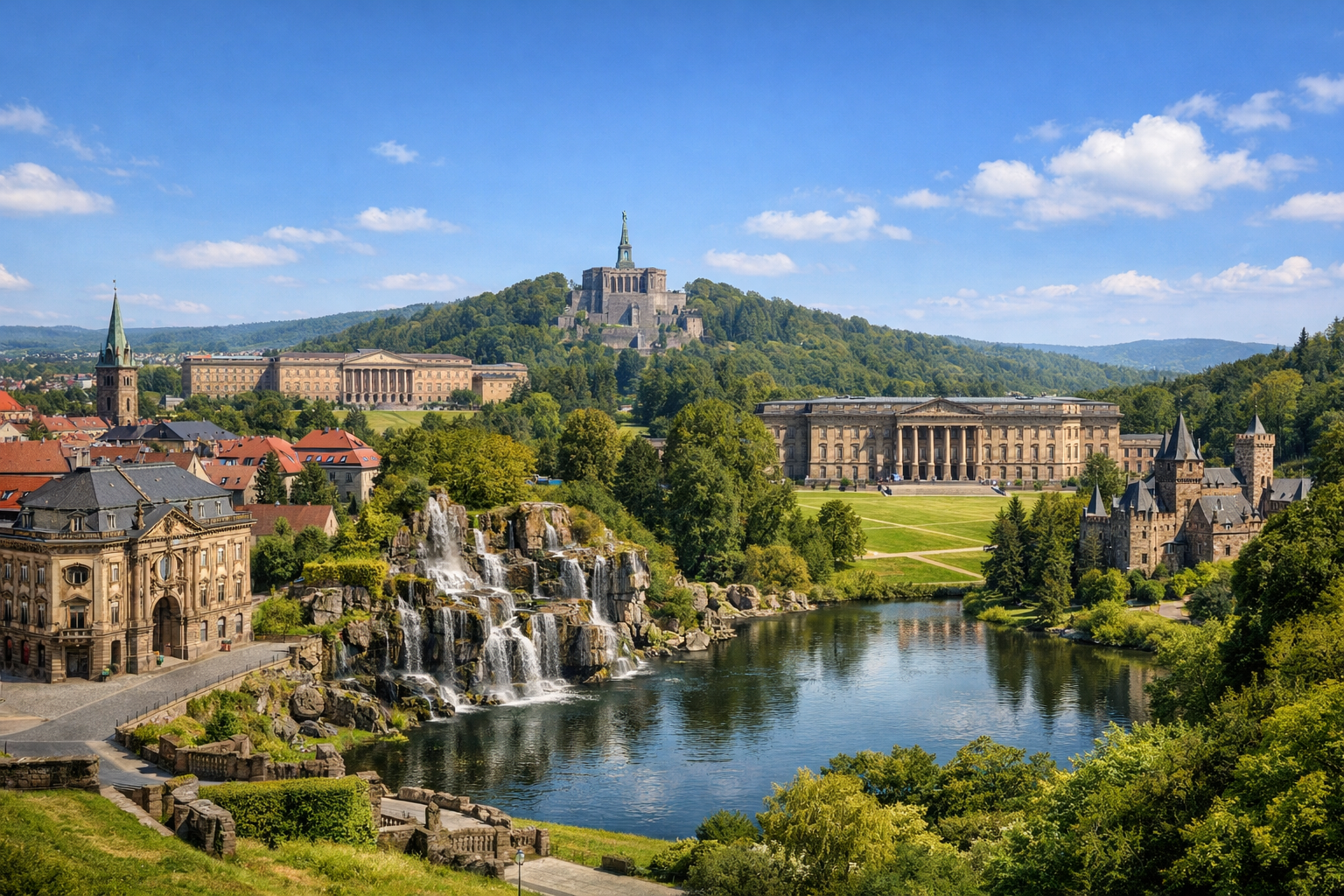
Day 1 — Kassel: Bergpark Wilhelmshöhe, the palace, and Löwenburg
🚆 Arriving in Kassel is most convenient via Kassel-Wilhelmshöhe station: it is the city’s main long-distance rail hub. From the station to the lower part of Bergpark Wilhelmshöhe, the trip by tram, bus, or a short taxi ride takes about 10–15 minutes, and hotels in the Bad Wilhelmshöhe area let you shift almost immediately from travel mode into a calm spa-and-park atmosphere. This is especially important for the first day: the park is huge, hilly, and has an elevation difference of more than 200 meters between the lower and upper zones, so it is better not to try to “rush through” it, but to walk with breaks, scenic stops, and time for coffee.
🚶 Start the day in the lower part of Bergpark Wilhelmshöhe at Schloss Wilhelmshöhe. This is not just a beautiful park, but one of the most impressive landscape ensembles in Germany and the largest hillside park in Europe, where Baroque theatricality, Romantic scenery, and the engineering boldness of the 18th century come together in a single route. Wilhelmshöhe Palace sets an almost cinematic tone for the place: a строгий классицистический фасад, a broad green axis in front of the building, mirrored alley perspectives, and the feeling that the whole park composition obeys one grand idea — to lead your gaze and your steps ever higher, toward the Hercules monument. Inside the palace are art collections, including the famous Old Masters Picture Gallery, so it is easy to spend 1.5–2 hours here without rushing: it is a good way to begin the route calmly and not exhaust yourself with climbs first thing in the morning.
🚶 After the palace, it is worth continuing your walk through the middle level of the park toward Löwenburg. The walk, with stops for photos and rest, usually takes about 30–40 minutes, and this stretch reveals the character of Wilhelmshöhe especially well: it does not feel like an urban park in the usual sense, but rather like a carefully composed landscape where woods, meadows, reflective water surfaces, and architectural accents work like scenery for a romantic journey. Löwenburg, the “Lion Castle,” looks like a medieval fortress, but in fact it is an elegant historical staging from the late 18th century — not a ruin, but a dream of a knightly past, created for impression and status. Towers, stone walls, bridges, a chapel, and an almost theatrical silhouette make it one of the most atmospheric spots in Kassel. Visits inside are usually organized at set times and with a guided tour, so it makes sense to allow extra time in advance and not plan an overly tight schedule here.
💤 It is best to allow at least 60–90 minutes for lunch and rest. In a hilly park, fatigue builds up almost unnoticed: even if the distances seem moderate, the constant climbs, stairs, and stops at viewpoints make the day physically intense. The ideal strategy is not to try to walk to Hercules from the palace on the same day, but to save your energy and turn the first day into a deeper introduction to the lower and middle parts of the ensemble: the palace, the museum section, park views, Löwenburg, and a calm evening finish in Bad Wilhelmshöhe.
🚶 In the second half of the day, you can return to Schloss Wilhelmshöhe, stroll through the formal area by the fountains and lawns, and then finish the day at an unhurried pace around Wilhelmshöher Allee or near your hotel. This rhythm makes the route realistic: instead of overload, you get a full first day with art, history, and nature. In the evening, Kassel feels quite different than during the day: the city does not overwhelm with scale, and the Wilhelmshöhe area is especially appealing for its measured pace, greenery, and the feeling of old resort-style Germany, where a walk is not a backdrop but an important part of the journey itself.