
Buy PDF guide

Buy PDF guide — 4.28 USD

PDF — 4.28 USD

HESSE - Frankfurt skyscrapers Main museums

HESSE - Frankfurt skyscrapers Main museums

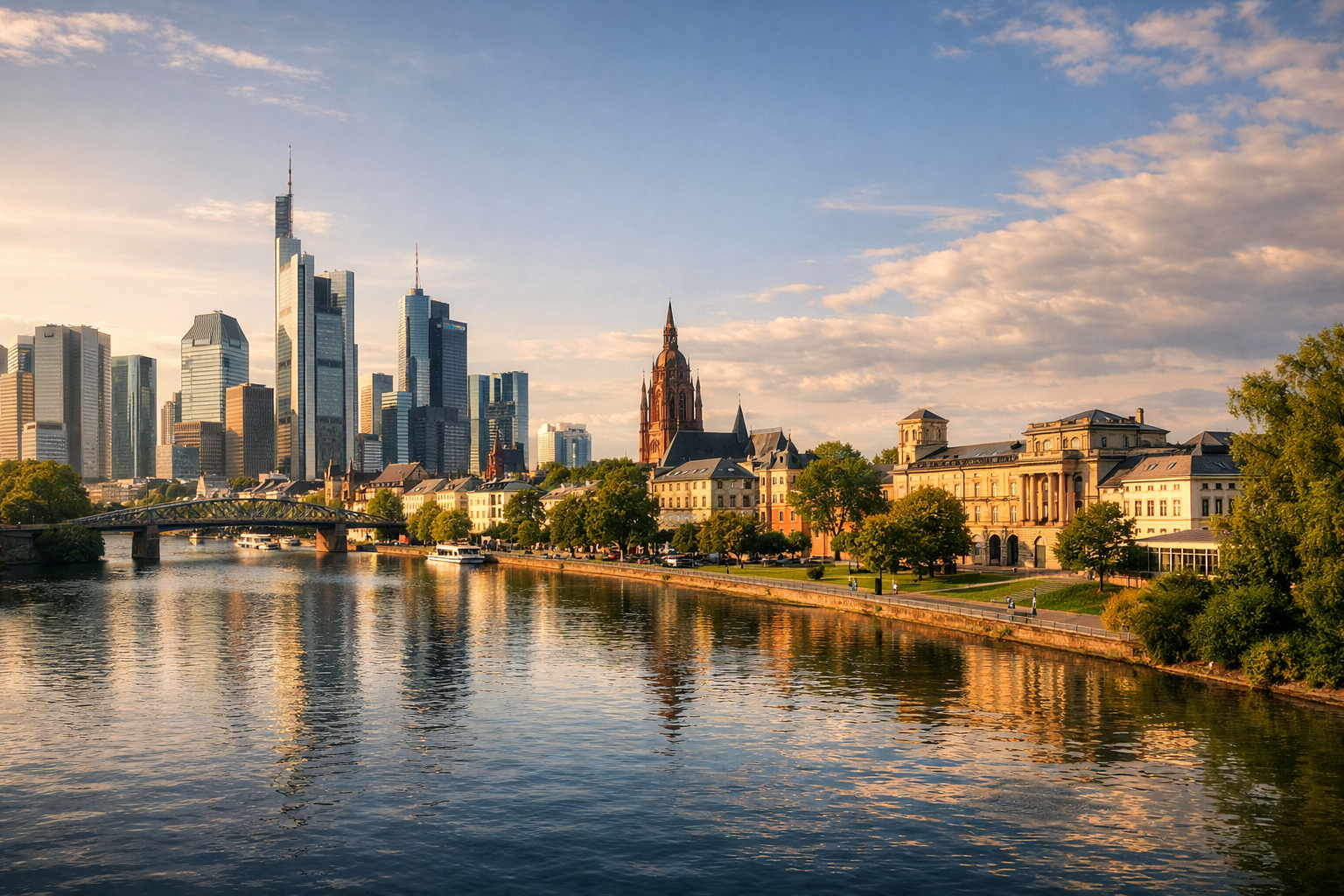
Hesse blends sleek city energy with riverside charm in Frankfurt am Main, where striking skyscrapers rise above the Main. Wander world-class museums, stylish streets, and a skyline that gives the region its modern edge.

🧭 DAY-BY-DAY ROUTE

Ready-made country and city routes with daily plans, sights, transport and accommodation. Buy PDF guides for independent travel.

🧭 DAY-BY-DAY ROUTE


Day 1 — Frankfurt: skyline, old center and an evening on the Main

  • 🚆 If you arrive at Frankfurt Airport, the most convenient way to start the route is to head straight to the center on the S-Bahn S8 or S9: getting to the central station usually takes about 15 minutes, and from there reaching your hotel area is often just a 10–15 minute walk or one short transfer. This is a very comfortable setup for a short 2-day trip: no car, no extra logistics, and a quick immersion into the city.

  • 🏨 After check-in, give yourself 45–60 minutes to rest and head out into the city at an unhurried pace. Frankfurt is especially good at exactly this tempo: don’t try to “do everything at once,” but let the city unfold in layers — first the glass and steel of the banking district, then old squares, then the river, bridges, and museum embankment.

  • 🚶 Start the day in the skyscraper area around the banking district and Main Tower. This is where Frankfurt shows its most recognizable image — an almost New York-like verticality that is rare in Germany. Narrow street perspectives suddenly open onto mirrored tower facades reflecting clouds, trams, historic buildings, and the movement of a major business city. Even an ordinary walk through this area makes a strong impression: Frankfurt feels composed, energetic, and very international. If the Main Tower observation deck fits your schedule, go up closer to late afternoon or golden hour — from above it is especially beautiful to see how the business center transitions into the old town, while the Main cuts through the urban fabric as a wide, calm ribbon.

  • 🚶 Then walk toward Römerberg and the historic center, allowing about 20–25 minutes for the walk with photo stops. This transition is very striking: in a short time, it feels as if you move from a modern financial metropolis into a postcard of old Germany. Römerberg square, with its half-timbered facades, the Römer town hall, and its proximity to the cathedral, creates a completely different mood — intimate, warm, almost theatrical. It’s nice not to rush here: look closely at the decorative gables, stonework details, towers, windows, signs, and small cafés. In the reconstructed Neue Altstadt quarter, you can especially feel Frankfurt’s identity as a city that knows how to combine businesslike modernity with respect for historical memory.

  • 🚶 After the old center, head to the Main embankment and the Eiserner Steg bridge. From Römerberg, the river is only a few minutes away, and this is one of the best moments of the route: the city suddenly opens up wide. The bridge is almost always lively, yet surprisingly calm at the same time — wind off the water, boats on the river, the lines of the embankments, cyclists, runners, and the silhouettes of towers in the distance. This is one of those spots where Frankfurt is especially photogenic: the museum banks are visible to the left and right, the skyline lies ahead, and beneath your feet flows the Main, softening the city’s strict business character.

  • 🍽️ Save a walk along the Museumsufer — the museum embankment — for the evening. Even if you don’t go into all the museums on the first day, the atmosphere of this stretch is worth time on its own. In about 40–60 minutes, you can walk a beautiful section along the water, pause for coffee or dinner, and meet the sunset against the backdrop of illuminated skyscrapers. After sunset, the skyline starts to play in a completely different way: the glass towers turn into graphics made of light, and the river gathers those lights into long shimmering reflections. For a short trip, this is almost the perfect ending to the first day — spectacular, but not exhausting.

  • 💤 After the evening walk, allow 15–25 minutes to return to your hotel on foot or by tram/S-Bahn, depending on where you are staying. It’s better not to overload the first day with late transfers: Frankfurt is compact, and its main advantage in a 2-day format is the ability to see a lot without exhausting distances.


Day 2 — Frankfurt: Main museums, Palmengarten and a calm finale

  • 🚶 The second day is best devoted to museum Frankfurt and the softer, more cultural side of the city. Don’t start the morning too early; leave around 8:30–9:30 for breakfast and getting ready, and plan your main departure for the opening of the museum you choose. For a short route, it’s better not to try to fit in too many major collections in a row: ideally choose 1–2 large museums and complement them with a walk in a park.

  • 🏛️ The best anchor for the day is the Städel Museum on Schaumainkai. This is one of Germany’s most important art museums, and it does not feel like a formal “box to tick,” but like a genuinely deep place. It is especially pleasant to move gradually through the eras here: from the old masters to modernism and then to more contemporary works. The museum’s location itself also adds to the experience — it stands on the famous Museumsufer, and even the approach along the embankment sets the right mood. It is reasonable to allow 2–2.5 hours for the visit with breaks: that way the museum won’t tire you out, but will leave you with the feeling of a rich yet not overloaded morning.

  • 🏛️ If you want contrast after classical art, the second museum can be chosen by interest: Senckenberg Naturmuseum for lovers of natural history and impressive dinosaur skeletons, or MMK — Museum für Moderne Kunst — for a bolder and more contemporary art experience. It is convenient to travel between museums by tram, U-Bahn, or taxi; within central Frankfurt, such rides usually fit into about 15–25 minutes including waiting time. For a 2-day format, the ideal rhythm is one large museum in the morning and one shorter or thematic museum after lunch.

  • 🌿 In the second half of the day, switch to Palmengarten. After the city’s geometry and the concentration of museums, this park feels like a deep exhale. Palmengarten is not just a green zone, but a beautiful botanical world with greenhouses, themed plantings, palms, tropical and subtropical spaces, broad avenues, and calm ponds. It is especially pleasant to spend 1.5–2 hours here without hurrying: sit on a bench, walk through the glasshouses, watch how the light changes in the leaves, and simply let the city become quieter. This is a very successful way to end the route, because Frankfurt is memorable not only for its towers, but also for its ability to feel cozy, green, and unexpectedly relaxed.

  • 🚶 If you still have energy, finish the trip with an easy final walk along the embankment or around Alte Oper / Innenstadt. 45–60 minutes is enough for this segment: no specific goal, just stroll past shop windows, squares, and city vistas, buy something for the road, and take one more look at the skyline. On this kind of final walk, Frankfurt is especially good: it no longer feels like a strict business hub, but comes across as a complete and very convenient European city, where the river, museums, transport, and architecture come together in a clear and well-thought-out rhythm.

  • 🚆 If your flight or departure is on the same day, allow about 15 minutes from the center to the airport on the S-Bahn to Flughafen Regionalbahnhof, plus extra time for reaching the platform and terminal. For a comfortable end to the trip, it is best to leave at least 2–2.5 hours before a flight within Europe, and even earlier for long-haul flights.

Flight tickets

eSIM for travel

Buy PDF guide

Buy PDF guide — 4.28 USD

PDF — 4.28 USD