
Buy PDF guide

Buy PDF guide — 10.71 USD

PDF — 10.71 USD

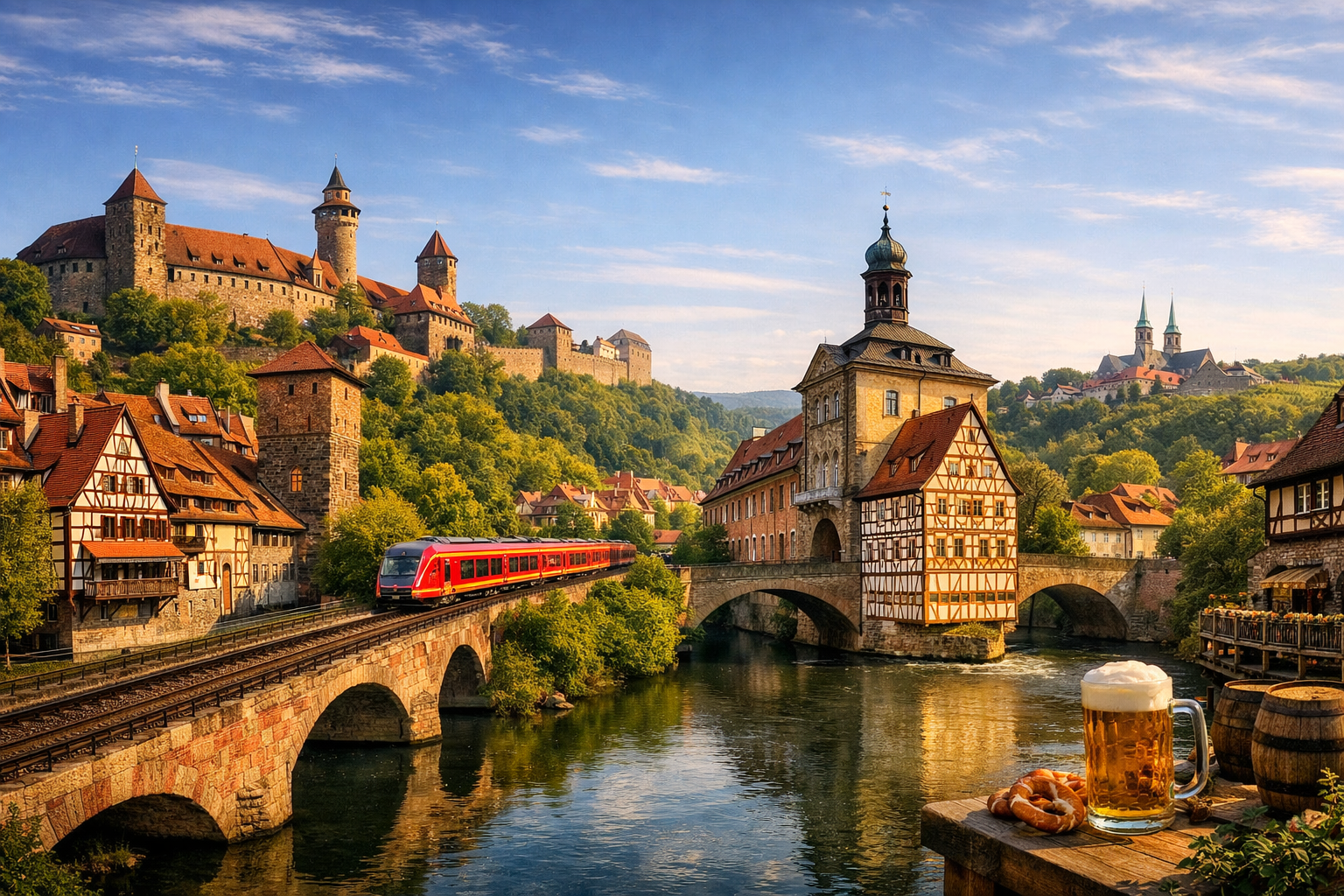
Germany, Nuremberg and Bamberg. An affordable railway route through medieval centers, fortresses, old streets, and traditional breweries of Franconia.

Germany, Nuremberg and Bamberg. An affordable railway route through medieval centers, fortresses, old streets, and traditional breweries of Franconia.

Discover Franconia on an affordable rail journey from Nuremberg to Bamberg and back, where medieval squares, hilltop fortresses, and winding old streets feel close enough to touch. Between the two cities, Germany reveals a richer, slower rhythm shaped by half-timbered beauty, imperial history, and some of its most beloved traditional breweries.

🧭 DAY-BY-DAY ITINERARY

Ready-made country and city routes with daily plans, sights, transport and accommodation. Buy PDF guides for independent travel.

🧭 DAY-BY-DAY ITINERARY


Day 1 — Nuremberg: old town, fortress, and artisan quarters

  • 🚆 Arrival in Nuremberg and check-in at a budget hotel near Hauptbahnhof is the best way to avoid spending money on unnecessary transfers and start exploring the city on foot right away. From the main station to the historic center, the walk is easy and short: in just a few minutes, the modern transport hub gives way to the towers of the city walls, bridges over the Pegnitz, and cobbled streets where medieval Nuremberg feels almost tangible. For the first day, this is an especially good base: minimal transport costs, maximum time for walking, resting after the journey, and a gentle immersion into the atmosphere of old Franconia.

  • 🚶 Start with a walk along Königstraße and through the old city gate to the quarters around Hauptmarkt. Here Nuremberg reveals itself as one of the most expressive medieval cities in southern Germany: Gothic facades, reddish sandstone, deep bay windows, old bridges, and narrow streets create the feeling that the city is both solemn and very much alive. Be sure to walk to Weißgerbergasse — one of the most beautiful old streets in the city, where a dense row of half-timbered craftsmen’s houses has been preserved. This is one of the best free places on the route: not a museum behind glass, but the real historic fabric of the city, where you can walk slowly, looking at signs, shutters, and the uneven lines of old roofs.

  • 🚶 Then head up to Kaiserburg Nürnberg — the imperial fortress rising above the city. Even if you limit paid visits, the grounds around the fortress itself, the courtyards, walls, views of tiled roofs and old towers are already worth a separate visit. For centuries, the fortress was one of the most important imperial centers of the Holy Roman Empire, and its silhouette still conveys not decorative but real defensive power. If your budget allows, you can choose to go inside on one of the days; if not, the viewpoints, walls, and outer courtyards are enough to make a strong impression. Nearby, it is especially pleasant to sit with an inexpensive coffee or pretzel, watching the whole old town lie below like a map of stone and tile.

  • 🍺 In the evening, it makes sense to stay in the Tiergärtnertor area. The atmosphere of old Nuremberg is especially cinematic here: fortification walls, small squares, old houses, and beer halls where the Franconian tradition is felt without any museum-like staging. For a budget dinner, look for simple local dishes: sausages, soup of the day, dumplings, pretzels, and local beer in small establishments or beer halls in the historic center. A rough daily budget for a frugal style: food about 20–35 € per person, while local transport on a walking day can be reduced to zero or 3–10 € for one or two rides.


Day 2 — Nuremberg: Albrecht Dürer, city walls, and Franconian beer

  • 🚶 Dedicate the morning to the northern part of the old town and the Albrecht Dürer House. The area around Albrecht-Dürer-Straße is already an attraction in its own right: here Nuremberg feels more intimate, quieter, and more residential than around the central market. The Dürer House is especially good for a short paid visit on a budget route because it combines art, everyday life, and the city’s history in one compact place. Even from the outside, the building makes a strong impression: a heavy lower floor, half-timbered upper level, and a sense of solidity and artisanal dignity characteristic of old Nuremberg.

  • 🚶 After the museum, walk in a loop via Burgstraße, fortress viewpoints, and old bridges over the Pegnitz. This day can be planned as a “lazy historical route” without extra spending: look at facades, courtyards, reflections on the water, towers, the Heilig-Geist-Spital hospital, and the Kettensteg suspension bridge. Nuremberg is beautiful precisely at this pace — without rushing and without the need to keep buying tickets. The city opens up in layers: first as a postcard, then as a former imperial center, and then as a place where history has not been polished into sterility and still lives in the curves of the streets, in the stone of the walls, and in the way the light changes toward evening.

  • 🏛️ If you want to add one larger museum, Germanisches Nationalmuseum is a good choice for the second half of the day. It is not the easiest museum, but it is very valuable if you want to understand the context of southern German and broader European history. On a limited budget, there is no need to spend half a day there: even a short visit of 1.5–2 hours will provide a solid historical framework for the whole trip. If you want to save even more, the museum can be replaced by a completely free walk along the city walls and a break in the park area near the fortress.

  • 🍺 The evening is best devoted to Franconian beer culture without expensive tasting programs. In Nuremberg, it is sensible to choose traditional beer halls or small historic establishments in the old center, where you can order one local beer and a simple hot dish. Franconian beer culture here is not about a loud tourist attraction, but about a long-standing urban habit: dark wood, calm conversations, simple food, and a drink perceived as part of regional everyday life. Estimated costs: museum 0–10 €, food 20–35 €, and if needed, a city day ticket 8–15 € depending on the zone and type.

Day 3 — Bamberg: transfer, island town, and riverside quarter

  • 🚆 The transfer Nuremberg → Bamberg by regional train takes about 35–45 minutes and makes the route especially cost-effective: the distance is short, a transfer is often unnecessary, and Bamberg itself is excellent for a trip without a car. That is why the Nuremberg + Bamberg combination is one of the most logical budget scenarios in Franconia. After arrival, it is convenient to leave your things at a hotel near the station or at a youth hostel and then continue exploring the city on foot: the center is compact, and the main impressions here are best gained while walking anyway.

  • 🚶 The first major route through Bamberg should begin from the station through the garden district to the historic core. Bamberg does not resemble a formal museum ensemble; rather, it feels like a city that grew naturally over hills, islands, and bends in the water. This unevenness is exactly what makes it especially attractive. When you emerge into the old center, there is a sense of a complex, multilayered city: towers, bridges, narrow ascents, facades of former merchants’ houses, and water that constantly draws the eye back to reflections. There is a rare combination of coziness and dignity in this.

  • 🚶 Be sure to walk to Altes Rathaus — the old town hall standing directly on a bridge over the river. This is one of Bamberg’s most recognizable images and one of those urban scenes that truly make an impression without any exaggeration. From there, it makes sense to continue toward “Little Venice” — a row of old fishermen’s houses along the banks of the Regnitz. Here Bamberg becomes especially quiet and almost watercolor-like: boats, water, old walls, flowers in the windows, and a rare sense of harmony between urban history and everyday life.

  • 🍺 In the evening, arrange a budget-friendly introduction to the city’s brewing tradition. Bamberg is famous for its Franconian breweries, and it is especially interesting here to try local beer not in an expensive “tour + tasting set” format, but as part of an ordinary meal. It is best to choose a traditional beer hall in the old town, order one or two regional varieties, and an inexpensive local dish. In Bamberg, the value lies in authenticity: old halls, a calm crowd, and the feeling that the tradition is not being performed for tourists, but simply continues. Estimated costs: train 10–25 € at the regular fare or cheaper with Bayern-Ticket/Deutschlandticket, food 20–35 €, and a walking day with almost no local transport.

Day 4 — Bamberg: Cathedral Square, residence, museums, and Altenburg hill

  • 🚶 Start the morning with a climb to Domberg. This is the heart of historic Bamberg, where the city looks not just beautiful, but truly monumental. The square with the cathedral, the New Residence, and Alte Hofhaltung feels like a concentration of Franconia’s ecclesiastical and princely history. Here it becomes especially clear why Bamberg is considered one of Germany’s most important medieval urban ensembles: the space does not break apart into separate objects, but works as a single scene where stone, scale, and topography create a rare sense of historical depth.

  • 🏛️ For a budget route, it is enough to choose one paid site on this day. The best option is Historisches Museum Bamberg in Alte Hofhaltung or Neue Residenz, depending on your interest in urban history or palace interiors. The point is not to “cover as many museums as possible,” but to add a more substantial inner layer to one of the days. After unhurried walks through the streets, it is especially interesting to go inside and see how power, religion, everyday life, and artistic taste took shape in these cities.

  • 🚶 In the second half of the day, if the weather is good and you want to avoid extra expenses, you can climb to Altenburg. This is no longer the central tourist postcard, but a calmer and almost contemplative Bamberg. The ascent takes time and effort, so allow for rest and water, but on a clear day the reward is views over the city, hills, and red roofs that make Bamberg look like an old town from an engraving. If you do not want to walk uphill, an alternative is a long stroll along the embankments and quiet lanes beyond the busiest spots.

  • 🍽️ In the evening, stick to a money-saving strategy: dinner in a traditional eatery without excesses, or bread, cheese, sausages, fruit, and drinks from a supermarket for a picnic in one of the calm areas by the water. For a 5-day budget tour, this is one of the best money-saving techniques: do not try to make every dinner an event, but alternate atmospheric beer halls with simple purchases at REWE, Lidl, Edeka, or bakeries near the station and in the center. Estimated costs: museum 5–12 €, food 15–30 €, bus to more distant points 3–8 € if needed.

Day 5 — Nuremberg: return, final walk, and departure

  • 🚆 The morning transfer Bamberg → Nuremberg is again short and convenient, so the last day does not turn into exhausting logistics. This is an important advantage of the whole route: even with a strict budget, it remains comfortable and safe, without overnight transfers, without renting a car, and without excessive dependence on complicated connections. If your flight or onward train is later, leave your luggage at the station or hotel and use a few hours for a calm end to the trip.

  • 🚶 It is best to keep the last day as light as possible: a walk along the fortress walls, another pass through your favorite parts of the old town, the market, souvenir shops, and an inexpensive bakery for breakfast or lunch. After Bamberg, Nuremberg is often perceived as even more voluminous: larger, harsher, more “stony,” yet surprisingly warm in the details. The final hours are best spent without rushing, allowing the route to come together into a single image of Franconia — a region where medieval centers do not look decorative, but continue to live in their own rhythm.

  • 🛍️ If you need an inexpensive food souvenir, the most practical option is to buy it in city shops, at the market, or in specialized stores without airport markups: bottled Franconian beer, mustard, gingerbread, and small regional products. For a budget traveler, this is better than impulsive purchases at tourist spots. For the final day, 10–25 € for food and small expenses is usually enough if you are not planning expensive museums.

  • ⚠️ Before departure, be sure to check the current train schedule, platforms, possible repair work on the line, and weather conditions once again. Information about safety, weather, road conditions, and route accessibility may change. Before the trip and during the travel days, recheck official warnings, the weather forecast, transport schedules, and possible restrictions. No destination can be considered completely safe; a reasonable time buffer, daytime transfers, and attention to your belongings are the best basic strategy for this route.

Flight tickets

eSIM for travel

Buy PDF guide

Buy PDF guide — 10.71 USD

PDF — 10.71 USD