
Buy PDF guide

Buy PDF guide — 8.57 USD

PDF — 8.57 USD

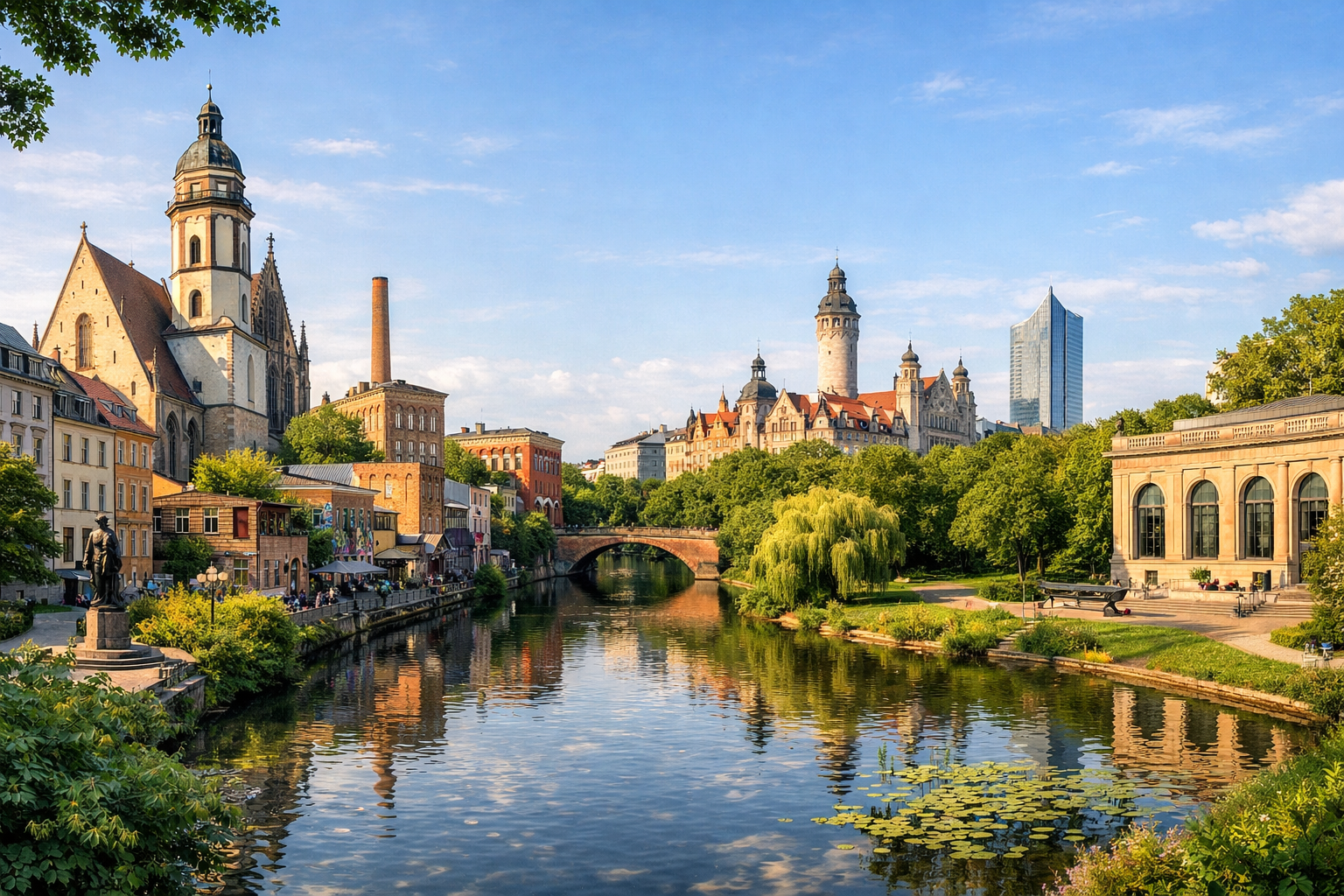
Germany, Leipzig. An inexpensive city break with musical attractions, creative neighborhoods, parks, canals, and free galleries.

Germany, Leipzig. An inexpensive city break with musical attractions, creative neighborhoods, parks, canals, and free galleries.

Leipzig is a smart pick for an affordable city break, where classical music heritage meets a fresh creative energy. Spend four easy days wandering lively neighborhoods, relaxing in green parks, drifting along canals, and dipping into galleries that often cost nothing at all.

🧭 DAY-BY-DAY ITINERARY

Ready-made country and city routes with daily plans, sights, transport and accommodation. Buy PDF guides for independent travel.

🧭 DAY-BY-DAY ITINERARY


Day 1 — Leipzig historic center: Bach, squares, and free museums

  • 🚆 If you arrive via Leipzig/Halle Airport, the cheapest and most convenient way to get to the center is the S-Bahn S5 or S5X to Leipzig Hauptbahnhof. The trip takes about 15 minutes, and from there most central hotels are a 5–15 minute walk away. This lets you avoid spending on a taxi on day one and immediately fit into Leipzig’s compact, highly walkable layout.

  • 🚶 Start your route in the Thomaskirchhof and Thomaskirche area — one of the city’s most atmospheric musical places. It is here that you most clearly feel why Leipzig is called Germany’s musical capital: old facades, inner courtyards, the bronze Bach monument, and the church space come together not as a “tourist set,” but as a living part of the city where music still sounds natural. Even without going to paid concerts, the square itself and the exterior of the church make a powerful impression: this is that very Leipzig where the classical tradition is not museum-like, but woven into everyday life.

  • 🏛️ Nearby, it makes sense to visit the Bach-Museum at Thomaskirchhof 15/16. This is the main stop of the day for those who want not just to see the surname “Bach” on a plaque, but to understand how the composer was connected specifically to the city. The museum has a modern presentation, with audio materials and a clear exhibition narrative, so it is interesting even for those who do not consider themselves experts in Baroque music. For a budget trip, it is important to remember that a regular ticket costs about €14, and admission is free on the first Tuesday of the month — if your dates match, this is one of the best free bonuses of the whole itinerary.

  • 🚶 After Bach, walk through the market streets of the old center toward Marktplatz, Naschmarkt, and Mädler-Passage. One pleasant thing about Leipzig is that its major urban beauty does not require mandatory spending: arcades, inner galleries, historic passages, merchant-house facades, and narrow passages between them can be explored for free for hours. The city looks composed and elegant, yet not too pompous: even in the very center it invites a slow walk, the search for details, shop windows, courtyards, and intimate musical associations.

  • 🖼️ In the second half of the day, add Museum der bildenden Künste Leipzig, Katharinenstraße 10. This is a major art museum in the center, easy to reach on foot without extra transfers. Even if you do not want to make the day all about museums, it is worth going in for its strong collection and spacious modern architecture. For a budget itinerary, it is a good “smart paid choice”: instead of several expensive activities, one substantial museum and a long free walk around the city.

  • 🍜 For inexpensive food on the first day, stick to bakeries, Asian noodle spots, döner places, and supermarkets near Hauptbahnhof and the center. A realistic food budget in economy mode is about €8–15 for a simple lunch and €10–18 for dinner without alcohol. In this respect Leipzig is noticeably more comfortable than many large German cities: here it is easier to put together a full day without drifting into expensive restaurants.


Day 2 — Musical Leipzig: Mendelssohn, Schumann, GRASSI, and Augustusplatz

  • 🚶 The second day is best built around the musical museums in the eastern part of the center so that almost everything can be done on foot. Start with Mendelssohn-Haus Leipzig at Goldschmidtstraße 12 — this is the last surviving home of Felix Mendelssohn. The place is especially valuable because here Leipzig opens up not only as Bach’s city, but also as a space of 19th-century Romantic musical culture. The house museum feels much more intimate than large city museums: it is not just an exhibition, but a chance to feel the scale of the person through living spaces, salon atmosphere, and the story of the city’s musical elite.

  • 🚶 Then you can walk 15–20 minutes to Schumann-Haus Leipzig, Inselstraße 18. This is another important musical stop, more intimate and very human in mood. The house is connected with the first happy years of Clara and Robert Schumann’s life together, and so it feels not like a dry memorial address, but as a place of personal history, love, creativity, and domestic musical life. For a short trip, spaces like this are especially good: they provide emotional depth without exhausting museum overload.

  • 🏛️ After that, head to the GRASSI complex at Johannisplatz 5–11. Here you will find the Museum of Musical Instruments of Leipzig University — one of the best stops on the route for the theme of music. The collection lets you look at the history of sound not through composers’ biographies, but through the instruments themselves, their shape, structure, and evolution. A ticket costs about €6, and admission is free on the first Wednesday of the month, which makes the museum especially appealing for budget travel. In this same complex, it is easy to take a break, rest in the inner architectural setting, and avoid wasting energy on long transfers.

  • 🎼 Then spend some time at Augustusplatz — one of Leipzig’s most important urban spaces. Gewandhaus and Oper Leipzig stand nearby, and even without expensive evening tickets, the place works as an important city stage. The square is broad, bright, and very “musical” in identity: around it you feel modern cultural Leipzig, where academic music, university life, and city life come together in one rhythm. This is a good point in the itinerary just to sit, watch the flow of people, catch your breath, and feel the scale of the city without extra spending.

  • 🥪 A budget strategy for this day is one paid musical museum of your choice and the rest of the time on foot. For snacks, sandwiches, pastries, takeaway coffee, or supermarket purchases are convenient. If you want to save even more, combine Mendelssohn-Haus with a walk around Augustusplatz and GRASSI, and leave Schumann-Haus as an optional stop depending on your interest and budget.

Day 3 — Plagwitz and Lindenau: creative districts, canals, and free galleries

  • 🚋 The third day is best devoted to Leipzig’s western districts — Plagwitz and Lindenau. From the center, it is convenient to get here by tram in about 15–25 minutes depending on your starting point, after which the route once again becomes mostly walkable. This is a very good choice for an affordable trip: one day combines industrial aesthetics, water, greenery, street culture, design spaces, and a gallery scene, while most of the impressions are available for free.

  • 🚶 Start with Karl-Heine-Straße — one of the liveliest and most pleasant streets in modern Leipzig. Here you can clearly see how a former industrial environment has turned into a creative urban landscape: brick facades, workshops, small cafés, independent bars, courtyards, cycling culture, and a noticeably more relaxed rhythm than in the center. The district does not look “polished” for tourists, and that is exactly what makes it compelling: it has lots of real urban energy, students, artists, and local everyday life.

  • 🌊 Be sure to walk along Karl-Heine-Kanal. The canal is one of the most beautiful and underrated parts of budget Leipzig. It is pleasant to stroll here without hurry, looking at bridges, boats, former factory buildings, and green banks. In good weather, this area gives an almost resort-like feeling of an urban break: instead of a mandatory checklist of “must-sees,” you get air, water, beautiful views, and a very photogenic industrial-romantic atmosphere.

  • 🖼️ The main stop of the day is Leipziger Baumwollspinnerei, Spinnereistraße 7. The former cotton mill has become one of Germany’s best-known art clusters. It is an ideal location for your request for creative districts and free galleries: a large part of the site can be explored as a self-guided walk, moving between courtyards, workshops, exhibition halls, and gallery spaces. Here you especially feel how Leipzig’s industrial past has turned into cultural capital: heavy brick buildings, wide courtyards, and contemporary art form a space of rare coherence.

  • 🆓 Inside Spinnerei, it is best to focus precisely on the free gallery spaces and the general walk around the grounds. Even if specific exhibitions change, the logic of the place works without buying expensive tickets: it feels as if you have entered a separate art city inside the city. This is the best day of the itinerary for maximum savings without losing impressions.

  • ☕ For food in this area, it is reasonable to plan for a casual café on Karl-Heine-Straße or a quick snack from a bakery. For a budget, expect around €7–12 for a daytime snack and €10–16 for a simple dinner. If you want to keep it very cheap, it is convenient to buy groceries at a supermarket and take a break by the water or in one of the green spots along the way.

Day 4 — Parks, contemporary art, and a calm finale by the water

  • 🌳 It is best to make the last day lighter and greener so as not to overload the trip. Start with Clara-Zetkin-Park — a large urban park area that is easy to reach on foot from the center or by a short tram ride. It is an excellent finale for Leipzig: after the musical museums and industrial districts, the city reveals itself as a very comfortable place to live, where green spaces are literally woven into the urban rhythm. Here you can not only walk, but simply slow down, sit by the water, and watch cyclists, runners, and local residents.

  • 🖼️ Then head to Galerie für Zeitgenössische Kunst Leipzig, Karl-Tauchnitz-Straße 9–11. This is one of the city’s key contemporary art addresses. For a budget itinerary, it is especially convenient that admission is free here on Wednesdays. Even on a regular day the museum remains relatively affordable, but if you plan your trip around the week, Wednesday makes this stop almost mandatory. The atmosphere here is more experimental and intellectual than in the city’s classical museums, so it is a good ending to the route after Spinnerei: you will see another side of Leipzig’s art scene.

  • 🚶 If you still have energy and interest, you can add a calm walk back to the center through the green streets of the southern part of the city or make a short detour to one of the urban waterfront areas near the park zones. The final day should not be overloaded: Leipzig is remembered better not for the number of points, but for the combination of music, water, brick industrial beauty, and a surprisingly gentle urban atmosphere.

  • 🛍️ If you want one more free cultural accent, leave time for another pass through the passages of the center, bookshops, inner courtyards, and viewing perspectives around Augustusplatz. In Leipzig, the “last day without hurry” format works very well: do not chase one more ticket, but reinforce the impression of the city as a place you want to return to.

  • 🚆 Before departure, keep about 30–40 minutes in reserve for the trip from the center to Leipzig Hauptbahnhof or about 15 minutes by S-Bahn from Hauptbahnhof to Leipzig/Halle Airport, plus time for waiting for the train. For an economical and realistic itinerary, it is better not to plan too packed a schedule on departure day.

Flight tickets

eSIM for travel

Buy PDF guide

Buy PDF guide — 8.57 USD

PDF — 8.57 USD