
Buy PDF guide

Buy PDF guide — 10.71 USD

PDF — 10.71 USD

Germany and Austria. Moselle Cycle Route (Trier - Koblenz). Season: May - October

Germany and Austria. Moselle Cycle Route (Trier - Koblenz). Season: May - October

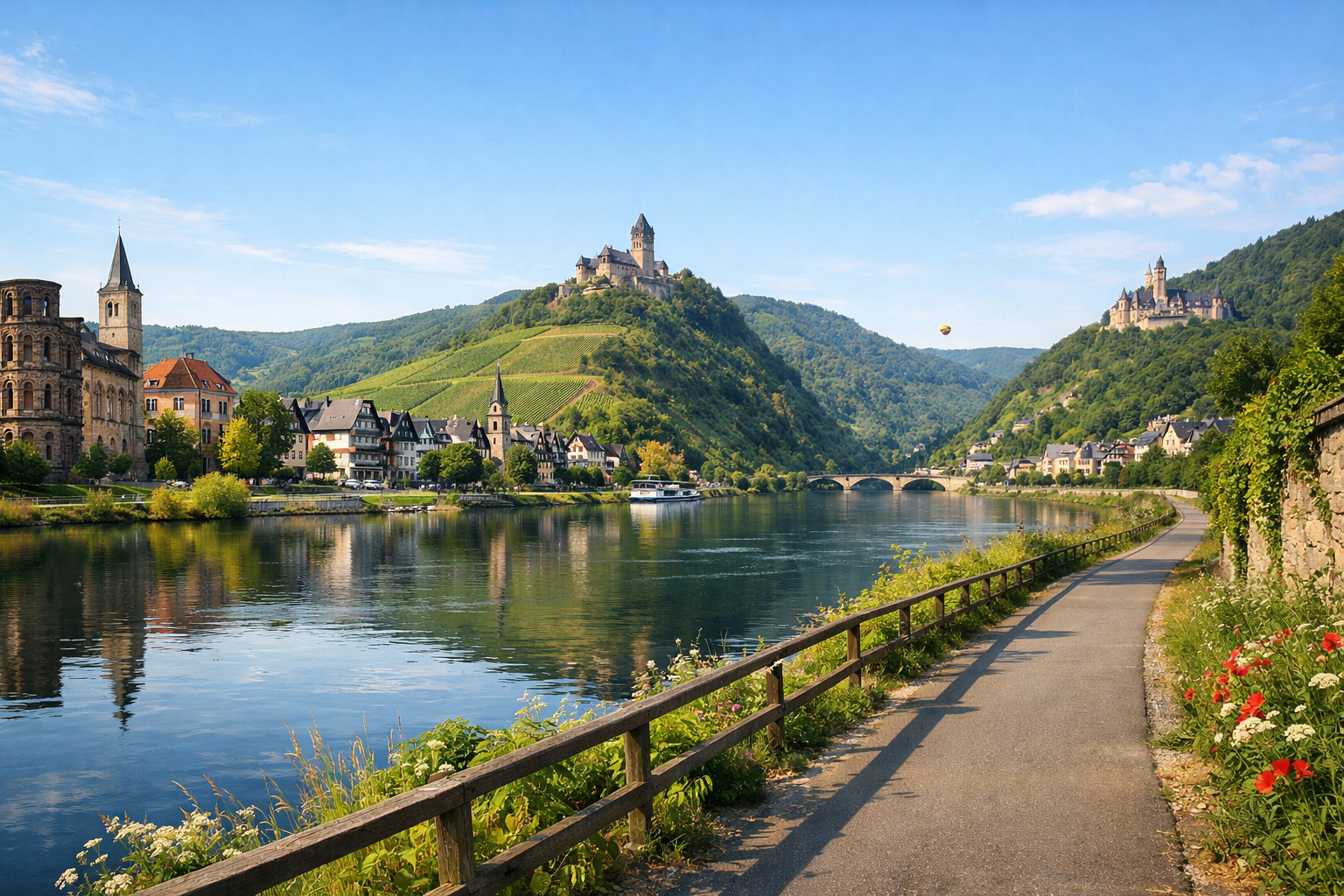
Follow the Moselle from ancient Trier to stately Koblenz on one of Europe’s most scenic cycle routes. Between vineyard-covered hills and storybook riverside towns like Bernkastel-Kues, Zell and Cochem, this ride is all about easy miles, grand views and long, golden days from May to October.

🚲 ROUTE BY DAY

Ready-made country and city routes with daily plans, sights, transport and accommodation. Buy PDF guides for independent travel.

🚲 ROUTE BY DAY


Day 1 — Trier → Neumagen-Dhron / Piesport: a gentle entry into the Moselle valley

  • 🚲 Start in Trier, finish in the Neumagen-Dhron or Piesport area. About 38–45 km, pure riding time 2.5–3.5 hours, elevation gain usually up to 150 m. The surface is mostly very tourist-friendly: paved Mosel-Radweg cycle paths, embankments, short stretches on quiet local roads, and possible sections of firm gravel. This is an easy day to calmly assemble your bike, get used to navigation, and avoid exhausting yourself on the very first evening. Along the way it makes sense to take 2–3 stops: Porta Nigra in Trier before departure, the cozy wine town of Schweich for coffee and water, and then Neumagen-Dhron — the region’s oldest wine village with a beautiful riverfront. Water is easy to refill in cafés, bakeries, and along town promenades; food is best bought in Trier in the morning and supplemented with a snack in Schweich or Trittenheim. It is more convenient to stay overnight in Neumagen-Dhron, Piesport, or nearby so that the second day does not become too long. Route nuances: after rain, some riverside sections may be damp or muddy, and the main official route sometimes runs only on one bank, so it is not worth crossing the river chaotically without need. The day is realistic for an average cycle tourist because the terrain is almost flat, services appear regularly, and the distance remains comfortable even on a regular trekking bike.


Day 2 — Neumagen-Dhron / Piesport → Bernkastel-Kues: vineyards and the classic Middle Moselle

  • 🚲 Start from Neumagen-Dhron / Piesport, finish in Bernkastel-Kues. About 28–35 km, pure riding time 2–3 hours, elevation gain around 100–180 m depending on detours and rides into old quarters. Surface: mostly paved riverside cycle paths, some quiet streets in villages, and in places firm gravel on river sections. Difficulty is easy. This is not a day for records, but for atmosphere: long bends of the river, vineyard slopes, boats at the piers, and an almost continuous chain of little Moselle settlements. The main stops along the way are Trittenheim for a short riverside pause, Zeltingen-Rachtig or Wehlen for a late lunch, and at the end the old center of Bernkastel and the Kues district on the opposite bank. Here it is easy to refill water, find a supermarket, bakery, pharmacy, and charge an e-bike. Staying overnight in Bernkastel-Kues is especially convenient: it is a major base with rentals, accommodation, a promenade, and a good choice of restaurants. Route nuances: in high season there are many pedestrians on the approach to the old center, so it is better to ride the last kilometers slowly and be ready to dismount in places. The day is realistic because the short distance leaves time for sightseeing, laundry, bicycle maintenance, and a relaxed evening without overload.

Day 3 — Bernkastel-Kues → Zell: longer, but still comfortable

  • 🚲 Start in Bernkastel-Kues, finish in Zell. About 36–42 km, pure riding time 2.5–3.5 hours, elevation gain 150–250 m. The surface is mixed but tourist-friendly: long flat paved sections of the Mosel-Radweg, embankments, short stretches on quiet secondary roads, and occasional gravel sections by the water. Difficulty is easy to moderate if riding into the wind or on a hot day. The main stops are Traben-Trarbach with its beautiful architecture and lunch options, Enkirch or Brühe as a calm riverside pause, and then the approach into Zell, famous for the long bend of the Moselle. Water and food are easiest to restock in Traben-Trarbach: it is one of the best intermediate service points. In Zell, staying overnight works well both for hotels and for camping. Route nuances: the route is easy to follow thanks to signs, but on urban promenades and in old quarters you have to share space with pedestrians; on a sunny day the section may feel hot because the valley is open in places and reflects heat from the water and slopes. The day is realistic for an average tourist thanks to the flat profile, dense infrastructure, and the option to reduce effort by taking an e-bike.

Day 4 — Zell → Cochem: the most beautiful river corridor of the tour

  • 🚲 Start in Zell, finish in Cochem. About 35–40 km, pure riding time 2.5–3.5 hours, elevation gain 150–250 m. Surface: paved cycle paths, river promenades, in places short stretches on local roads with low traffic, and occasional firm gravel bits. Difficulty is moderate only because of the tourist density and the desire to stop often. Especially good along the way are Beilstein as one of the most fairy-tale stops on the route, Bremm and the views of steep vineyard slopes, and then Cochem with its striking silhouette and Reichsburg Castle. For water and snacks, it is better to make a proper stop in one of the villages before Cochem or already on the approach to its promenade. It is more convenient to stay overnight directly in Cochem: the town is very practical logistically, with a railway station, services, bike rental, and backup return options by train. Route nuances: around Cochem and the popular wine villages the tourist flow is denser, so calm speed is needed during the day; in case of rain, paving stones and promenades may be slippery. The day is realistic because the distance is moderate, the profile remains gentle, and the reward of the beautiful final approach into Cochem justifies every kilometer.

Day 5 — Cochem → Koblenz: finish at Deutsches Eck

  • 🚲 Start in Cochem, finish in Koblenz at the confluence of the Moselle and Rhine. About 48–52 km, pure riding time 3.5–4.5 hours, elevation gain 150–250 m. The surface overall remains tourist-friendly, but the day is a bit more focused: cycle paths along the river, sections next to the road, approaches through suburban zones, and an urban finish along promenades. Difficulty is moderate. The main stops along the way are Treis-Karden for coffee and water, Kobern-Gondorf as a beautiful wine pause before the final stretch, and the last kilometers through Koblenz-Güls to the center. Water, food, and technical help are convenient to look for in Treis-Karden, Winningen, and then in Koblenz. It is best to stay overnight in Koblenz near the Mosel-Radweg or near the station if a return departure by train is planned. Route nuances: closer to Koblenz the route becomes more urban, in places runs next to the road, and requires attention at junctions, but remains safe when ridden in daylight. If the weather suddenly worsens or energy is running out, this is the easiest day to shorten with a regional train from one of the stations on the Moselstrecke line. The day is realistic for an average cycle tourist because it is the longest, but still flat and predictable, with many stations along the way and a clear beautiful finish at Deutsches Eck.

Flight tickets

eSIM for travel

Buy PDF guide

Buy PDF guide — 10.71 USD

PDF — 10.71 USD