
Buy PDF guide

Buy PDF guide — 12.85 USD

PDF — 12.85 USD

Germany and Austria. Elbe Cycle Route (Dresden - Magdeburg). Season: May - September

Germany and Austria. Elbe Cycle Route (Dresden - Magdeburg). Season: May - September

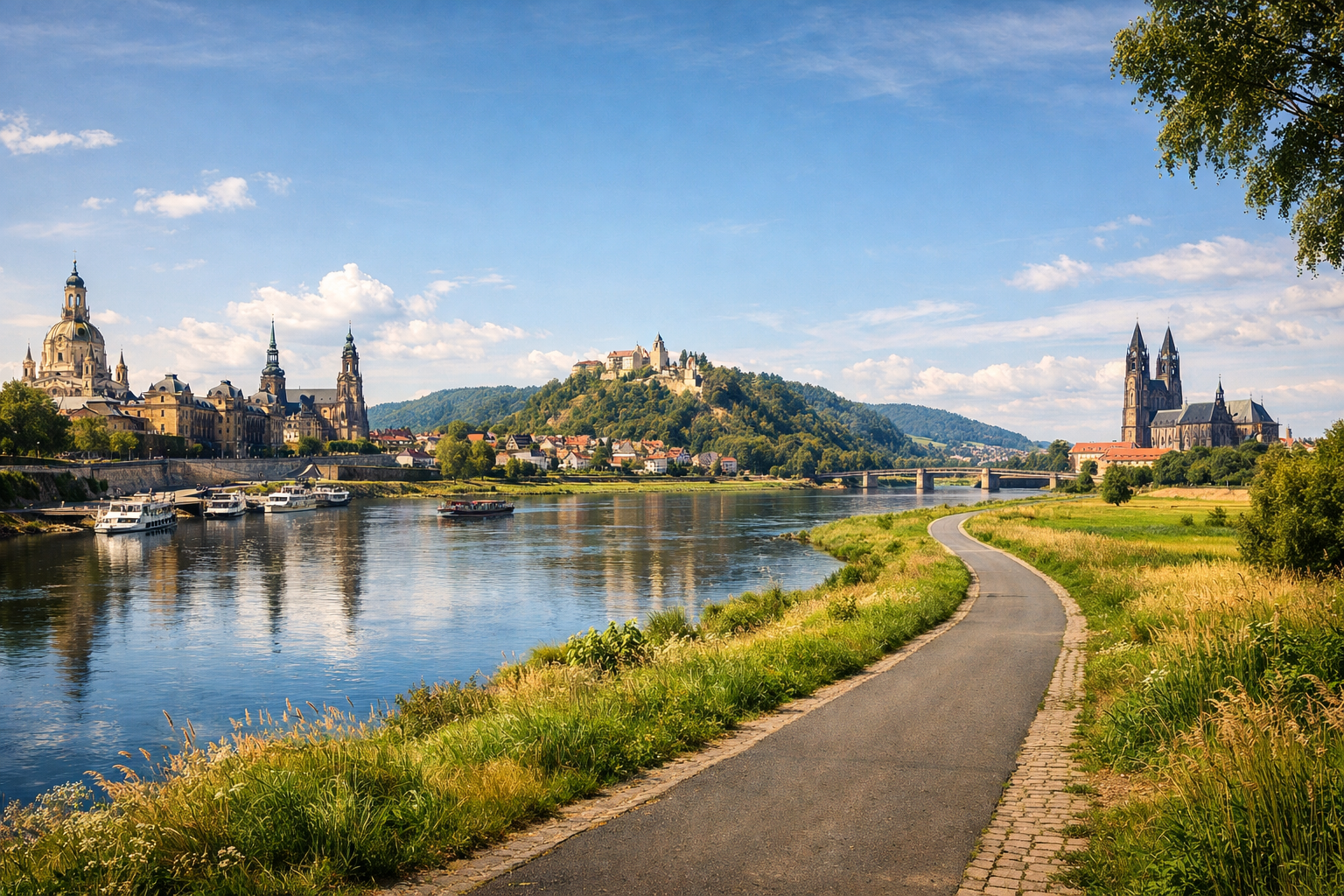
Pedal from Dresden to Magdeburg along the Elbe, where baroque skylines, vineyard hills, and graceful river meadows unfold mile after mile. From Meißen and Torgau to Wittenberg and Dessau, this ride blends storybook towns with a calm, easy rhythm that shines from May to September.

🚲 ROUTE BY DAY

Ready-made country and city routes with daily plans, sights, transport and accommodation. Buy PDF guides for independent travel.

🚲 ROUTE BY DAY


Day 1 — Dresden → Meißen: a gentle start along embankments and the Elbe’s wine villages

  • 🚲 Start in Dresden, finish in Meißen. About 28 km, actual riding time around 2 hours, with little elevation gain — usually up to 120 m if you do not climb high into the vineyards. The surface is mostly excellent: urban bike lanes, paved embankments, and a few sections of firm gravel. Difficulty: easy. This is the ideal first day to calmly pick up your bicycle or e-bike in central Dresden, adjust your fit, and join the Elberadweg without stress. Along the way it makes sense to stop 2–3 times: around the palaces on the Elbe, at the Schloss Wackerbarth wine estate in Radebeul, and then in the historic center of Meißen beneath the silhouette of Albrechtsburg. Water and food are easy to restock in Dresden before departure, then in Blasewitz/Neustadt, Radebeul, and at riverside cafés along the way. For the overnight stay, Meißen is the best choice: it is pleasant for an evening walk on foot, and in the morning you can continue straight along the river. Road nuances: Dresden’s embankments have many pedestrians, so it is best to take the first kilometers slowly; if you want, you can switch riverbanks by city ferries, but this is not necessary for the basic route. The day is realistic for an ordinary cycle tourist because the distance is short, the terrain is calm, and the route follows the river almost the whole way with easy navigation.


Day 2 — Meißen → Torgau: a long but flat river stage through meadows and small Elbe towns

  • 🚲 Start in Meißen, finish in Torgau. About 44 km, actual riding time around 3 hours, with minimal elevation gain — usually up to 150 m. The surface is mixed but comfortable: asphalt, firm dike paths, occasional gravel, and quiet rural roads. Difficulty: easy, or easy to moderate only because of the duration. In the morning it is worth setting out early after exploring Meißen and following the official Elberadweg line. The main stops along the way are river villages and viewpoints over the Elbe floodplain, as well as Riesa as a practical service break for food, a supermarket, and possible minor bike adjustments. Water is easy to refill in Meißen before departure, then in Riesa and in settlements closer to Torgau; it is better to carry snacks with you, because services between towns can be uneven. It is best to stay overnight in Torgau, where it is pleasant to end the day with views of Schloss Hartenfels and the old town. Road nuances: in windy weather, the open stretches on the dikes can feel harder than the distance suggests; after rain, some gravel sections may become slower, but the route remains tourist-friendly and safe. This day is realistic because the distance fits within a comfortable range for a flat riverside cycling route, and the profile requires almost no athletic preparation.

Day 3 — Torgau → Lutherstadt Wittenberg: a calm transition into the more natural part of the Middle Elbe

  • 🚲 Start in Torgau, finish in Lutherstadt Wittenberg. About 65 km, actual riding time around 4 hours, with low elevation gain — about 120–180 m. Surface: mostly dike cycle paths, paved rural access roads, occasional gravel, and sections along riverside roads with very light traffic. Difficulty: moderate. This is already a full cycling day, but without hard terrain: the river leads the route with almost no climbs, and the landscape becomes quieter and more natural. Main stops along the way are the morning visit to Schloss Hartenfels in Torgau, villages and meadows along the Elbe floodplain, and before Wittenberg, the open river landscapes of the Middle Elbe biosphere area. It is best to refill water and food in Torgau at the start, then use shops and bakeries in intermediate settlements; in hot weather you should definitely carry at least 1.5–2 liters per person, because long sections pass through areas without dense urban infrastructure. An overnight stay is ideal in Wittenberg’s historic center, so you can walk in the evening to the market square and the Reformation sites. Road nuances: crosswinds or headwinds are often felt on the dikes; in May and September, cool mornings and damp sections are possible, while in summer there is open sun almost without shade. The day is realistic for an ordinary cycle tourist because it is longer than average but very flat, easy to navigate, and free of dangerous road choices.

Day 4 — Wittenberg → Dessau-Roßlau: Middle Elbe nature and a more relaxed rhythm

  • 🚲 Start in Wittenberg, finish in Dessau-Roßlau. About 48 km, actual riding time around 3 hours 15 minutes, with small elevation gain — about up to 100 m. The surface is mostly good: paved riverside paths, dikes, forest and meadow sections on firm gravel, and short stretches on quiet roads. Difficulty: easy. After the longer previous day, this is a comfortable stage with plenty of time for stops. Along the way it is good to pause at viewpoints over the Middle Elbe, and closer to Dessau, allow time to enter the landscapes of the Dessau-Wörlitz Garden Realm if you want a more leisurely day. Water and food are easy to take in Wittenberg, then refill in villages and cafés closer to Dessau; it is useful to carry a quick snack, as services in the natural sections may be seasonal. The best overnight stay is in Dessau-Roßlau: from here it is convenient for the Bauhaus, the garden ensembles, and the next stretch toward Magdeburg. Road nuances: in biosphere sections you will encounter pedestrians, families, and local recreation by the water, so your speed should be calm; after heavy rain, it is better not to use some dirt shoulders and to stay on the main surface. The day is realistic because the mileage is moderate, the profile is flat, and the infrastructure of the final city allows you to recover and prepare the bicycle for the last two days.

Day 5 — Dessau-Roßlau → the Aken/Barby or Gommern area → closer to Magdeburg: a long green corridor

  • 🚲 Start in Dessau-Roßlau, finish in the suburban area before Magdeburg or at a base closer to the eastern entrance to the city. About 63 km, actual riding time around 4 hours, with elevation gain usually up to 120 m. Surface: Elberadweg on asphalt, dikes, and firm gravel, plus short connectors on rural roads. Difficulty: moderate. This day is best planned as a calm transit stage through the green floodplains of the Middle Elbe, where the main advantage is not a single museum but the road itself: the wide river, birds, meadows, dikes, and scattered old settlements. Main stops can be made at local riverside villages, around Aken or Barby for food and water, and in one of the riverside parks or viewpoint sections before approaching Magdeburg. Water should be refilled in Dessau at the start and definitely again during the day: services here are less frequent than in the Saxon part of the route. For the overnight stay, it is convenient to choose a hotel already in Magdeburg or near the city’s eastern approach, so as not to stretch the tour into an extra day. Road nuances: on some sections the surface is less “urban” than around Dresden and Meißen, so tourists on narrow road tires are better off staying on the official route rather than experimenting with field shortcuts; in strong wind the day feels longer. The day is realistic for an ordinary cycle tourist thanks to the flat profile and lack of serious climbs, although by distance it is one of the most demanding days of the route.

Day 6 — eastern approach to Magdeburg → central Magdeburg: a finish through parks, embankments, and the city’s Elbe bridges

  • 🚲 Start on the eastern approach to Magdeburg or from the suburb after the overnight stay, finish in central Magdeburg. About 55 km, actual riding time around 3 hours 30 minutes, with elevation gain up to 120 m if you do not add extra city loops. The surface is mostly convenient: dike roads, urban bike lanes, paved park avenues, and occasional compact gravel. Difficulty: easy to moderate. The final day is best done not as a race, but as a beautiful ride into the city: along the way, good stops include the green areas by the Elbe, the Herrenkrug area, and then the city embankments themselves. Main stops are Herrenkrug Park, river views, and the finish by Magdeburg Cathedral and the old center. Water and food are easy to replenish as you approach the city, and in Magdeburg itself there is no shortage of cafés and shops. The best overnight stay is in Magdeburg, especially if you need a train the next day: it makes it easier to return a rental bike or arrange a bicycle transfer. Road nuances: in the urban zone you need to watch bike markings, trams, and pedestrians carefully; strong crosswinds are possible on the bridges. This day is realistic because the final section is flat, not difficult to navigate, and allows you to finish the tour without overload even after the series of previous stages.

Flight tickets

eSIM for travel

Buy PDF guide

Buy PDF guide — 12.85 USD

PDF — 12.85 USD