
Buy PDF guide

Buy PDF guide — 8.57 USD

PDF — 8.57 USD

Germany and Austria. Bavarian Lakes (Munich - Chiemsee). Season: June - August.

Germany and Austria. Bavarian Lakes (Munich - Chiemsee). Season: June - August.

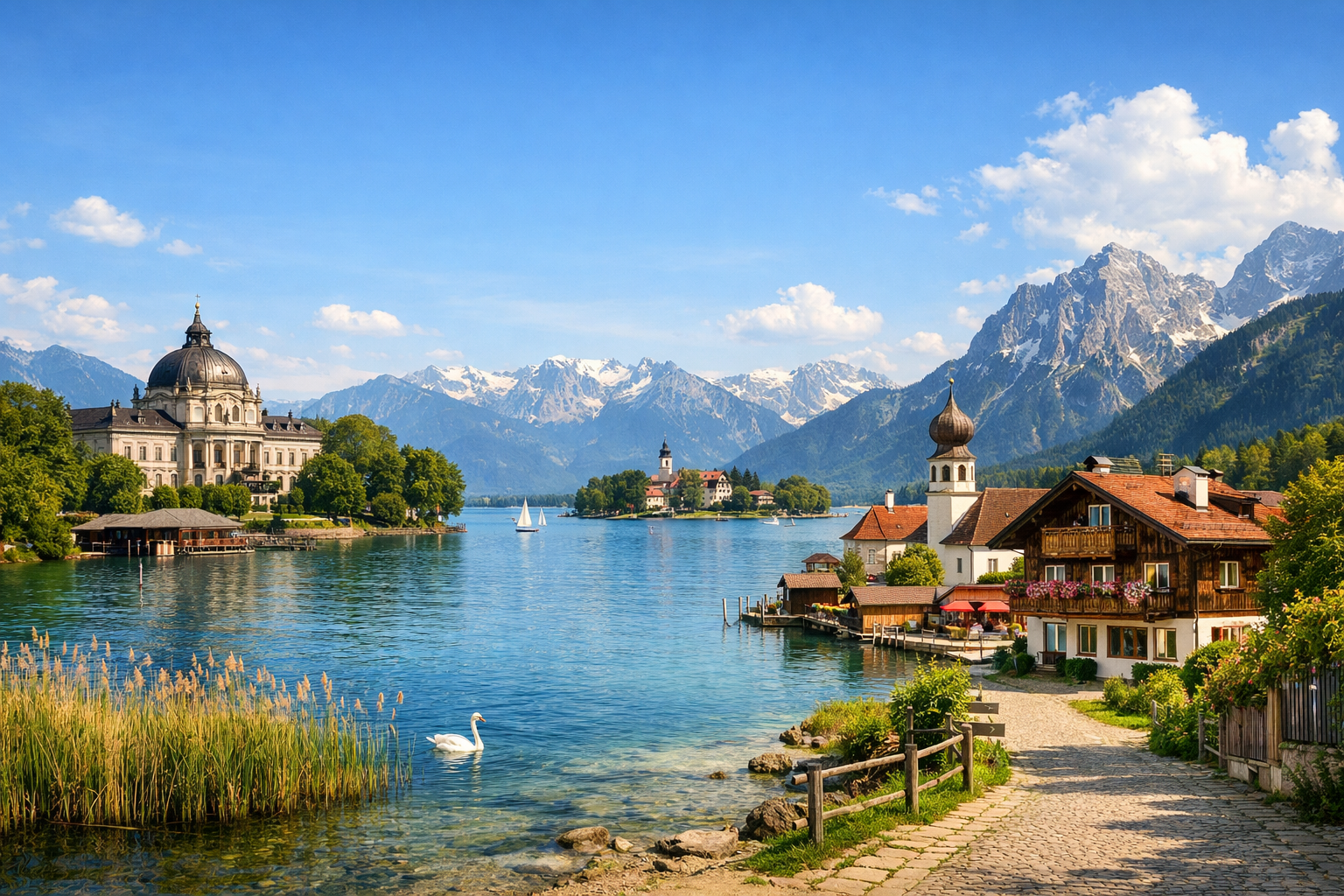
From Munich to the shores of Chiemsee, summer in Bavaria unfolds in sparkling lakes, green meadows, and storybook villages. Follow the route through Bad Aibling, Prien, Bernau, and Seebruck to Kloster Seeon for warm days of swimming, cycling, and relaxed beer garden evenings.

🚲 ROUTE BY DAY

Ready-made country and city routes with daily plans, sights, transport and accommodation. Buy PDF guides for independent travel.

🚲 ROUTE BY DAY


Day 1 — Munich → Bad Aibling: a gentle exit from the city into Bavarian pre-Alpine meadows

  • 🚲 It is best to start in Munich in the morning after adjusting the bike and checking your luggage. A realistic route for the day is about 58–64 km, pure riding time ≈ 4–5 hours, with moderate elevation gain: around 250–350 m. The surface is mostly asphalt and good bike paths, with some quiet rural roads and short sections of compact gravel. The most convenient scenario for an ordinary tourist is to leave the center via urban bike lanes, then head through the south-eastern green corridors and calm suburbs toward the Mangfall valley. Main stops along the way: 1) the green parks of eastern/south-eastern Munich for a smooth start, 2) the Mangfall valley area near Kolbermoor or Rosenheim, 3) the thermal spa town of Bad Aibling as a calm finish. Water and food are easy to restock in Munich, then in the suburbs and towns along the way, and after Rosenheim it is already easy to find bakeries, supermarkets, and cafés. It is best to stay overnight in Bad Aibling: it is a comfortable base before the next transition to Chiemsee, without extra stress and with normal urban infrastructure. Road nuances: in Munich itself, you need to follow the markings strictly and not confuse bike lanes with pedestrian zones; after the city there are occasional crossings with busier roads, but a tourist pace and the choice of local cycling routes make the day safe. In the heat of June–August, it is better not to delay the start, and in rain to be especially careful on the outskirts and around farm machinery. The day is realistic because it provides a long but not overloaded exit from the city on generally flat terrain and leaves energy for the lake part of the tour.


Day 2 — Bad Aibling → Prien am Chiemsee / Bernau: reaching the Bavarian Sea

  • 🚲 Today the route goes to Chiemsee itself and already feels like a classic Bavarian cycling day with open panoramas and the first views of the Alps. Approximate distance 46–55 km, pure riding time ≈ 3.5–4.5 hours, elevation gain about 200–300 m. Surface: asphalt bike paths, quiet secondary roads, and some sections of rural gravel without technical difficulty. It is convenient to plan the day through the Rosenheim region and then along the network of local cycling routes to Prien and Bernau, including sections close to the logic of the Bodensee–Königssee-Radweg. Main stops: 1) Rosenheim or its surroundings for coffee and service, 2) the promenade area of Prien-Stock, 3) an evening ride-out or short walk along the shore in Bernau-Felden. Water is easy to refill in towns and at lake bases; food is best taken for an early lunch in Rosenheim or already at Chiemsee. Overnight is optimal in Prien or Bernau: here there are rentals, piers, bike service, and a convenient start for a loop day around the lake. Road nuances: the closer to Chiemsee, the more tourists there are on the paths, especially in good weather and on weekends; it is better to reduce speed on the promenades. In strong westerly or northerly winds, open sections by the lake ride slower than the profile suggests. The day is realistic because the distance is moderate, the elevation change is small, and the finish by the lake makes it possible to end the stage early and calmly prepare for the most beautiful loop day of the tour.

Day 3 — Chiemsee loop: Prien / Bernau → Gstadt → Seebruck → Prien / Bernau

  • 🚲 This is the most postcard-perfect day of the route: shoreline, reeds, boat harbors, monastery islands, and wide views of the Chiemgau Alps. A realistic format is 52–64 km along the Chiemsee-Radweg, pure riding time ≈ 4–5.5 hours, with little elevation gain: around 120–220 m. The surface is mostly good: separate bike paths, asphalt, promenades, and short sections of compact gravel through natural areas like Kendlmühlfilzen. Main stops: 1) Prien/Stock or Bernau-Felden for an early start along the shore, 2) Gstadt as a convenient point for a break and an optional boat trip to the islands, 3) Seebruck or Chieming for lunch and a swimming stop. If you want to add a highlight, you can make a safe and logical boat insertion with Chiemsee-Schifffahrt to Herreninsel or Fraueninsel, leaving the main loop to the bicycle; in summer the large lake line between Prien, Gstadt, Seebruck, and Chieming operates seasonally, while demand for island trips is higher in good weather. Water and food are easy to get in Prien, Gstadt, Chieming, and Seebruck; there are many places for a short break along the promenades and piers, but in peak season it is better not to rely on just one restaurant. You can stay a second night in Prien or Bernau — that way you do not need to move your things every day. Road nuances: in high season there are many leisure cyclists and families on the shore sections, so it is better to ride without racing; after rain, forest and wetland stretches may be damp, and in hot weather there is little shade on the open banks. This day is realistic for an ordinary cycle tourist because the profile is flat, the distance fits into a classic lake loop ride, and the option to shorten the day by ferry or a shorter loop gives a good energy reserve.

Day 4 — Prien / Bernau → Seebruck → Kloster Seeon: a quiet finish through inland Chiemgau

  • 🚲 The final day leads away from the lively shore into the calmer rural Chiemgau with historic villages, rivers, and a monastery lake. Approximate distance 38–48 km, pure riding time ≈ 3–4 hours, elevation gain 180–280 m. The surface is mixed but comfortable: paved bike paths, secondary roads, and short gravel segments. It makes sense to ride along the eastern or north-eastern arc to Seebruck, and then use a direction close to the Klosterweg-Radtour through Truchtlaching and rural sections to Seeon. Main stops: 1) Seebruck on the Alz river, 2) Truchtlaching for coffee and lunch, 3) Kloster Seeon as a beautiful historic finish to the tour. It is easy to refill water and food in Seebruck and Truchtlaching; there are fewer services between them, so it is better to fill bottles in advance. An overnight stay at Kloster Seeon is especially successful as an atmospheric end to the trip: quiet water, old buildings, and a chance to relax without the bustle of the city. Road nuances: on rural roads there is some local car traffic and machinery, but overall they are calmer than main-road directions; in rainy weather short dirt sections may become softer, and in hot weather open fields heat up faster than the lake shore. The day is realistic because after the loop lake day it is shorter, gentler, and wraps up the tour well without overload — especially for an ordinary tourist or a couple on an e-bike.

Flight tickets

eSIM for travel

Buy PDF guide

Buy PDF guide — 8.57 USD

PDF — 8.57 USD