
Buy PDF guide

Buy PDF guide — 15.00 USD

PDF — 15.00 USD

Germany, Hesse and Rhineland-Palatinate. Cycling tour along the Lahn Cycle Route: from Marburg to Koblenz. Difficulty: easy or moderate. Season: April - September.

Germany, Hesse and Rhineland-Palatinate. Cycling tour along the Lahn Cycle Route: from Marburg to Koblenz. Difficulty: easy or moderate. Season: April - September.

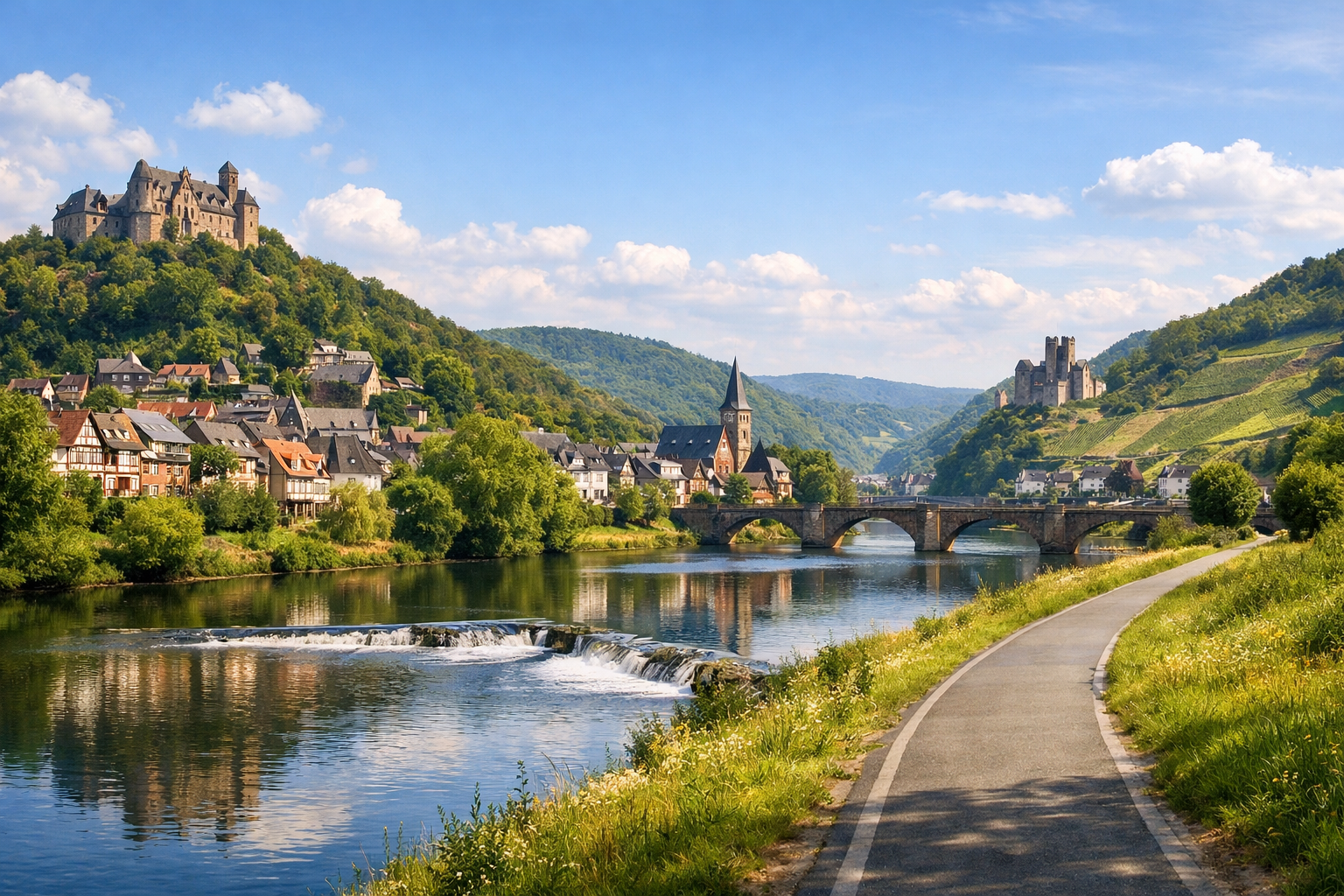
Follow the gentle curves of the Lahn from Marburg to Koblenz, cycling through medieval towns, riverside castles, and rolling green valleys in Hesse and Rhineland-Palatinate. This easy to moderate route is ideal from April to September, with highlights including Wetzlar, Limburg, Bad Ems, and the dramatic confluence of the Lahn and Rhine.

🚲 ROUTE BY DAY

Ready-made country and city routes with daily plans, sights, transport and accommodation. Buy PDF guides for independent travel.

🚲 ROUTE BY DAY


Day 1 — Marburg → Wetzlar: a gentle start along the Lahn

  • 🚲 Start in Marburg, finish in Wetzlar. Approximately 56–60 km, pure riding time about 3.5–4.5 hours, elevation gain usually moderate — around 180–300 m for the day, because the route generally follows the river valley. Surface: mostly paved cycle paths, embankment sections, rural roads, and quiet local roads; in places there are short good-quality gravel stretches. The main stops along the way are convenient around Fronhausen or Lollar for coffee and refilling water, and also in Giessen if you want a longer lunch break. This is a very realistic first day: longer than average, but technically simple, without serious climbs and with frequent settlements along the river. It is best to stay overnight in Wetzlar, where it is easy to combine an evening walk through the historic center with bike maintenance, dinner, and shopping for the next day. Route nuances: on some approaches to Giessen and further to Wetzlar there are more urban sections with street crossings and greater need for navigation attention; it is better to ride during the day, not at dusk. In hot weather it is worth taking 2 bottles in advance, although there are enough services along the way.


Day 2 — Wetzlar → Weilburg: a short beautiful river stage

  • 🚲 Start in Wetzlar, finish in Weilburg. Approximately 30–34 km, pure riding time 2–2.5 hours, elevation gain around 120–220 m. This is one of the calmest and most comfortable days of the tour: the valley becomes quieter, the landscape greener, and the cycle route remains clear and tourist-friendly. Surface — mostly asphalt, some compacted gravel sections, quiet roads along the river, and short waterfront stretches. Along the way it makes sense to stop 1–2 times in Leun or Löhnberg, while saving the main walk for Weilburg itself with its palace and views over the bends of the Lahn. Water and snacks are easy to replenish in almost every village; if you are riding an e-bike, the day is so short that charging is usually not an issue. It is best to stay overnight right in Weilburg near the center, so you can take your time visiting Schloss Weilburg and the famous Schiffstunnel. Route nuances: in places the route runs close to a transport corridor, so it is better to stick to the official Lahnradweg cycle signage and not take shortcuts along major roads. The day is realistic even for a beginner: the distance is short, the profile gentle, and there is plenty of time left for rest.

Day 3 — Weilburg → Limburg an der Lahn: the best balance of nature and towns

  • 🚲 Start in Weilburg, finish in Limburg. Approximately 38–42 km, pure riding time 2.5–3.5 hours, elevation gain around 150–250 m. After Weilburg, the route passes through one of the most pleasant and scenic sections of the Lahn valley: calm river meanders, green slopes, and long flat stretches where you can simply pedal at your own pace. Surface — a good mix of paved cycle paths, rural roads with low traffic, and short sections of hard-packed gravel. Main stops along the way: the Villmar area for scenic pauses, Runkel with its castle and old bridge, and closer to the finish — the historic center of Limburg itself. For water and food, it is convenient to rely on Runkel and the small shops/bakeries in the villages of the valley. The best overnight stay is in or near Limburg’s old center: in the evening you can walk to the cathedral and have dinner without extra transfers. Route nuances: in rain, some river sections can be slippery because of leaves and damp gravel; on weekends in good weather there are more pedestrians and rental bikes on family-friendly sections, so it is worth reducing speed. The day is realistic because it stays in a comfortable mileage range, and the infrastructure along the way is very dense.

Day 4 — Limburg → Balduinstein/Diez → Bad Ems: a long but smooth stage into Rhineland-Palatinate

  • 🚲 Start in Limburg, finish in Bad Ems. Approximately 58–63 km, pure riding time 4–5 hours, elevation gain roughly 220–380 m. This is the longest day of the route, but it is justified: the profile remains river-based, and the scenery between Diez, Balduinstein, Nassau, and Bad Ems is considered one of the most beautiful on the lower Lahn. Surface is mainly asphalt, good cycle paths, promenades, and quiet local roads; sometimes there are short sections of compacted dirt/gravel. Main stops along the way: Diez with Oranienstein Palace from the outside and the old town, Balduinstein as an atmospheric river pause, Nassau or its surroundings — the best moment for a more substantial lunch. Refilling water is easy: settlements come regularly, but between them the route already feels more natural, so you should not ride with just one small bottle. It is best to stay overnight in Bad Ems, where it is easy to combine leg recovery with a spa-town atmosphere and a short evening walk along the promenade. Route nuances: in several places the valley narrows, and a nearby road may be noticeable, so it is better to follow the cycle-route signs strictly and avoid B260; in rain and wind, the day feels longer. For the average cycle tourist, the stage is realistic thanks to the flat profile and the option to stop often.

Day 5 — Bad Ems → Lahnstein: a short day with time for spa relaxation and castles

  • 🚲 Start in Bad Ems, finish in Lahnstein. Approximately 18–22 km, pure riding time 1.5–2 hours, elevation gain around 80–180 m, if you do not head off on scenic climbs. This is an intentionally short day after yesterday’s long transfer: it leaves time for a relaxed morning in Bad Ems, a walk through the spa district, and, if desired, a ride up the Kurwaldbahn without the bike as a separate activity. Surface — calm cycle paths along the river, paved sections, some suburban passages, and promenades. Main stops: the Bad Ems promenade, the section by the wooded Nassau corridor, and at the finish — the Burg Lahneck area or a walk through the historic points of Lahnstein. It is best to take water and food in Bad Ems already or make a short stop along the way, as the day is short. Staying overnight in Lahnstein is convenient logistically: tomorrow there is an impressive final roll-out to the confluence of the Lahn and the Rhine. Route nuances: closer to Lahnstein the transport density of the region increases, so it is better to arrive before dark and be more attentive at urban crossings. The day is very realistic for any level, and the short distance serves as good insurance in case of rain, fatigue, or minor repairs.

Day 6 — Lahnstein → Koblenz via the mouth of the Lahn and the Rhine promenades

  • 🚲 Start in Lahnstein, finish in Koblenz. Approximately 12–18 km depending on the chosen urban loop, pure riding time 1–1.5 hours, minimal elevation gain — around 50–120 m. This is a symbolic and very beautiful final transfer: the mouth of the Lahn, the approach to the Rhine, city promenades, and the chance to finish the tour not just at the station, but at Deutsches Eck, where it truly feels like the end of a great river road. Surface is mostly asphalt, urban cycle paths, and promenades. Main stops: the confluence point of the Lahn and Rhine, the promenade in Oberlahnstein or Niederlahnstein, then the Koblenz Castle area and Deutsches Eck. Water and food are easy to get in the city environment — there are many cafés and shops. It is best to stay overnight in Koblenz near the center or near Hauptbahnhof if a train departure is planned for the next day. Route nuances: this is already an urban section, and here physical fitness matters less than attentiveness to junctions, pedestrians, and one-way streets. For the average traveler, the day is completely realistic: short, flat, and unhurried.

Day 7 — Koblenz: a circular city cycling day or weather reserve

  • 🚲 Start and finish in Koblenz. Approximately 25–35 km as desired, pure riding time 2–3 hours, elevation gain 100–220 m depending on whether you stay only on the promenades or add scenic urban climbs without extreme sections. This day is included as a full seventh day of the route and at the same time as a flexible buffer: it can be used as a calm final cycling day after arrival, as reserve time for heavy rain on one of the previous stages, or as a day of easy urban riding along the Rhine and Moselle. The optimal format is to ride along Koblenz’s promenades, reach bike parking near the main sights, see Deutsches Eck, the palace district, and safely complete the tour without a long transfer. Surface — urban asphalt, promenades, and cycling infrastructure. Main stops: Deutsches Eck, the Elector’s Palace area, and promenades along the Rhine and Moselle. Water, food, and coffee are easy to find every few kilometers along the way. If the bicycle needs to be returned or packed, this day is especially convenient: Koblenz has bike parking at the main station and workshops. Route nuances: there may be many people in the center, so moderate speed, lights in tunnels/under bridges, and good bike locking at stops are important. The day is realistic for everyone because it is not a race, but a gentle end to the tour.

Flight tickets

eSIM for travel

Buy PDF guide

Buy PDF guide — 15.00 USD

PDF — 15.00 USD