
Buy PDF guide

Buy PDF guide — 10.71 USD

PDF — 10.71 USD

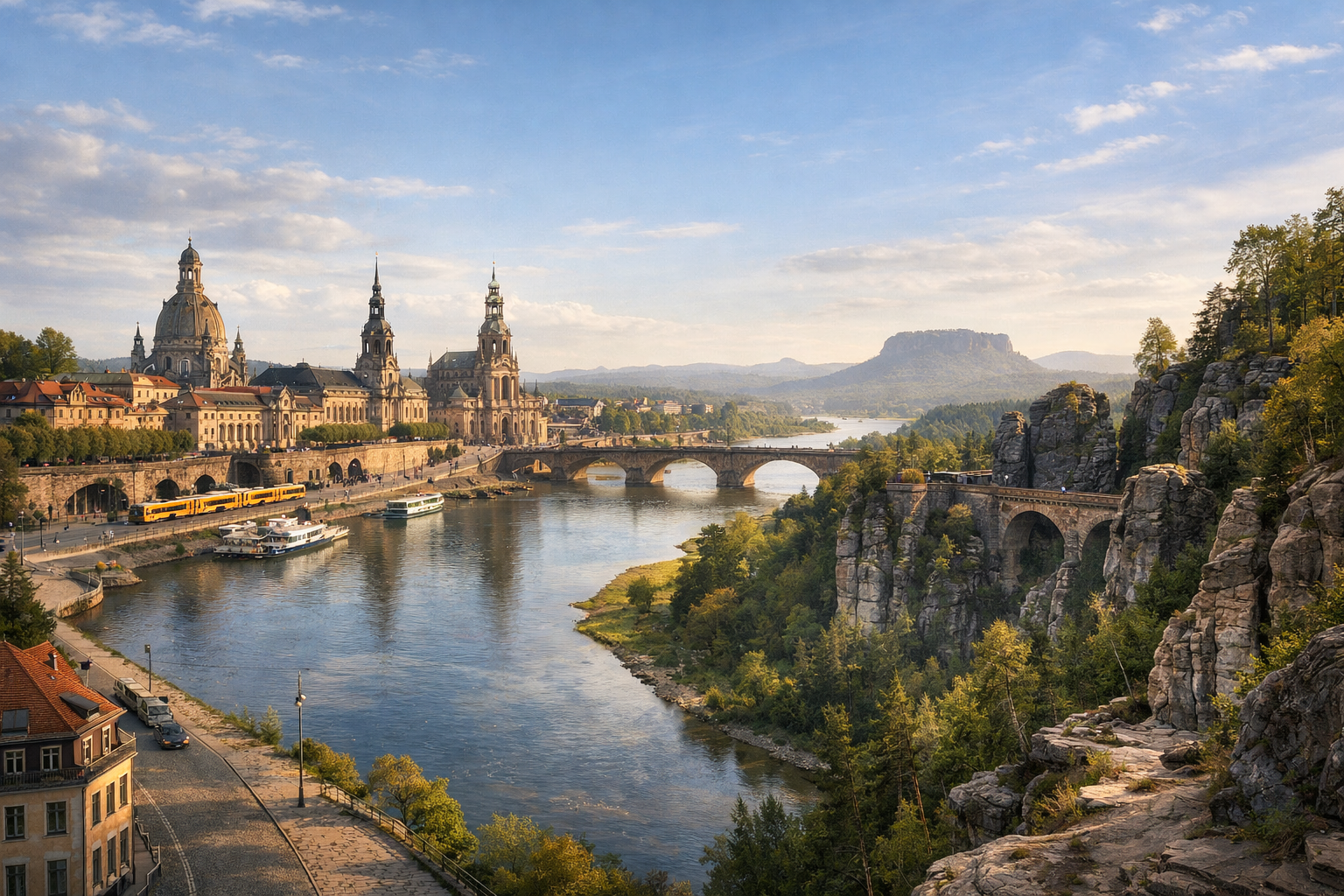
Germany, Dresden and Saxon Switzerland. A budget-friendly combination of a cultural trip and hikes through rock formations using regional transport.

Germany, Dresden and Saxon Switzerland. A budget-friendly combination of a cultural trip and hikes through rock formations using regional transport.

Discover Dresden’s baroque beauty, then hop on regional trains and ferries into Saxon Switzerland for dramatic hikes among sandstone towers, forested gorges, and sweeping Elbe views. It’s an easy, budget-friendly mix of culture and nature, with highlights from the Bastei and Schrammsteine to the mighty Königstein Fortress.

🧭 DAY-BY-DAY ITINERARY

Ready-made country and city routes with daily plans, sights, transport and accommodation. Buy PDF guides for independent travel.

🧭 DAY-BY-DAY ITINERARY


Day 1 — Dresden: historic center, terraces above the Elbe, and an evening in Neustadt

  • 🚶 Start your route with a compact and very budget-friendly introduction to Dresden, where some of the strongest impressions can be had even without expensive tickets. The Old Town is arranged almost like a stage: Baroque architecture, broad squares, domes, towers, and the soft light reflected in the Elbe create the feeling that you have stepped into an open-air museum. Walk through Theaterplatz to the Zwinger, circle its inner courtyards and fountains, then continue to the Residenzschloss and the Catholic cathedral. Even if you do not go inside every museum, the walk through this ensemble already provides a rich cultural impression: this is where you can especially feel how Dresden combines royal grandeur, traces of the destruction of the 20th century, and careful postwar restoration.

  • 🚶 Then head to Brühlsche Terrasse — the famous terrace above the Elbe, often called the “Balcony of Europe.” From here you get some of the best free views of the river, bridges, and the opposite bank. It is a good place to slow down after the journey, sit on a bench, and ease into the rhythm of the trip without extra expenses. After that, step into the courtyard of Frauenkirche and onto Neumarkt: the quarter has been restored so thoroughly that it looks both historic and theatrically ideal. If you want a first museum highlight without overload, it is convenient to choose one paid site nearby, for example the Albertinum, and leave the rest of the time for a city walk.

  • 🚋 Getting around the city: Dresden Airport → center by S2 to Dresden Hauptbahnhof, about 30 minutes; from Hauptbahnhof to Altstadt and back, it is convenient to use DVB trams or walk 10–20 minutes between key points.

  • 🍽️ For a budget day, it makes sense to have breakfast near the station or in a bakery chain in backerei format, and in the evening go or walk to the Äußere Neustadt district, where there are more inexpensive eateries, döner places, vegetarian cafés, and simple Asian spots than in the ceremonial center. For food without alcohol, expect roughly 18–35 € per day per person if you rely on bakeries, supermarkets, street food, and inexpensive lunches.

  • 💤 It is best to spend the night in Dresden near Hauptbahnhof or in Neustadt: this minimizes transfer costs, makes early departures to Saxon Switzerland easier, and makes the whole 5-day route more realistic.


Day 2 — Saxon Switzerland: Bastei and Rathen as the most accessible first hiking day

  • 🚆 This is the best day for an easy introduction to the Elbe Sandstone Mountains without overload and without expensive logistics. From Dresden, it is convenient to take an S-Bahn regional train toward Kurort Rathen: the trip usually takes about 35–45 minutes depending on the departure. The journey itself along the Elbe is already part of the experience — the river valley gradually narrows, the cliffs become higher, and the city rhythm stays behind. From Rathen station, the route usually continues on foot and with a crossing over the Elbe by local ferry, after which the ascent to Bastei begins. This is one of the region’s most famous views, but it truly deserves its popularity: Bastei Bridge seems to hang between rock towers, and the viewpoints open up a wide panorama over the Elbe valley, forests, and sharp sandstone massifs.

  • 🥾 For a budget traveler, Bastei is great because the main value of the day is nature itself, not expensive entrance tickets. The trail here does not require special gear in dry weather, but comfortable non-slip sneakers or hiking shoes are essential. Do not try to cut costs by wearing poor footwear: on wet sandstone and steps, this is exactly the kind of situation where saving money is inappropriate. After the main viewpoints, you can descend back to Rathen and walk some of the calmer trails at the foot of the cliffs so that the day does not turn into just a “checkmark at the bridge,” but gives you a real sense of contact with the landscape.

  • 🚆 Transfer: Dresden Hauptbahnhof / Dresden-Neustadt → Kurort Rathen by VVO S-Bahn, about 35–45 minutes one way. From the station to the ferry is a short walk, then a hiking route to Bastei. For the whole day, including ascents, stops, photos, rest, and the return trip, it is reasonable to allow 7–9 hours.

  • 🍽️ The cheapest and most practical option is to buy food in advance at a supermarket near the station in Dresden: water, sandwiches, fruit, nuts. In Rathen and near Bastei, food is usually noticeably more expensive than in the city. With this approach, the day’s food budget can be kept roughly in the 12–25 € range.

  • ⚠️ Before setting out, be sure to check the rain forecast, official trail warnings, and current route conditions. Temporary closures are possible in the region due to forestry work, weather damage, fire danger, or trail damage. No trail in the rocky area can be considered completely safe, especially after rain and in strong winds.

Day 3 — Bad Schandau and Schrammsteine: the most spectacular hiking day

  • 🚆 Today the route becomes more “mountainous,” but it is still reachable without a car. From Dresden, it is convenient to take the S-Bahn line to Bad Schandau in about 45–60 minutes. From there, you can use local transport to the starting points, including the historic Kirnitzschtalbahn if it fits the day’s schedule, or a local bus. The Schrammsteine area is often called the heart of Saxon Switzerland, and you feel it immediately: here the landscape is no longer just for strolling, but dramatic — jagged ridges, narrow passages, ladders, rock steps, and views where the river and forest remain somewhere far below.

  • 🥾 The route to Schrammsteinaussicht and along the ridge sections is one of the most beautiful, but also one of those days when you need to assess your fitness honestly. The ascents here are steeper than at Bastei, and in places the trail requires confident hiking movement, attention, and no strong fear of heights. In good weather, the reward is enormous: from the viewpoints, an almost cinematic panorama opens up — waves of forest, individual sandstone towers cut by light, and the feeling that you are walking on a stone ship above the whole valley. If your energy allows, this day usually becomes the emotional peak of the entire trip.

  • 🚋 Local logistics: Dresden → Bad Schandau by S-Bahn about 45–60 minutes. Then you can reach the start of the trail by a combination of walking, bus, or Kirnitzschtalbahn depending on the chosen loop and the schedule. The hike itself, with breaks and a safe pace, is best planned for 5–7 hours of net time plus travel there and back.

  • 🍽️ On this day, it is especially important to take a supply of water and a simple hiking snack from Dresden or Bad Schandau. A lack of water in warm weather is felt here faster than it seems down in the city. A rough guide for food and minor expenses is about 12–28 € per person if you bring the essentials with you.

  • ⚠️ If the forecast promises rain, thunderstorms, strong wind, or heat, it is better to replace the long ridge route with a shorter walk in the lower parts of the valley or return to Dresden’s museums. Rock ladders, metal elements, and wet sandstone become significantly more risky. Before the trip, check the official page for current trail warnings and closures.

Day 4 — Königstein and the fortress above the Elbe: history, views, and a gentler pace

  • 🚆 After the most active hiking day, it is good to make the route a little softer without losing natural and cultural richness. A trip to Königstein offers exactly that balance. From Dresden, it is convenient to travel here by regional transport through the Elbe valley; then from the station you can climb to the fortress on foot, by bus, or combine both options depending on how you feel. Festung Königstein is one of the largest hilltop fortresses in Europe, a huge rock platform with bastions, inner courtyards, exhibitions, and magnificent viewpoints. What is especially pleasant here is that the museum and landscape experience are combined: you are not just looking at walls, you literally spend half a day on a stone summit above the valley.

  • 🏰 Even for a traveler on a budget, this is a worthwhile paid site because it gives the day a lot of substance: Saxon history, fortifications, powerful views, and enough space for an unhurried rhythm. The panoramic path around the fortress perimeter, the deep well, old casemates, and extensive grounds make the visit informal, not “only about display cases.” If the weather is clear, from here you can clearly see the bends of the Elbe and the rocky massifs you walked through on previous days, and the route begins to come together into a complete geographical picture.

  • 🚆 Transfer: Dresden → Königstein about 40–55 minutes by VVO regional transport, then a local ascent to the fortress. For the fortress itself, it is reasonable to allow at least 3–4 hours, and for the whole day 6–8 hours with travel, rest, and lunch.

  • 🍽️ If you want to keep the budget under control, you can combine one inexpensive snack brought with you and one hot meal after returning to Dresden. In the tourist area by the fortress, prices are usually higher than in the city. For food, expect about 15–30 €.

  • 🎫 Entry to the fortress is one of the few major paid tickets on this route, so overall the tour remains budget-friendly precisely because the other days are built around public transport, walks, viewpoints, and hiking trails. Before your visit, check the current opening hours: in the warm season, the fortress is usually open longer, and the last entry is one hour before closing.

Day 5 — Dresden: museum finale, the Great Garden, and a calm end to the trip

  • 🚶 It is best to leave the last day for Dresden without long excursions: this reduces the risk of delays before departure, gives your body time to recover after the trails, and allows you to end the tour culturally rather than only athletically. Choose one or two museums according to your interests and do not try to squeeze in too much. For this route, Deutsches Hygiene-Museum is especially suitable if you want a modern, accessible, and unconventional exhibition about the human being, or the Albertinum if you are drawn to 19th–21st century art. If the weather is good, after the museum it makes sense to walk through Großer Garten — a large city park that works as a calm green pause after intense days among the cliffs.

  • 🎨 This finale matters precisely as a contrast. Saxon Switzerland gives you verticality, stone, and wind, while Dresden on the last day brings back the scale of the city, museum context, and a sense of completion. You can go back to the Elbe again, sit quietly on the embankment, walk across Augustusbrücke, or take a final stroll through Neustadt for coffee and an inexpensive lunch. This rhythm is especially good for a budget tour: instead of one more expensive attraction, you get space for choice, rest, and a gentle departure.

  • 🚋 Getting around within the city: DVB trams and buses or on foot. From Altstadt to Deutsches Hygiene-Museum and Großer Garten, it is convenient to go by tram or walk part of the way. Panometer Dresden is easier to reach by tram/bus.

  • 💶 A rough guide to the total budget for the whole 5-day route with early booking and accommodation in an inexpensive hotel/hostel: lodging about 45–110 € per night per person depending on room type; food about 18–35 € per day; for local and regional transport, it is usually more economical to buy VVO day tickets or use the Deutschlandticket if you have many regional trips around Germany during your journey. The final budget without flights and without expensive restaurants can usually be kept in a moderately budget-friendly range.

  • ⚠️ Information on safety, weather, road conditions, schedules, and route accessibility may change. Before the trip, be sure to check official warnings, the weather forecast, transport schedules, and possible restrictions on the trails. No destination can be considered completely safe.

Flight tickets

eSIM for travel

Buy PDF guide

Buy PDF guide — 10.71 USD

PDF — 10.71 USD