
Buy PDF guide

Buy PDF guide — 10.71 USD

PDF — 10.71 USD

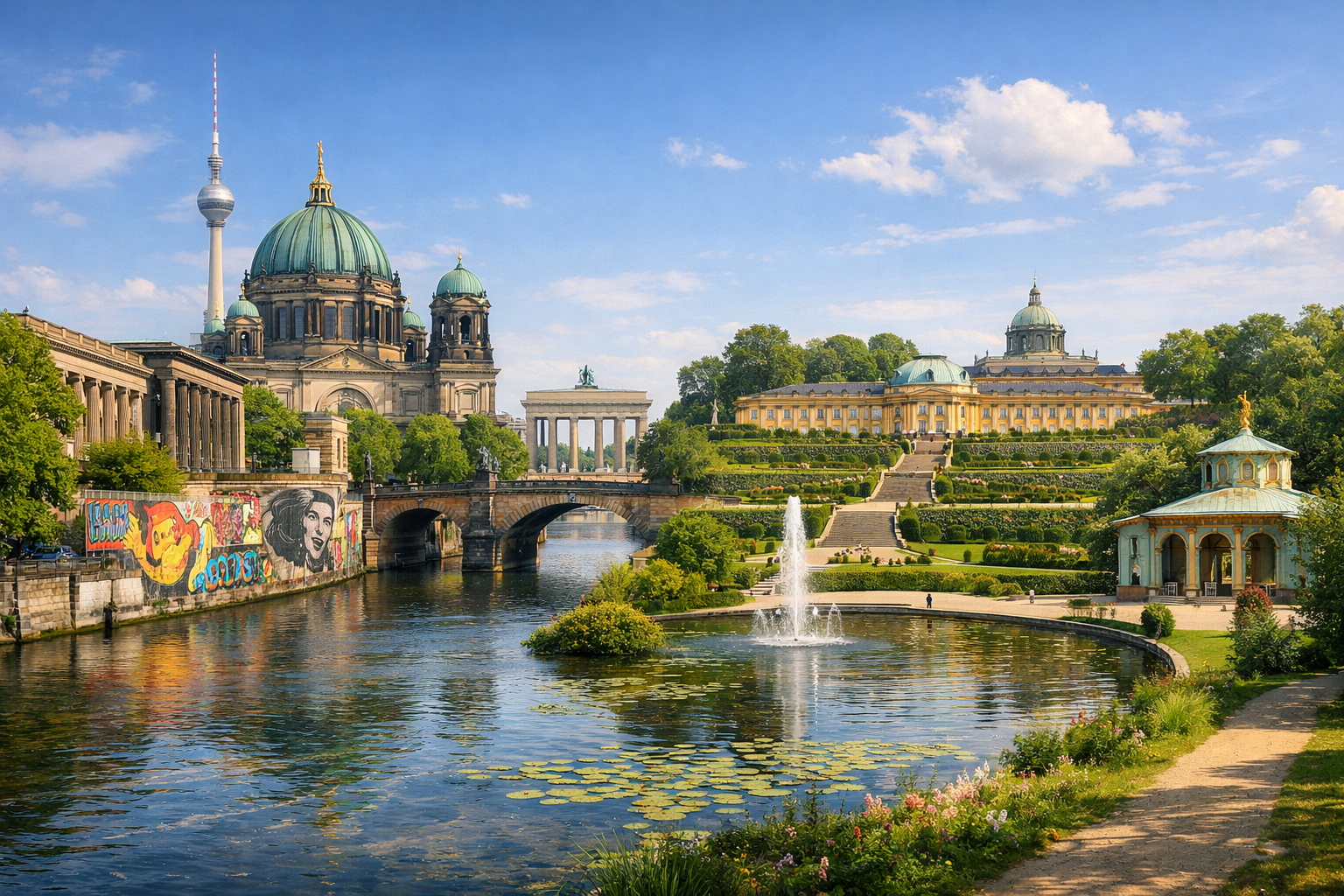
Germany, Berlin and Potsdam. A budget-friendly introduction to museums, historic districts, street art, parks, and palaces

Germany, Berlin and Potsdam. A budget-friendly introduction to museums, historic districts, street art, parks, and palaces

Discover Germany through Berlin and Potsdam, where grand history meets bold creativity without stretching your budget. In five days, wander museum halls, historic neighborhoods, street art corners, leafy parks, and elegant palaces for an easy, affordable first taste of the country.

🧭 DAY-BY-DAY ROUTE

Ready-made country and city routes with daily plans, sights, transport and accommodation. Buy PDF guides for independent travel.

🧭 DAY-BY-DAY ROUTE


Day 1 — Berlin: the historic center and Museum Island with a budget-friendly logic

  • 🚶 Start getting to know Berlin in the area of Alexanderplatz → Berliner Dom → Museum Island → Unter den Linden. This is one of the most convenient routes for a first day: most of the walk is on foot, which means you save on extra rides and immediately get a feel for the scale of the city. In the morning, Alexanderplatz greets you with the stern modern energy of former East Berlin, and just a few minutes later the city changes tone: broad avenues, 19th-century facades, the dome of Berlin Cathedral, and an island where, literally within a few blocks, a huge part of Germany’s cultural memory is concentrated. If you want to save money, it makes sense on the first day to choose one paid museum and devote the rest of the time to walking along the Spree embankments, the courtyards of Nikolaiviertel, and the viewpoints around the island.
  • 🏛️ If you are interested in archaeology and ancient civilizations, visit the Neues Museum on Museum Island: it is one of Berlin’s strongest museums in both atmosphere and content, where the history of the ancient world feels not like a dry display case but like a slow journey through layers of time. If you want a more emotional and accessible context about everyday life in the 20th century, an alternative could be the DDR Museum, located right nearby by the water. It is especially good for a first trip because it shows not only politics, but also everyday life, apartments, design, transport, and the habits of people in the GDR. For a budget trip, do not try to cover everything at once: one museum per day + a long walk will give you more impressions and less fatigue.
  • 🍽️ To save money, it is convenient to have lunch not at tourist restaurants near the cathedral, but in the format of a bakery, döner, currywurst, REWE/EDEKA supermarket, food court at the station. Budget guide: quick breakfast €4–8, street food or a simple lunch €7–12, dinner without alcohol €10–16. In central Berlin, this is one of the most realistic ways to stay within budget without sacrificing safety and convenience.
  • 🚆 Transport for the day: if you plan 2–4 rides and a long walk, single ticket AB or 24-hour ticket AB is usually the best value. If you are flying into BER that same day or already know you will go to Potsdam, it makes more sense to look at ABC. Paper tickets bought from a machine need to be validated before the first ride; digital tickets in apps usually become valid immediately.


Day 2 — Berlin: the Reichstag, Brandenburg Gate, Tiergarten and the memory of the 20th century

  • 🚶 The second day is best built around the axis Berlin Hbf → Regierungsviertel → Reichstag → Brandenburger Tor → Memorials → Tiergarten → Potsdamer Platz → Topographie des Terrors. This is a very strong day in terms of historical content and at the same time one of the most budget-friendly, because the key points of the route are either free or only require advance planning. The morning light falls beautifully on the government quarter, where glass and stone look especially expressive, and then the route gradually leads you from the official modern capital into spaces of memory, where Berlin speaks in a completely different voice — quiet, complex, and often painful.
  • 🌳 Tiergarten in this route is needed not only as a park, but also as a breather. After intense historical sites, it is very helpful to walk along the alleys, sit by the water, or simply pause for a takeaway coffee. It helps you avoid emotional overload. On a budget trip, this rhythm is especially valuable: you do not spend money on chaotic movements and spontaneous expensive stops, but move logically and calmly.
  • 🏛️ Topographie des Terrors is one of the most important places on the route and at the same time one of the best free ones. Here, on the grounds of the former Gestapo, SS, and Nazi terror apparatus structures, history is presented in a very concentrated and honest way. This is not an “entertainment” museum, but a serious documentation space that is worth visiting without rushing. It is convenient to come here closer to the second half of the day, when the main tourist crowds have already spread out across the center. A preserved section of the Wall is nearby, so the site shows especially well how different eras of violence, division, and recovery overlap in Berlin.
  • 🍽️ Budget format for the day: breakfast at the hotel or near the station, then lunch around Potsdamer Platz or near Mall of Berlin in an inexpensive format, and in the evening — simple food near Hauptbahnhof or in the Friedrichstraße area. Food cost guide: €20–35 per person for the day with sensible choices.

  • 🚆 Transport for the day: this day is convenient to do almost entirely on foot with 1–2 rides on the U-Bahn/S-Bahn/bus. If you like walking, you can save money and keep rides to a minimum. If the weather is rainy or hot, it is more convenient to take a 24-hour ticket AB.

Day 3 — Berlin: street art, Kreuzberg, Friedrichshain and traces of the Wall

  • 🎨 This day is devoted to the Berlin that independent travelers on a limited budget especially love: Urban Nation → Schöneberg/Kreuzberg → East Side Gallery → Oberbaumbrücke → Friedrichshain. Start with the URBAN NATION Museum for Urban Contemporary Art, where street art is moved from the backstreets into a museum context without losing its boldness, social energy, and urban character. It is a good way to see Berlin not only as a capital of empires, wars, and political regimes, but also as a living, multilayered, sometimes rough, but very creative city.
  • 🚶 After the museum, it is especially pleasant to walk through the neighboring streets, looking at facades, tags, murals, independent cafés, and the contrast between ceremonial and everyday Berlin. Then head to the East Side Gallery — the most famous open-air section of the Berlin Wall. Here, history turns into a long visual dialogue: political trauma, the hopes of the 1990s, tourist bustle, photogenic appeal, and the very uneven quality of the surrounding urban environment. It is better to come not at the midday peak, but either in the morning or closer to evening, when it is easier to calmly look at the works rather than just make your way around crowds.
  • 🌉 The walk to Oberbaumbrücke and further along the Spree gives one of the most expressive urban views of the whole trip. The red-brick bridge, the water, former industrial spaces, and traces of the divided city create that very “Berlin nerve” that many travelers come here for. If you still have energy, you can simply wander around Friedrichshain without a strict list: on budget trips, such hours often become the most memorable.
  • 🍽️ This is the best day for inexpensive street food: döner, falafel, Vietnamese noodles, bakeries, pizza by the slice, Asian snack bars. A realistic food budget is €18–30 for the day. The neighborhoods on this route let you eat more cheaply than near the main postcard landmarks.

  • 🚆 Transport for the day: you will need several moves between neighborhoods, so it is usually most convenient to take a 24-hour ticket AB. If you are already using a multi-day tourist pass, there is no need to buy additional single rides. Keep an eye on your personal belongings in carriages and on platforms, especially in crowded tourist areas and late in the evening.

Day 4 — Potsdam: Sanssouci Park, palaces and a calm historical rhythm

  • 🚆 In the morning, head to Potsdam — this is the best day trip from Berlin for those who want to see a world-class palace-and-park ensemble without expensive intercity logistics. From Berlin to Potsdam, people usually travel by trains and regional VBB transport; for such a trip you need the ABC fare, because Potsdam is in zone C of the Berlin transport region. Travel time from central Berlin districts to Potsdam Hbf or Potsdam Park Sanssouci usually takes about 35–50 minutes depending on your starting point and transfers.
  • 🌿 The main value of this day for a budget route is Park Sanssouci. Even if you do not buy admission to all the palaces, the park itself already gives the feeling of a grand royal stage set: vineyard terraces, straight alleys, pavilions, statues, hills, vistas, and a very delicate balance between architecture and landscape. It is easy to spend half a day here with almost no expenses, simply moving from one composition to another. The park is well suited to a slow pace: alternate walking, resting on benches, drinking water, and short visual stops.
  • 🏰 If you want to choose one paid palace site, for a first visit it makes sense to look either at Sanssouci Palace or Neues Palais. The first is more intimate, elegant, and almost theatrical; the second is more monumental and representative. But on a strict budget trip, you may choose not to overload the day with interiors at all, and limit yourself to exterior views, the park, the historic mill, the terraces, and the road to the New Palace. This approach honestly saves money and preserves your energy.
  • 🏙️ After the park, you can ride or walk to Alter Markt and the old center of Potsdam, where the atmosphere is completely different — smaller, lighter, and more measured than in Berlin. If your budget and interest in art allow, Museum Barberini would be a good addition. But if you have already visited a museum in Berlin and want to keep costs down, you can leave Barberini as an optional choice.
  • 🍽️ In Potsdam, it is cost-effective to bring a snack from a Berlin supermarket or buy simple food near the station and in the center. Guide: €15–28 for food for the day with moderate spending. Be sure to bring water, because a walk through the park can easily stretch into many hours.

Day 5 — Berlin: an alternative finale with a choice between a museum, a park, and a district of memory

  • 🚶 It is best to keep the final day flexible and not overload it with a race to tick off “must-sees.” The optimal budget logic is to choose the combination Jüdisches Museum Berlin → Kreuzberg/Landwehrkanal or a lighter option Charlottenburg/Tiergarten/free time in your favorite district. If a deep, meaningful museum matters more to you, the Jüdisches Museum Berlin will be a powerful ending to the trip: its architecture and exhibition dramaturgy work not only as a story about the Jewish history of Germany, but also as an experience of personally confronting memory, absence, and rupture.
  • 🌆 If, after four intense days, you want a freer rhythm, spend the morning at a market, in a park, or in a favorite neighborhood you want to return to without rushing. Berlin opens up especially well precisely this way — not only through the “main sights,” but also through ordinary streets, courtyards, canals, bookstores, kiosks, bakeries, and long walking routes without a mandatory goal. For a budget tour, this is also the most sensible way to end the trip: fewer tickets, less fatigue, more of your own impression of the city.

  • 🛍️ It is convenient to leave the last hours for inexpensive shopping in a supermarket, bakery, or station shop before departure. If you are flying out of BER, allow extra time for the trip and use an ABC ticket. To and from the airport, tickets can be bought from machines at the station and in the terminal, as well as in the VBB, BVG, or S-Bahn apps. Paper tickets from a machine must be validated before the trip begins.
  • ⚠️ An important reminder for the whole trip: information about safety, weather, road conditions, the operation of parks, museums, and transport may change. Before departure, be sure to check official warnings, the weather forecast, transport schedules, possible line maintenance, and access restrictions. No destination can be considered completely safe. For evening walks, choose well-lit routes, keep an eye on your belongings at stations, and do not leave your phone and documents unattended in cafés or on transport.

Flight tickets

eSIM for travel

Buy PDF guide

Buy PDF guide — 10.71 USD

PDF — 10.71 USD