
Buy PDF guide

Buy PDF guide — 25.71 USD

PDF — 25.71 USD

Gelnhausen

Gelnhausen

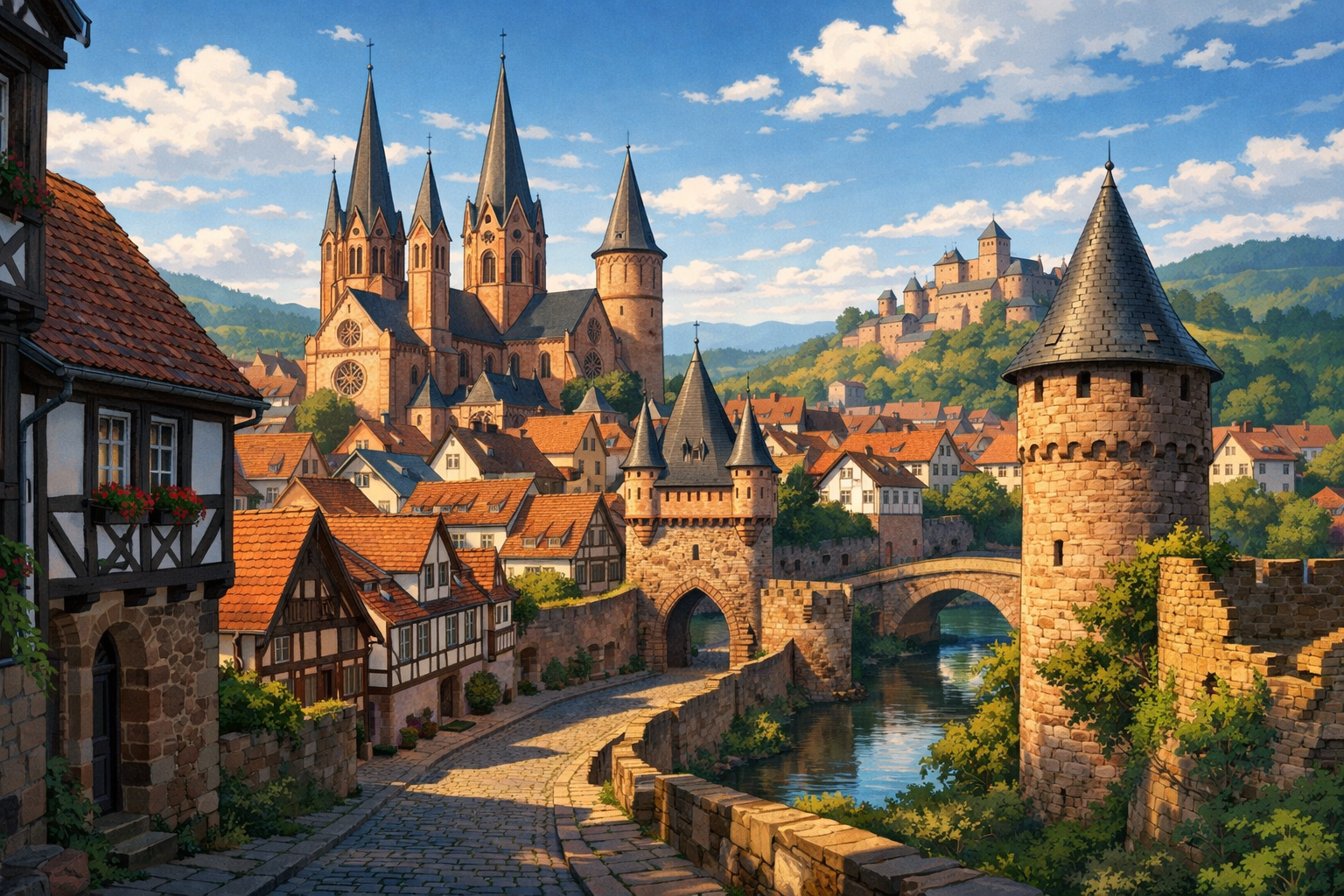
Germany blends storybook old towns with rolling green landscapes, all within easy reach of Frankfurt. From the medieval charm of Gelnhausen to the peaceful beauty of the Kinzig Valley, this journey offers a relaxed glimpse of historic heartlands and scenic countryside.

🧭 DAY-BY-DAY ITINERARY

Ready-made country and city routes with daily plans, sights, transport and accommodation. Buy PDF guides for independent travel.

🧭 DAY-BY-DAY ITINERARY


Day 1 — Arrival in Frankfurt and transfer to Gelnhausen: a gentle introduction to historic Germany

  • ✈️ After arriving at Frankfurt Airport, allow about 45–90 minutes to leave the terminal, collect your luggage, and get oriented. The most convenient option is usually the train: first from the airport station to Frankfurt (Main) Hbf, then a regional train toward Gelnhausen. In total, the journey usually takes about 1 h 10 m – 1 h 30 m, not including transfer waiting time.

  • 🚶 Upon arrival in Gelnhausen, do not overload your first day. Check into your hotel and head out for a relaxed walk through the old town. Here, the number of sights matters less than the first impression: cobbled streets, half-timbered facades, varied relief, the gentle river landscape of the Kinzig, and the sense of a town that still reads as a medieval node on an old trade route. In the evening, walk through the Upper and Lower Market squares, observe the structure of the quarters, and tune into the rhythm not of a metropolis but of a historic “imperial province,” where architecture reveals itself gradually.


Day 2 — Kaiserpfalz Gelnhausen: Barbarossa’s imperial residence

  • 🚶 Dedicate the morning and first half of the day to the city’s main monument — Kaiserpfalz Gelnhausen. These are not just picturesque ruins, but one of the best-preserved imperial palaces in Germany. Its location is especially valuable: the complex stands on a former island in the Kinzig, and the very topography immediately explains why the site was chosen for a representative residence on an important trade road. Look not only at individual masonry fragments, but also at the overall logic of the ensemble: the division into the core and outer bailey, the massive walls, the Romanesque clarity of the volumes, and the rare combination of military practicality with courtly representational character.

  • 🚶 After your visit, pause for lunch and then return to the complex once more closer to evening. On the second pass, the ruins are perceived differently: the light falls more softly, the reddish stone reads more sharply, and the arches and window openings begin to work like almost theatrical frames. This is a day to live slowly — the palace does not demand haste; it reveals itself through scale, silence, and imagination.

Day 3 — Marienkirche: the transition from Romanesque to Gothic

  • 🚶 Today the focus is on Marienkirche — the town’s main church and one of the architectural high points of Gelnhausen. The church is especially interesting because it embodies a transitional moment between Romanesque and Gothic. View it as a textbook on the evolution of forms: the massiveness and concentration of the earlier parts gradually turn into a more upward-reaching plasticity, while the interior space becomes more complex and expressive. Pay special attention to the western section, the overall silhouette, and the artistic richness of the interior, including the famous sandstone rood screen with the theme of the Last Judgment.

  • 🚶 After the main visit, walk around the church from the outside and choose several viewpoints for a more distant perception. In Gelnhausen, it is very important to see the church not in isolation but as the vertical dominant of the entire medieval fabric. From different streets it appears differently: somewhere solemnly, somewhere almost unexpectedly, like a stone landmark organizing the whole town.

Day 4 — Gelnhausen Town Museum: historical context and “layers of time”

  • 🚶 Dedicate the morning to Museum Gelnhausen on Obermarkt. This is a good day for “assembling the context” after two major monuments. The exhibition lets you see the town’s history as a succession of eras — from the High Middle Ages and the figure of Barbarossa to the early modern period, Grimmelshausen, and later history associated with Philipp Reis. Such a visit is especially useful in the middle of the route: after it, the town stops being just a beautiful backdrop and begins to be perceived as a place of continuous, layered biography.

  • 🚶 After the museum, stroll through Obermarkt and the surrounding streets, linking the stories seen in the exhibition with the actual urban environment. This can be made into a lighter day: leave time for a coffee break, a short rest at the hotel, and an evening walk without a strict checklist. A historical trip benefits from having space to “digest” the material.

Day 5 — The Romanesque House, old passages, and the medieval street scene

  • 🚶 Today, focus on the urban fabric. Walk to the Romanisches Haus — one of Gelnhausen’s most important secular medieval buildings. Its value lies precisely in showing not the churchly or palatial, but the administrative and urban side of the Staufen era. At such a site, it becomes especially clear what the “working” architecture of power looked like in the 12th century: dense, heavy, functional, yet still representative.

  • 🚶 Then continue your route through the historic streets: look for narrow passages, stretches of the old trade axis, places where space narrows and widens, shaping movement to the human scale. In Gelnhausen, there is no need to hunt only for “icons” — the old town itself is an architectural text. Half-timbering, stone ground floors, the uneven rhythm of facades, small squares, and gates offer a rare chance to feel how a trading imperial commune once lived.

Day 6 — St. Peter’s Church, the former synagogue, and a conversation about the town’s memory

  • 🚶 The sixth day is best devoted not only to form, but also to memory. Start with Peterskirche — another important sacred site in the center of Gelnhausen. It helps to understand that the town’s religious architecture is not limited to a single dominant landmark. What is interesting here is the dialogue between the old building substance and later artistic interventions: the church reads as a building that did not freeze in the Middle Ages, but passed through a long history of changes.

  • 🚶 After that, include the former synagogue and other points connected with historical memory in your walk. A day like this gives the route more depth: Gelnhausen opens up not only as a “beautiful old town,” but as a place where behind the stone stands human history — urban, religious, cultural, and tragic. Plan a calm pace, with stops and time to read plaques and reflect on what you see.

Day 7 — Panorama day: urban relief, the Kinzig, and views of Gelnhausen’s silhouette

  • 🚶 After several busy days, arrange a route in which architecture is read through distance. Walk to viewpoints of the town from outside the historic core, from the side of the river and open approaches. This is exactly how Gelnhausen’s silhouette is best perceived: Marienkirche rises above the quarters, while the palace lies slightly apart, like a memory of power that both belongs to the town and is separated from it.

  • 🚶 This day should not be empty — on the contrary, it is compositionally very important. When you see the historic center as a whole, it becomes clearer how the church, markets, administrative buildings, bridges, and water space are connected to one another. Add a long lunch and a rest in the middle of the day: after that, you can return to your favorite panorama at sunset.

Day 8 — Historical walks along the QR route: the town as an open-air museum

  • 🚶 Gelnhausen has a digital historical route through the old town, and this day is conveniently built around it. This format works well because it combines independent walking with structured storytelling. You move step by step from Marienkirche through old streets to notable houses, gates, and public sites, and the town opens up as a coherent narrative rather than a set of separate objects.

  • 🚶 In practical terms, this is one of the most comfortable days: the distances are short, the rhythm is flexible, you can take breaks, return to places you liked, and revisit familiar quarters. Use the day as a chance to look once again closely at the details — door surrounds, stone carving, half-timbered joints, changes in elevation, arched passages. It is exactly such “small elements” that make old Gelnhausen rare and alive.

Day 9 — An unhurried outing into the surroundings: Meerholz and the calmer periphery

  • 🚌 If you wish, head out to a quieter part of the municipal area, for example toward Meerholz. Local bus connections and taxis make it possible to do such a short outing without overloading the route. Travel within the district usually takes from 10 to 20 minutes depending on the starting point and timetable.

  • 🚶 This day is meant to show the contrast between the dense medieval core and the calmer, almost suburban environment around it. Such a comparison is useful: it highlights just how concentrated a historic center Gelnhausen has. If you do not feel like going far, you can simply shorten the day to slow rest, a late breakfast, and one evening walk.

Day 10 — Returning to Kaiserpfalz and favorite sites: a day of rereading

  • 🚶 A good historical route almost always benefits from a repeat visit. Go back to what impressed you most: most often this is Kaiserpfalz, Marienkirche, or the Romanesque urban layer around the market squares. A second visit works differently from the first: you are no longer spending attention on orientation and can look more deeply — at proportions, traces of destruction, masonry technique, the scale of the windows, and how space directs human movement.

  • 🚶 In the second half of the day, leave time to rest. You can have a long lunch, buy books or postcards, take photographs without rushing, and simply spend time in the old town. This day is needed so that the tour does not turn into a tiring list, but remains a lived experience.

Day 11 — Free historical day: details, shopping, local cuisine, evening light

  • 🚶 The penultimate day is best kept free, but thematically consistent. Dedicate it to what there is usually not enough time for: quiet courtyards, another museum visit, a calm look at a church interior, watching the evening light on the streets. In a small historic town, a “low pace” is especially important — when you are not so much looking as settling into the place.

  • 🚶 In the evening, choose a route from the old market to Marienkirche or to the palace area. At this hour, stone and wood begin to sound especially expressive: the reddish tones of the masonry, the dark beams of the half-timbering, the soft shadows of the arches, and the almost theatrical silence create a sense of the journey’s completion.

Day 12 — Departure: Gelnhausen → Frankfurt Airport

  • 🚆 On the day of departure, allow at least 1 h 20 m – 1 h 40 m for the trip to the airport, with extra margin for the transfer, and for an international flight it is better to have additional reserve time. Usually, the route goes via Frankfurt (Main) Hbf or another transfer point in the regional network, after which the train arrives at Frankfurt’s airport stations.

  • 🚶 If your departure is not early, leave yourself one last morning for a short walk through the old town. Gelnhausen is especially good at such hours — still without bustle, when the medieval center feels almost like a private space. This is a worthy conclusion to the route: not a “checkmark,” but a calm farewell to one of Hesse’s most expressive small historic towns.

Flight tickets

eSIM for travel

Buy PDF guide

Buy PDF guide — 25.71 USD

PDF — 25.71 USD