
Buy PDF guide

Buy PDF guide — 4.28 USD

PDF — 4.28 USD

HAMBURG - St. Pauli nightlife and the Reeperbahn

HAMBURG - St. Pauli nightlife and the Reeperbahn

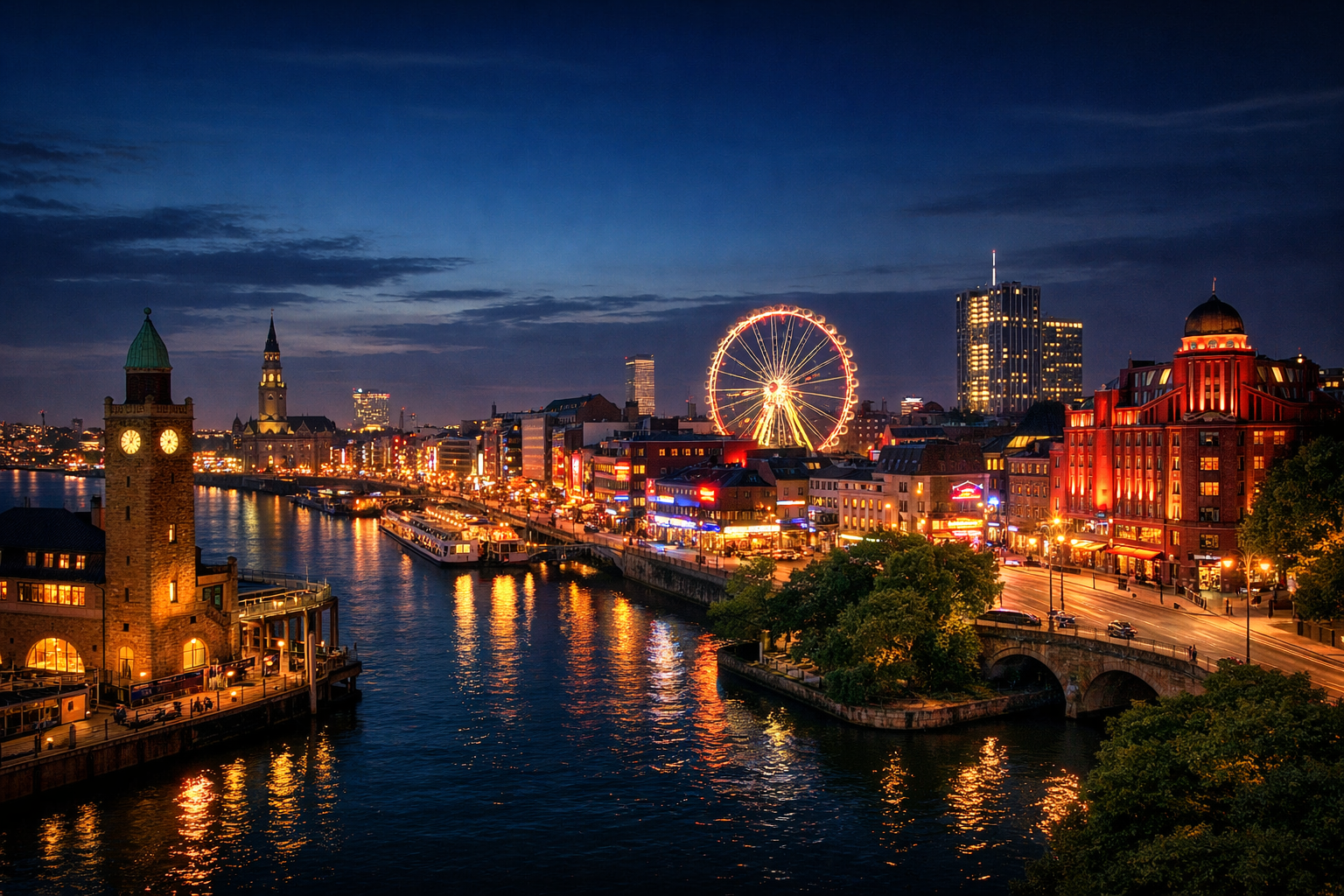
Hamburg comes alive after dark in St. Pauli, where the Reeperbahn pulses with music, lights, and legendary nightlife. From the harbor atmosphere at Landungsbrücken to the old Elbe Tunnel and the calm green paths of Planten un Blomen, the city blends edge and elegance with ease.

🧭 DAY-BY-DAY ROUTE

Ready-made country and city routes with daily plans, sights, transport and accommodation. Buy PDF guides for independent travel.

🧭 DAY-BY-DAY ROUTE


Day 1 — St. Pauli: Reeperbahn, Große Freiheit, and the evening Kiez

  • 🚶 It’s best to devote the first day to the most recognizable face of nighttime Hamburg — the St. Pauli district. Start after check-in without rushing, closer to late afternoon, so you don’t “burn out” before the evening: head to St. Pauli station, come out at Spielbudenplatz, and gradually settle into the rhythm of the area. Here the city sharply changes its tone: instead of classic Hanseatic restraint, you get neon, theatrical flair, concert posters, old facades, bars, club entrances, and a dense flow of people. Reeperbahn should not be seen only as an entertainment street — it is a whole cultural layer of Hamburg, where music, port history, counterculture, and tourist energy all mix together. By day the district looks a little rougher and more honest, and by dusk it quite literally starts illuminating its own character.

  • 🎵 From Spielbudenplatz it is easy to walk to Beatles-Platz and then continue toward Große Freiheit. This part of the route is short in distance but very rich in atmosphere: within just a few hundred meters you get the symbols of that very “musical” and nighttime biography of St. Pauli. Beatles-Platz works as a striking starting point — a place where it is easy to recall the early Hamburg chapter in The Beatles’ story — and then turn onto Große Freiheit, one of the most famous side streets off Reeperbahn. In the evening you especially feel how the district lives on contrasts: old signs stand next to modern clubs, the tourist showcase meets genuine club memory, and the street noise feels not like chaos but like part of the local scene.

  • 🍸 Plan the evening flexibly and realistically: the optimal format is a 2–3 hour walk with stops, then dinner or a bar, and only after that, if you want, a continuation of the night. Distances between points within Reeperbahn and St. Pauli are usually short — about 5–12 minutes on foot — so there is no need to overload the day with transport. If you want a more “overview-style” introduction, build in a stop for Panoptikum or a short visit to St. Pauli Museum before evening, and then head back outside just when the district begins to play its main role. For a comfortable rhythm, it also helps to build in a break at the hotel before the nighttime part of the route: 1–1.5 hours in the evening really makes sense here.


Day 2 — Landungsbrücken, Alter Elbtunnel, and the green contrast of Planten un Blomen

  • 🌊 It is better to start the second day more gently and calmly to balance the nighttime energy of the previous evening. From St. Pauli, it is easy to walk to Landungsbrücken — the route takes about 10–15 minutes depending on your starting point in the Reeperbahn area. Here Hamburg reveals itself not as a club city, but as a port city: the broad line of the Elbe, piers, wind, moving ferries, and the characteristic mix of tourist bustle with the working texture of the harbor. This is one of the best places to feel the scale of the city and its connection to the water. Even a simple walk along the waterfront works here as a full-fledged attraction.

  • 🛟 From Landungsbrücken, it makes sense to go down into Alter Elbtunnel — the historic underground passage beneath the Elbe, which still remains one of the most memorable urban experiences. For the crossing itself, a short walk, and photos, it is best to allow about 30–45 minutes without rushing. After the tunnel, you can return to the St. Pauli Landungsbrücken area and then walk or ride to Museum für Hamburgische Geschichte if you want to add some city context: this museum nicely “pulls together” Hamburg’s port, trade, and cultural biography. The walk from Landungsbrücken to the museum takes about 15–20 minutes, and for the museum itself it is reasonable to allow 1–1.5 hours if you are not trying to see absolutely everything.

  • 🌿 The finale of the route is best built on contrast and to end the trip in Planten un Blomen. After stone, water, the noise of the piers, and nighttime memories of Reeperbahn, this large urban park feels almost like an exhale: gardens, pathways, water features, and a sense of space help “gather” your impression of Hamburg in a calmer tone. From Museum für Hamburgische Geschichte to the park entrances, the route is short, about 5–10 minutes on foot. This is a good place to end the trip with a long unhurried walk, takeaway coffee, and a final look at the city no longer as a nightlife stage, but as a layered northern space where port, music, history, and green pauses exist together with remarkable ease.

Flight tickets

eSIM for travel

Buy PDF guide

Buy PDF guide — 4.28 USD

PDF — 4.28 USD