
Buy PDF guide

Buy PDF guide — 8.57 USD

PDF — 8.57 USD

Hamburg - Lüneburg Heath

Hamburg - Lüneburg Heath

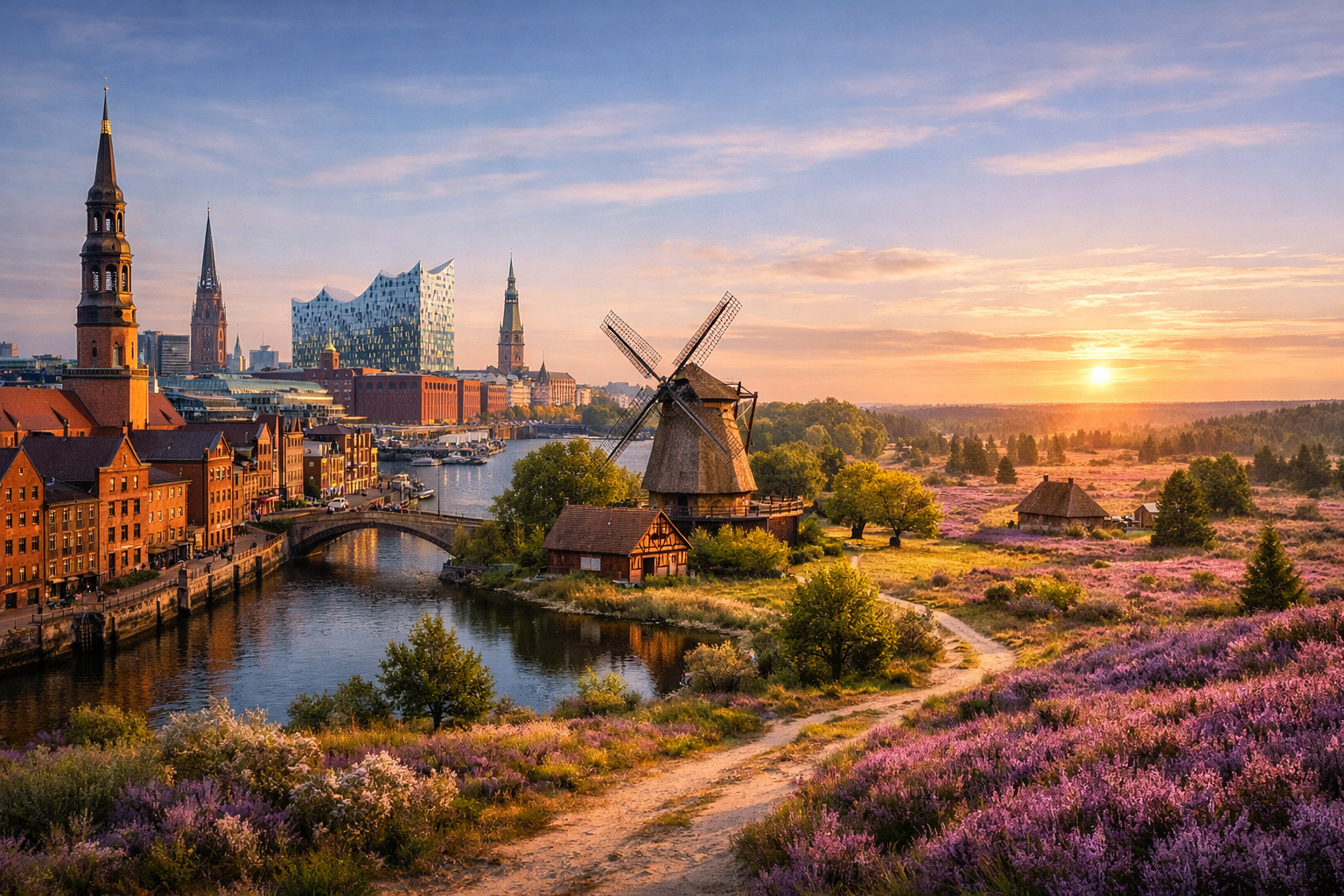
From Hamburg, the city quickly gives way to the wide, purple bloom of the Lüneburg Heath. Wander from Lüneburg through Wilsede to Wilseder Berg and the quiet hollow of Totengrund, where open skies and rolling heathland feel timeless.

🧭 DAY-BY-DAY ROUTE

Ready-made country and city routes with daily plans, sights, transport and accommodation. Buy PDF guides for independent travel.

🧭 DAY-BY-DAY ROUTE


Day 1 — Hamburg: Altstadt, Speicherstadt, and the Elbe panorama

  • 🚶 The first day is best devoted to your “entry” into Hamburg through its most cinematic side: the historic center, canals, and the brick-built Speicherstadt. Start calmly, without overloading the day with too many stops: the Rathaus area and the streets of the old town set the rhythm well, and from there it feels natural to move on to the warehouse quarters with bridges, water, and red-brick facades. This is where Hamburg reveals itself as a northern port metropolis with a very distinctive atmosphere — strict, businesslike, yet surprisingly photogenic. Be sure to plan a break for coffee or a late breakfast so the day doesn’t turn into a race. After that, head toward Miniatur Wunderland or CHOCOVERSUM depending on your mood: the first is about scale, detail, and almost childlike wonder, while the second offers a lighter and more interactive format.

  • 🌆 In the second half of the day, move on to the Elbphilharmonie and HafenCity. From Speicherstadt, it is easy to walk here in about 15–25 minutes, with stops for photos and short canal views. The Plaza at Elbphilharmonie is one of the best viewpoints in the city: from here, Hamburg is perceived in several layers at once — the port, the water, the glass of modern HafenCity, and the mass of old warehouses. The evening is best finished with a slow walk along the waterfront or a short trip to Landungsbrücken if you still have energy. Don’t overload the day with museums “until closing time”: Hamburg reads best when you have time to simply look at the city, the wind over the water, and the way light works across the facades.


Day 2 — Hamburg: port character, St. Pauli, and departure for Lüneburg

  • 🚢 Dedicate the morning to the city’s portside face. The Landungsbrücken area and the views of the Elbe show a completely different Hamburg — more open, windier, and more alive. If you want a museum focus, the Internationales Maritimes Museum works very well: it is not just a collection of ships and artifacts, but a way to feel why maritime history here is not decoration, but part of the city’s DNA. After the museum, leave time for lunch and a short rest, because after that it makes sense not to rush, but to transition gently toward the transfer.

  • 🚆 In the second half of the day, travel from Hamburg Hbf to Lüneburg. It is realistic to allow about 35–45 minutes for the train itself, and around 2–2.5 hours total including getting to the station, waiting, and checking in. This keeps the day from feeling fragmented. In the evening, walk around Lüneburg: this old Hanseatic town with its brick facades, narrow streets, water, and soft northern light contrasts sharply with the scale of Hamburg. Here the route is best built slowly: Am Sande, the old harbor at Am Stintmarkt, the little bridges over the Ilmenau, the towers, and the slightly “storybook” quiet of the center. An evening in Lüneburg is not for ticking off a list, but for switching rhythms before the nature part of the journey.

Day 3 — Lüneburg and the heart of Lüneburg Heath: Wilsede, Wilseder Berg, and Totengrund

  • 🌿 This is the main nature day of the route, and it is best to start early. From Lüneburg to the starting points in the Heideregion, it is usually most convenient to go by rental car/car sharing, or to combine regional transport with a taxi to villages at the edge of the reserve. Allow about 60–90 minutes for the journey to a convenient entry point to the walking area, depending on your chosen start and connections. It is important to remember: Wilsede is inside the car-free part of the reserve, where you cannot drive a regular car. The final stretch is done on foot, by bicycle, or by horse-drawn carriage. That is exactly what makes the day special: you do not simply “drive up to a sight,” but enter the landscape gradually.

  • 🥾 The main link-up of the day is Wilsede → Wilseder Berg → Totengrund. Wilsede itself feels like a living museum settlement: silence, thatched roofs, old houses, the absence of car noise, and the rare feeling that time flows differently here. From here, it is convenient to walk to Wilseder Berg — one of the most famous high points of the heath, with wide views over the rolling heather landscape. Then it is worth continuing to Totengrund — one of the most beautiful and emotionally powerful places in the region: it is not “emptiness,” but rather a natural bowl with very expressive relief, where you especially feel the depth and calm of northern German nature. For the walking part, including stops, photos, and lunch/a snack, it is realistic to allow 4–6 hours at a comfortable pace. Plan your return to Lüneburg without rushing, leaving the evening free for dinner and rest.

Day 4 — Lüneburg: salt, museums, and a calm finale

  • 🏛️ The final day is best spent in Lüneburg without long transfers. After the natural climax, a cultural and urban finale works especially well: start with the Deutsches Salzmuseum, because it was salt that made Lüneburg rich and influential. Through this story, the city begins to read more deeply: the houses, the trading past, the scale of former wealth, and even the slightly uneven shape of the streets become more understandable. Then you can walk through the quarters around the former saltworks and return to the center via quieter streets.

  • 🕯️ In the second half of the day, add the Ostpreußisches Landesmuseum or simply leave time for a long walk through the Altstadt. A good idea is not to try to “fit everything in,” but to experience the city slowly: sit by the water, walk once more through the old harbor, choose a quiet café, and let the route close beautifully. If you are leaving in the evening for Hamburg or the airport, allow a buffer: from Lüneburg to Hamburg Hbf by train is usually about 35–45 minutes, and to the airport with a transfer in the city it is most often reasonable to count about 75–100 minutes total. This kind of finale makes the journey feel complete: first a big port city, then intimate Hanseatic architecture, then the heather heart of the region, and finally the calm historical depth of Lüneburg.

Flight tickets

eSIM for travel

Buy PDF guide

Buy PDF guide — 8.57 USD

PDF — 8.57 USD