
Buy PDF guide

Buy PDF guide — 4.28 USD

PDF — 4.28 USD

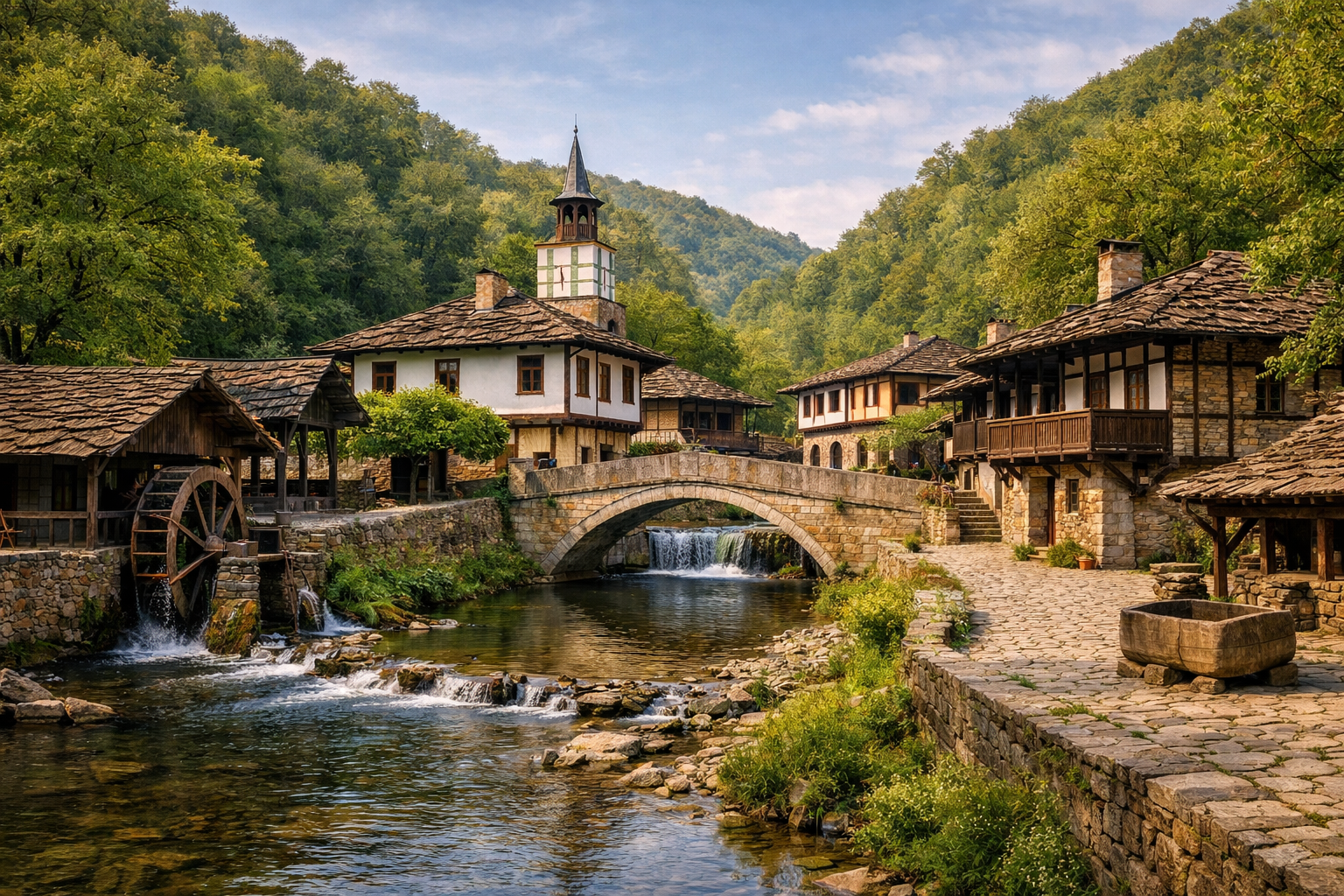
Gabrovo - Etar: open-air museum

Gabrovo - Etar: open-air museum

Gabrovo blends mountain-town charm with Bulgaria’s playful spirit, making it a memorable stop on the road through the Balkans. Just outside town, Etar’s open-air museum brings traditional crafts and old-world streets to life, with the peaceful Sokolski Monastery close by.

🧭 DAY-BY-DAY ROUTE

Ready-made country and city routes with daily plans, sights, transport and accommodation. Buy PDF guides for independent travel.

🧭 DAY-BY-DAY ROUTE


Day 1 — Sofia → Gabrovo → House of Humour and Satire → Gabrovo center

  • 🚆 Transfer: Sofia → Gabrovo. The most practical option for a short route is an intercity bus from Sofia Central Bus Station; the trip usually takes about 3 hours. From Sofia Airport, you can conveniently get to the center and transport hub by metro or city bus in about 20 minutes, then calmly transfer to a service toward Gabrovo. If you want more freedom with timing, you can rent a car in Sofia and drive to Gabrovo in about 3–3.5 hours without long stops.

  • 🏨 After arriving in Gabrovo, it is best to check into a hotel in the city center, leave your luggage, and take a 45–60 minute break to rest. This is an important part of the route: the region is hilly, and although the transfer is not extreme, it is tiring, while a two-day tour is much more pleasant if you do not turn it into a race between stops.

  • 🚶 Start getting to know Gabrovo with the House of Humour and Satire — a place without which it is impossible to truly feel the city. Gabrovo has long lived with the special reputation of being Bulgaria’s “capital of humour,” and this museum does not look like an ordinary collection of display cases and plaques. It feels like the city’s cultural manifesto, where self-irony, caricature, play, and absurdity have been turned into part of the urban identity. The space is housed in a former industrial building and combines exhibition halls, art displays, collections of satirical art, and the visual jokes characteristic of Gabrovo that are known far beyond the region. The atmosphere here is special: this is not a “lightweight” museum, but a place where laughter is used to show the character of the Balkans, local habits, city legends, and that rare ability to look at oneself without pomposity. It is reasonable to allow 1.5–2 hours for a walk through the museum and the adjacent sculpture park.

  • 🚶 After the museum, it is worth walking through the center of Gabrovo at an easy pace. The city lies in the valley of the Yantra River and has a very recognizable relief: the streets rise and fall, drawing the eye toward the slopes, while the urban fabric combines the Bulgarian Revival, industrial past, and provincial intimacy. It is in this kind of walk that the character of Gabrovo is best revealed: not as a “must-see stop along the way,” but as a living city of craftsmen, traders, factory owners, and people with a very tenacious local identity. In the center, it is pleasant to set aside time for an unhurried dinner, and not overload the evening — the next day, the main and more насыщенная part of the route will be connected with Etar and the surrounding area.


Day 2 — Etar → Sokolski Monastery → Interactive Museum of Industry / departure

  • 🚍 Transfer: Gabrovo center → Etar Open-Air Museum. You can reach the museum by city buses No. 1, No. 7, and No. 10; the trip from the city usually takes about 15–20 minutes. By car or taxi, the journey is shorter — about 10–15 minutes, depending on your starting point.

  • 🚶 Etar is the main reason to come to this region even on a very short trip. The Regional Ethnographic Open-Air Museum “Etar” is located in a picturesque valley south of Gabrovo and feels not like a standard museum park, but like a living scene from 19th-century Bulgaria. Here, water really powers historic mechanisms, craft workshops do not look like decorative props, and the stone paths, wooden facades, roofs, bridges, and smell of wood create a rare sense of a space where the past has not been reconstructed “just for show,” but carefully assembled into a coherent environment. The museum is especially valuable because it shows not just pretty houses, but an entire way of life from the Bulgarian Revival era: crafts, trade, water-powered technical structures, and the organization of the street, workshop, and domestic space. The main charshia, workshops, and water installations make the walk highly cinematic: it feels as if the shop owner is about to step out from around the next bend or the wheel of an old mill is about to creak. It is best to allow at least 3 hours for Etar right away, and if you want to enter workshops, pause for coffee, and stroll calmly without rushing — all 4 hours.

  • ⛪ After Etar, it makes sense to continue the route to Sokolski Monastery, which is very close and complements the museum experience well. The transfer takes about 10 minutes by car or taxi; if you wish, you can also arrange a more active format with a short walk in the surroundings, but for a two-day route it is better not to overload the day. The monastery is located among Balkan slopes and feels like a point of silence after the craft and museum intensity of Etar. White arcades, a calm courtyard, mountain air, and distance from city noise create a very composed, almost meditative mood. This is a good place not for a long tour, but for a 40–60 minute pause: catch your breath, look at the architecture, sit in the courtyard, and feel how sharply the emotional rhythm of the region changes in just a few kilometers.

  • 🚘 Return to Gabrovo. If you are leaving in the evening, finish the route with the Interactive Museum of Industry in the city center. This is a very successful final stop, because it ties together everything you have already seen: the old crafts of Etar, the commercial and entrepreneurial spirit of Gabrovo, and its transformation into an important industrial center. The exhibition is designed in a modern way — with multimedia installations, visual effects, and an emphasis on vivid storytelling rather than a dry set of facts. Here you understand especially well that Gabrovo is not just a “cute Balkan town,” but a place where genuine industrial history grew out of craft energy. Usually 1–1.5 hours is enough for the museum, after which you can depart for Sofia. The return trip to Sofia by bus or car again takes about 3–3.5 hours, so if you have an evening flight, it is better to leave a good time buffer.

Flight tickets

eSIM for travel

Buy PDF guide

Buy PDF guide — 4.28 USD

PDF — 4.28 USD