
Buy PDF guide

Buy PDF guide — 10.71 USD

PDF — 10.71 USD

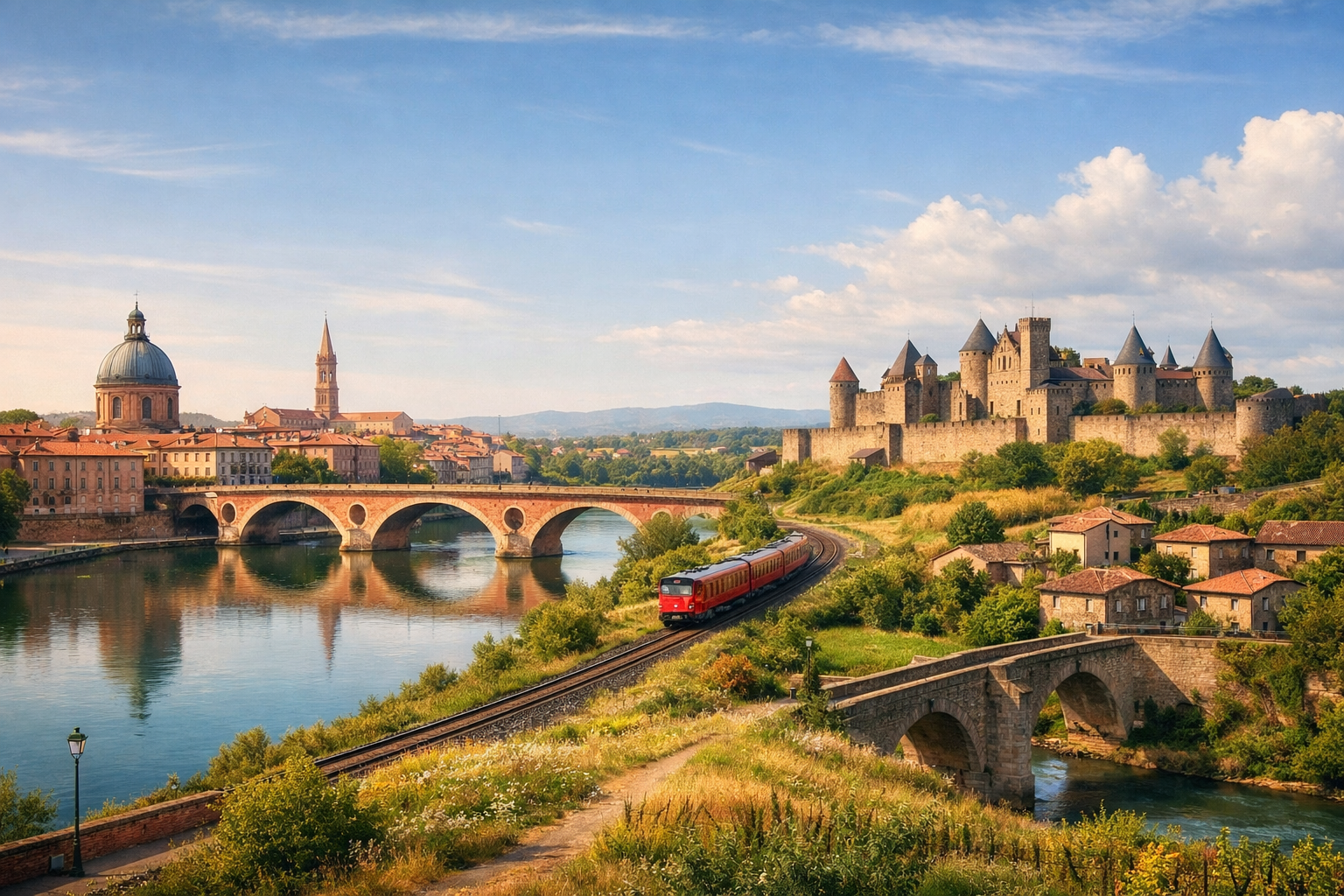
France, Toulouse and Carcassonne. A budget trip through the pink city and the medieval fortress with a convenient train transfer and accommodation in hostels.

France, Toulouse and Carcassonne. A budget trip through the pink city and the medieval fortress with a convenient train transfer and accommodation in hostels.

Discover the charm of southern France on a budget, from Toulouse’s sun-warmed pink streets to the storybook towers of Carcassonne. With an easy train ride between the two and hostel stays that keep costs low, this trip blends laid-back city energy with unforgettable medieval magic.

🧭 DAY-BY-DAY ROUTE

Ready-made country and city routes with daily plans, sights, transport and accommodation. Buy PDF guides for independent travel.

🧭 DAY-BY-DAY ROUTE


Day 1 — Toulouse: the historic center, the Capitole, and the Garonne embankments

  • 🚶 Start getting to know Toulouse from its heart — Place du Capitole and the surrounding quarters. Toulouse is called the “pink city” for good reason: in the soft southern light, the brick facades really do shimmer here in warm pink and terracotta tones, and even an ordinary walk through the center feels like a journey through a very cohesive, lively, and noble city. From the square it is easy to walk along old streets to the Basilica of Saint-Sernin, peek into courtyards, arcades, and small passageways, and then head down to the Garonne. The embankments and bridge views are especially beautiful toward evening, when brick, water, and sunset light create that very atmosphere of southwestern France for which even those who are not chasing “must-see” checklists come to Toulouse.

  • 🏛️ For a budget-friendly start to the day, do not overload the plan with paid sights: the Capitole from the outside, a walk through the historic streets, the facades of old mansions, the market, and the embankments cost almost nothing, yet give a very complete sense of the city. On the way, it is convenient to include the Basilica of Saint-Sernin — one of the main Romanesque churches in France and an important stop on the pilgrims’ route to Santiago de Compostela. Even a short visit here makes the route deeper: this is not just a beautiful church, but a true historical anchor of Toulouse, where you can feel both medieval power and the calm of a vast sacred space.

  • 🍽️ To save money on the first day, it is best to rely on bakeries, lunch menus, markets, and small Asian or Middle Eastern places in the center. A realistic food budget for the day with this approach is about €18–30 per person. If you arrive early, it makes sense to have one more substantial meal during the day and limit yourself in the evening to a picnic by the Garonne or an inexpensive supermarket meal.


Day 2 — Toulouse: Couvent des Jacobins, Jardin des Plantes, and the city’s calm rhythm

  • 🚶 Dedicate the second day to a more thoughtful and still budget-friendly side of Toulouse. In the morning, head to Couvent des Jacobins — one of the most striking monuments of brick Gothic in southern France. This place impresses not with external pomp, but with the refinement of its interior space: slender columns, light, the cloister courtyard, and a rare sense of architecture that is both austere and almost airy. If free admission is available on certain days during your dates or a reduced fare applies, this is an especially good addition to a budget route; if not, you can limit yourself to seeing it from the outside and focus on free walks.

  • 🌿 After that, switch to a greener and more relaxed rhythm: Jardin des Plantes, the connected walking areas around the garden, and the quarters of the southern part of the center are perfect for a slow day without major expenses. Jardin des Plantes is not an “attraction,” but a pleasant urban breath: tree shade, calm alleys, locals, students, and the feeling that Toulouse knows how to be not only impressive, but also very comfortable for living. On a day like this, it is useful to leave some time without a rigid plan — the city opens up especially well in the pauses between points.

  • 🏛️ If you still have energy, you can add the Muséum de Toulouse or at least a walk past it and along the nearby avenues. This is a good option in heat, wind, or rain. Once again, the evening is best finished inexpensively: get takeaway food or choose a simple bistro outside the most touristy spots. A budget guideline for the day is €20–35 for food and €0–15 for attractions, depending on whether you go inside paid sites.

Day 3 — Transfer Toulouse → Carcassonne and a first look at the fortress

  • 🚆 In the morning, transfer from Toulouse Matabiau to Carcassonne on a direct SNCF train. According to current timetables, there are many direct departures, the average travel time is about 54 minutes, and the fastest option is around 42 minutes, which makes this connection one of the most convenient for a short budget route in France. To save money, it is better to take a regular direct TER or an inexpensive Intercités in advance, but not to build the route around too rigid a dependence on a single train: the short journey is good precisely because of its flexibility.

  • 🏰 After check-in, head toward the medieval Cité de Carcassonne — one of the most impressive fortified panoramas in France. Even if you do not buy the full ticket to Château Comtal and the walls right away, simply entering the old town, walking along the fortifications, seeing the gates, towers, cobbled streets, and the overall silhouette of the fortress already makes a strong impression. Carcassonne does not feel like just an “old town”: it is perceived as a complete stone-and-brick world with an almost theatrical medieval power, especially if you come closer to evening, when there are fewer tour groups and the light becomes softer.

  • ⛪ Be sure to step into the Basilica of Saint-Nazaire inside the citadel. It is one of those places where Carcassonne opens up not only as a photogenic fortress, but also as a genuine historical space where religious architecture, traces of long centuries, and deep silence are mixed together. In the evening, it is worth simply wandering without hurry through the streets of the citadel and choosing an inexpensive dinner outside the priciest tourist terraces. Day budget: train €10–25, local transport as needed €1–3, food €18–30.

Day 4 — Carcassonne: Château Comtal, the ramparts, the lower town, and Canal du Midi

  • 🚶 This day is best made your main Carcassonne day. In the morning, it makes sense to visit Château Comtal and the ramparts while it is not yet too hot and there are fewer groups. Here Carcassonne stops being just a pretty picture and turns into a multilayered historical system: the defensive lines, towers, passageways, views of the surroundings, and the very logic of the medieval fortress become much clearer. This is one of the few paid points on the route where it is not a pity to spend money, because it is exactly what explains why the city is considered a landmark monument in both the French and European context.

  • 🌉 After lunch, head down to bastide Saint-Louis — the lower town, which is often unfairly skipped. The contrast between the fortress and more “ordinary” urban life makes the trip richer: the streets are wider here, the rhythm is calmer, and there is more everyday France without the medieval stage set. If you want a full but inexpensive day, add the Musée des Beaux-Arts de Carcassonne, where admission is free, and then walk to Canal du Midi. In Carcassonne, the canal gives a completely different tone — not defensive and dramatic, but slow, almost domestic, with trees, water, and a long line of movement.

  • 🍽️ The easiest way to save money on food in Carcassonne is this: have a substantial lunch in the lower town, and in the evening choose something simple near the hostel or food from a supermarket. If you really want to try cassoulet, choose a lunch formula or a small family-run place rather than a restaurant in the most expensive part of the citadel. Budget guideline: €20–40 for the day, including food and the entrance ticket to the main fortress area.

Day 5 — Return to Toulouse, final walk, and departure

  • 🚆 Return by train from Carcassonne to Toulouse Matabiau in the morning or closer to noon. The return journey usually takes about 42–60 minutes depending on the type of train, so even on a flight day or the day of onward travel, the route remains realistic and not exhausting. This is one of the main advantages of such a trip: you get two very different cities without tiring connections and without the need to rent a car.

  • 🚶 The last hours in Toulouse are best devoted to something that does not require rushing or expensive tickets: a walk along Canal du Midi, the area around Jean Jaurès and Wilson, another outing to the center, or a short visit to a museum or garden if you did not manage something in the first two days. This ending is good because it does not create stress: instead of a “catching-up” program, you simply bring the journey to a gentle close in a city that knows how to be beautiful without constant consumption of paid entertainment.

  • ⚠️ Before departure, be sure to check current weather warnings, transport changes, possible repair works, SNCF train timetables, museum opening hours, and the accessibility of walking areas. Information about safety, weather, route accessibility, and the transport situation may change; no destination can be considered completely safe. On the final day, allow at least 2–3 hours of buffer time before the departure of a long-distance train or an airport flight. Budget guideline: train €10–25, food €12–25, city transport €0–8.

Flight tickets

eSIM for travel

Buy PDF guide

Buy PDF guide — 10.71 USD

PDF — 10.71 USD