
Buy PDF guide

Buy PDF guide — 10.71 USD

PDF — 10.71 USD

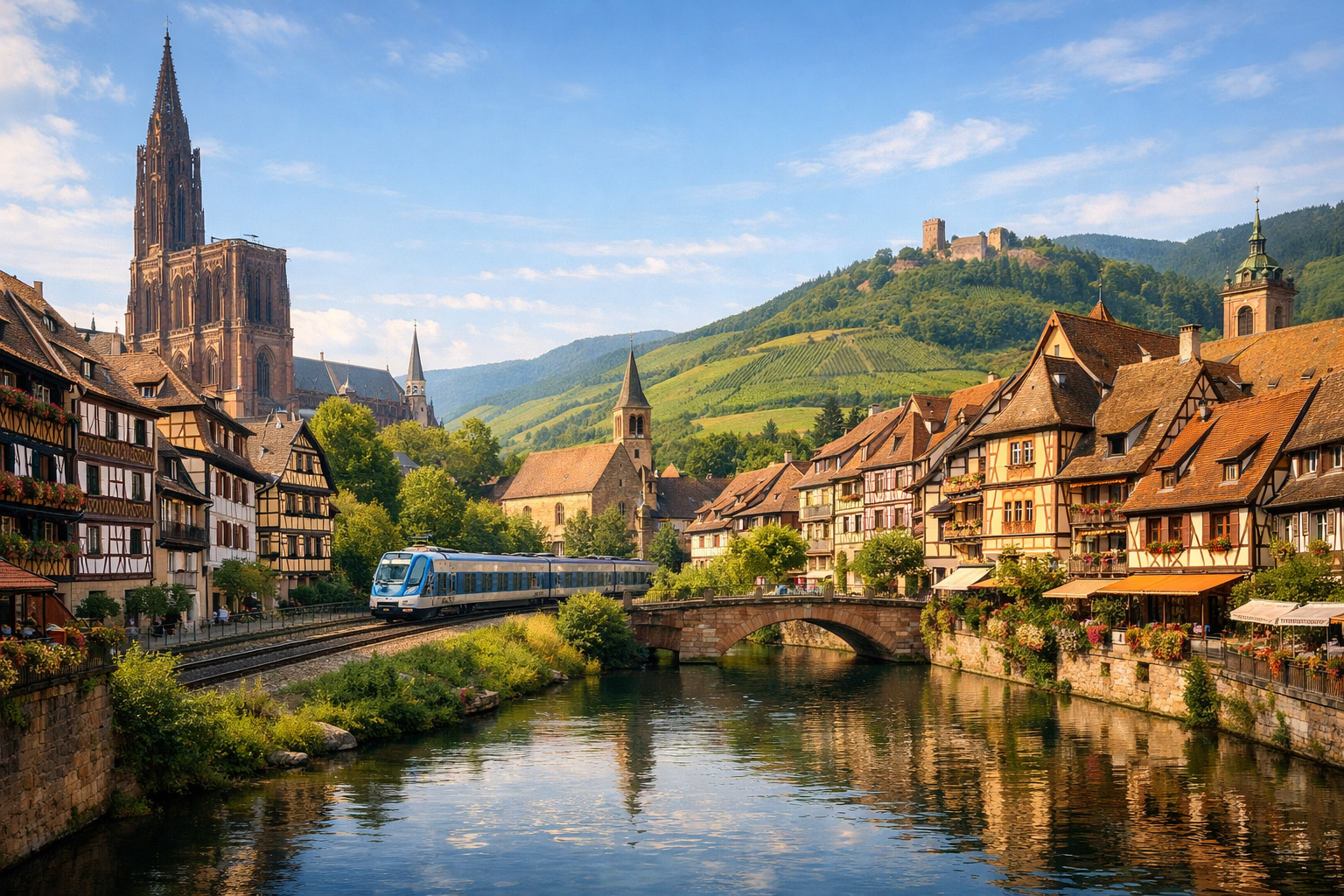
France, Strasbourg and Colmar. A budget-friendly route through Alsace with half-timbered quarters, canals, cathedrals, and trips on regional trains.

France, Strasbourg and Colmar. A budget-friendly route through Alsace with half-timbered quarters, canals, cathedrals, and trips on regional trains.

Discover Alsace on a budget with an easy route from Strasbourg to Colmar and back, linked by quick regional trains. Wander through half-timbered streets, canal-lined corners, and grand cathedrals as two of France’s most charming towns unfold at a relaxed pace.

🧭 DAY-BY-DAY ITINERARY

Ready-made country and city routes with daily plans, sights, transport and accommodation. Buy PDF guides for independent travel.

🧭 DAY-BY-DAY ITINERARY


Day 1 — Strasbourg: the cathedral, Grande Île, and the first half-timbered streets

  • 🚆 If you arrive at Strasbourg Airport, the cheapest and most logical way to get to the center is the short TER shuttle train to Strasbourg-Ville: the trip takes about 8 minutes, and from there it is easy to walk to a budget hotel near the station or take a tram. For an economical start, it is convenient to buy a combined airport + city transport ticket for 24 hours if you plan to make more trips around the city that day; if you have little luggage and your accommodation is in the center, part of the route can be done on foot so you do not overpay for unnecessary rides.

  • 🚶 It is best to devote the first day to the historic core of Strasbourg — the island of Grande Île, where the city opens up exactly as people expect from Alsace: narrow streets, the warm color of stone, wooden shutters, neat signs, and endlessly photogenic facades. The central point of the route is Cathédrale Notre-Dame de Strasbourg, Place de la Cathédrale, 67000 Strasbourg. This is not just the city’s main church, but an architectural landmark for the whole region: giant pink sandstone, an extraordinarily complex Gothic facade, sculptures, arches, and the feeling that before you stands an encyclopedia of medieval Europe assembled in stone. Even if you do not go up to the platform, it is worth walking around the cathedral, peeking toward Place du Château, and spending at least an unhurried hour here.

  • ⛪ For budget travel, it is especially pleasant that the best impressions in central Strasbourg cost very little or are completely free: walking around the cathedral square, admiring the exterior decoration, the streets around Rue Mercière, the path to the river, the bridges, and viewpoints in the old town. If you still have energy, you can add the climb to the cathedral platform by stairs: it is paid, but comparatively affordable, and gives one of the best views over Strasbourg’s rooftops, the Vosges, and on a clear day even the distant horizon. Allow about 45–60 minutes for the ascent including waiting time and rest.

  • 🥖 After visiting the cathedral, head to the quarters around Rue des Hallebardes, Rue Mercière, and Place Gutenberg. Here it is better not to chase an expensive restaurant experience, but to build a typically Alsatian budget day from bakeries, sandwiches, quiche, tarte flambée in a simple format, or a basic lunch menu. In the center there are many bakeries and small places where you can spend around 8–15 € for a snack or 12–20 € for a simple lunch without extras. To save money, it makes sense to have breakfast at a bakery and your main hot meal during the day, when better-value set menus are easier to find.

  • 🌆 In the evening, take a slow walk to the embankments of the Ill and through the old center without a rigid plan. Strasbourg is especially beautiful at dusk: shop windows reflect in the water, the cathedral darkens against the sky, and the half-timbered houses gradually begin to glow with warm yellow light. This evening is not for ticking boxes, but for slowing down after the journey and settling into the rhythm of Alsace without extra spending.


Day 2 — Strasbourg: La Petite France, covered bridges, and canals

  • 🚶 Dedicate the second day to the La Petite France area, Place Benjamin Zix, 67000 Strasbourg — the most picturesque quarter of Strasbourg and one of the most expressive urban landscapes in Alsace. This is where the image of the “postcard-perfect” region is best read: half-timbered houses with sloping roofs, flowers on the windows, narrow lanes, wooden galleries, and water that sometimes opens up the space and sometimes hides behind houses and bridges. The quarter is especially lovely in the morning, because there are fewer people and the soft light makes the whole area feel almost theatrical.

  • 🌉 Walk through the Ponts Couverts — covered bridges with towers from the medieval fortifications — and then go up to Barrage Vauban. This dam-fortification offers one of the best free panoramic views in the city: from here you can clearly see the canals, towers, rooflines of Petite France, and the cathedral spire in the distance. For a budget route, this is a must-stop because it replaces expensive viewpoint activities while still delivering a strong visual impression. For the full walking loop of Petite France → covered bridges → Vauban → return through the canals, it is comfortable to allow 2.5–4 hours with stops for photos and coffee.

  • 🛶 If you want to see the city from the water, you can consider a sightseeing boat on the canals, but for a strictly budget format this is an extra rather than a necessary expense. The basic version of the day works perfectly on foot: Strasbourg is very compact, and the main value of the area is precisely in looking a lot, turning into side alleys, and catching different angles of bridges, locks, and house reflections in the water.

  • 🏛️ After lunch, you can head to Église Saint-Thomas, 11 Rue Martin Luther, 67000 Strasbourg, one of the city’s important historic churches, or simply continue your walk along the water toward Place Kléber and the more “urban” part of the center. This balance works well for the budget: in the first half of the day you spend almost nothing, and in the second you can vary the plan — either keep walking for free or add one inexpensive visit based on your interests.

  • 🍲 For dinner, stick again to simple formats: daytime bistros, affordable flammkuchen places, soups, quiches, dish-of-the-day options, and menus in neighborhoods slightly away from the main tourist axes. A realistic food budget in Strasbourg in economy mode is about 20–35 € per person per day if you combine bakeries, supermarkets, small cafés, and one hot meal.

Day 3 — Colmar: TER transfer, Little Venice, and the old town

  • 🚆 In the morning, transfer Strasbourg → Colmar by regional TER train. This is a key part of the budget logic of the route: Colmar is close enough that you do not need to spend money on a car, and the journey itself usually takes about 30–35 minutes on a direct train. The line is frequent, with regular departures throughout the day, so you can choose a convenient morning slot without getting up too early. It is most convenient to buy tickets in advance in the SNCF Connect app, on the SNCF/TER Grand Est website, or from machines at the station; with early planning it is sometimes possible to get a better fare, but even without “hunting for deals,” this transfer usually remains one of the most reasonably priced in the region.

  • 🏘️ Upon arrival in Colmar, start with the historic center and the Petite Venise quarter. Colmar’s Little Venice is not a huge area, but rather a concentration of Alsatian beauty: the calm Lauch canal, a row of colorful houses, narrow footbridges, reflections of facades in the water, and the feeling that the city was made not for rushing, but for slowly taking in the details. It is best to walk from the Marché Couvert area through Quai de la Poissonnerie and then continue through the quarter, gradually coming out to the broader squares of the center.

  • 🏠 Be sure to include Maison Pfister, 11 Rue des Marchands, 68000 Colmar, in your walking loop — one of the symbols of old Colmar. The house immediately stands out with its carved wooden bay window, turret, gallery, and decorative paintings; it is exactly the kind of urban architecture that draws even those travelers to Alsace who are not usually interested in building history. Nearby, a walk to Koïfhus, Place de l'Ancienne Douane, 68000 Colmar, the former customs house, and to Collégiale Saint-Martin, Place de la Cathédrale, 68000 Colmar, works very well too; its massive Gothic form contrasts beautifully with the more “storybook” civic buildings around it.

  • 🍞 Colmar is convenient for a budget day because its center is very compact: between the main points you can often walk in 5–15 minutes without using public transport at all. Food here can also stay in budget mode: bakeries, ready-made sandwiches, small cafés, salads, tarts, dishes of the day. With this format, the daily food budget often stays around 18–30 € if you avoid the most touristy seats by the water.

  • 🌙 It makes sense to spend the night in Colmar so you do not make an unnecessary return the same day. This reduces fatigue, gives you a chance to see the city in evening light, and makes the trip more humane: by day Colmar opens like a postcard, and in the evening it becomes calmer, deeper, and more romantic, when the canals darken and the colorful houses reflect in the water with hardly any crowds.

Day 4 — Colmar: the Unterlinden Museum, quiet quarters, and the city’s second layer

  • 🏛️ Dedicate the morning of the fourth day to Musée Unterlinden, 1 Place Unterlinden, 68000 Colmar. This is the city’s main museum and one of the most significant cultural places in Alsace, housed in an unusual architectural complex where an old Dominican convent is joined to more modern spaces. Even if you are traveling mainly for the atmosphere of the streets, the museum is worth considering as one paid visit for the whole route: there is a strong collection here, the famous Isenheim Altarpiece, and a very solid presentation of art history that adds not only “pretty images” but also cultural depth to the trip.

  • 🖼️ Allow 2–3 hours for the museum without rushing. For a budget traveler, this is a justified expense precisely because the rest of the route relies mostly on free walks. If the museum is not a priority for you, an alternative could be a lighter day focused on the Tanneurs quarter, the quiet streets around the old center, markets, Saint-Martin church from the outside, and a long walk across bridges and canals.

  • 🌿 After the museum, it is pleasant to walk toward Parc du Champ de Mars, Avenue de la République, 68000 Colmar. This is a calm green break that is useful for a budget route: you can rest, have a simple picnic from supermarket or bakery purchases, and avoid paying for a long restaurant lunch. This format is especially helpful for keeping expenses balanced if you have already spent money on the museum.

  • 🏘️ In the second half of the day, explore the less “postcard-perfect” but still very pleasant parts of the center: the tanners’ quarter with its tall half-timbered houses, the side alleys around Rue des Marchands, and the squares where the tourist noise is already weaker. Colmar reveals itself precisely in the details — in the color of shutters, in wooden beams, in small signs, in the sharp transition from a grand square to an almost intimate courtyard. This is a day when it is better not to “finish” the city with a checklist, but to live it slowly.

  • 🍷 In the evening, keep your budget discipline: instead of a full restaurant dinner, you can limit yourself to a supermarket, ready-made food, pastries, salad, and a takeaway drink. In Colmar this is especially convenient, because the center is small and most places are nearby. This move helps keep the overall trip cost under control without making you feel like you are saving on everything.

Day 5 — Return to Strasbourg: final walk, market/park, and departure

  • 🚆 In the morning, return Colmar → Strasbourg by TER. The train takes about 34 minutes on average, and services are frequent during the day, so you can choose a departure that fits your flight or onward train. If your journey home starts from Strasbourg Airport, it is convenient to first travel to Strasbourg-Ville and then change to the airport TER shuttle; if your departure is from the central station, it is better not to overload the day with additional distant locations.

  • 🧳 After leaving your bags in the hotel luggage room or station storage, devote the last hours to a light and inexpensive plan. A good option is Parc de l'Orangerie, Allée de la Robertsau, 67000 Strasbourg: a green park where you can walk calmly, relax by the water, and end the trip in a more relaxed rhythm. A second option is to return once more to the center and simply walk your favorite stretches: from Place Kléber to the cathedral, and then down to the water.

  • 🛍️ If you want to take home something inexpensive and local, focus on small gastronomic items from supermarkets or food shops: biscuits, mustard, simple regional sweets, tea, jams. Souvenir shops in the most touristy spots are often noticeably more expensive. For a budget tour, this is an important little detail: you do not have to give up shopping entirely, it is enough to buy outside the “front line” around the cathedral.

  • ⚠️ Before your final departure, be sure to recheck the current TER and city transport schedules, especially if you have an early flight or connection. Information about safety, weather, transport disruptions, line works, platform availability, strikes, and temporary restrictions may change. Neither Strasbourg nor Colmar can be considered completely safe destinations under all circumstances, so in the evening avoid poorly lit deserted areas, keep an eye on your belongings at stations and in tourist quarters, and adjust your walking load in very hot weather or during thunderstorms.

  • 💶 On average, such a 5-day route with a budget approach can remain fairly gentle on your wallet: simple accommodation, food without restaurant splurges, a few rides on city transport, 2 intercity TER transfers, and 0–2 paid cultural sights. It is precisely the compactness of Alsace that makes this trip successful: you see a very expressive region without spending money on long transfers and complicated logistics.

Flight tickets

eSIM for travel

Buy PDF guide

Buy PDF guide — 10.71 USD

PDF — 10.71 USD