
Buy PDF guide

Buy PDF guide — 6.43 USD

PDF — 6.43 USD

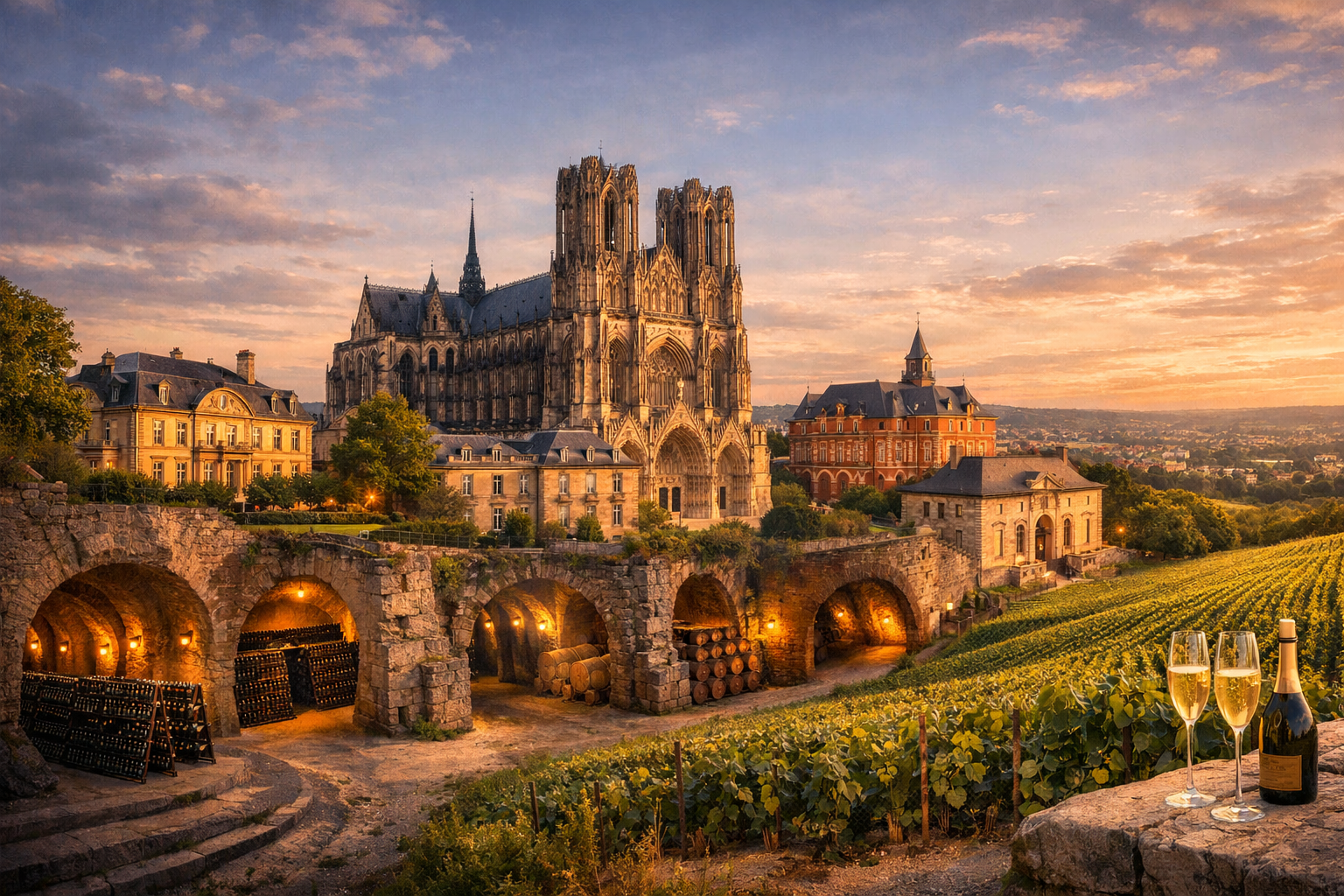
France, Champagne, Reims. A journey through the historic cellars of the champagne houses Taittinger, Pommery, and Veuve Clicquot with a visit to Reims Cathedral and tastings of different styles of champagne.

France, Champagne, Reims. A journey through the historic cellars of the champagne houses Taittinger, Pommery, and Veuve Clicquot with a visit to Reims Cathedral and tastings of different styles of champagne.

Discover Reims through its grand champagne houses, from the historic cellars of Taittinger, Pommery, and Veuve Clicquot to elegant tastings that reveal the region’s many styles. Along the way, admire the majesty of Reims Cathedral and follow the sparkling trail from Saint-Nicaise through the Montagne de Reims to Épernay.

🧭 DAY-BY-DAY ITINERARY

Ready-made country and city routes with daily plans, sights, transport and accommodation. Buy PDF guides for independent travel.

🧭 DAY-BY-DAY ITINERARY


Day 1 — Reims: Taittinger, Reims Cathedral, and an evening with a wine mood

  • 🚆 It is best to plan a convenient arrival in Reims for the morning: from Paris, you can usually reach Reims by TGV in about 45 minutes, and the central station itself is quite close to the historic center. This makes the city an ideal base for a short but rich wine trip without unnecessary transfers and without the need to rent a car on the very first day.

  • 🏨 After arrival, leave your luggage at the hotel and give yourself 30–60 minutes for a calm start. For this route, it makes sense to stay in central Reims or near the cathedral district: this makes it easier to move on foot between gastronomic spots, historic landmarks, and wine houses, and after tastings you do not need to think about driving.

  • 🍾 The first major wine stop is Champagne Taittinger, the historic Saint-Nicaise site in Reims. This is one of the most atmospheric stops of the whole trip: a visit here is especially valuable not only because of the cuvées themselves, but also because of the rare feeling that you are descending into the depth of Champagne’s living history. The chalk galleries, Gothic vaults, and cool underground world create an almost monastic sense of silence, where it becomes especially clear why champagne aging is an art of time rather than just a technology. The house welcomes guests year-round, but tour formats, available languages, and tasting selections may change with the season, so booking should be made in advance on the official website. It is best to allow around 1.5–2 hours for the visit.
  • 🥂 At the tasting in Taittinger, it makes sense to focus on the house styles and pay attention to the difference between fresher, finer, more citrus-driven profiles and rounder, more gastronomic wines. In this house, it is especially interesting to discuss concepts such as lees aging, bubble texture, the role of chardonnay in the blend, and how the perception of the wine changes with different serving temperatures. This is a good start to the route because it sets a high standard for experiencing champagne from the very first day.

  • 🍽️ If you want to continue the wine theme without extra logistics, it is worth considering lunch or an early aperitif at Polychrome on the house grounds near the Taittinger experience. This is a convenient format for arrival day: there is no need to cross the city again, and the gastronomy naturally extends the champagne theme. It is better to choose light dishes so as not to overload your taste buds before the next walks.
  • ⛪ After the wine-themed start, head to Notre-Dame de Reims Cathedral. This is not just a beautiful Gothic monument, but the place where French kings were crowned for centuries, so a visit here gives the route the historical depth it needs. After the intimate underground atmosphere of the cellars, the cathedral makes the opposite impression: verticality, light, stone lacework on the facades, sculptures, and an enormous historical scale. Allow at least 45–60 minutes for a walk around the facades and a calm look inside.
  • 🚶 Near the cathedral, it is pleasant to stroll through the center of Reims without rushing, taking in the elegant streets, squares, and wine shop windows. This city is especially good at the pace of a slow walk: here it is easy to alternate culture, gastronomy, and a glass of champagne without turning the day into a race through a checklist.

  • 🍷 It is best to finish the evening in the spirit of responsible wine leisure: either a restaurant with a good champagne list or a wine bar serving different styles by the glass. The point of the first day is not to drink as much as possible, but to set the palette: brut non-vintage, blanc de blancs, rosé, perhaps one more mature wine for comparison. After tastings, avoid driving yourself: only walking, taxi, or a pre-booked transfer.


Day 2 — Reims: Pommery, Veuve Clicquot, the Saint-Remi district, and Parc de Champagne

  • 🍾 The second day is best devoted entirely to the great champagne heritage of Reims, focusing on the Saint-Remi area, where wine history is quite literally built into the urban landscape. Start with Maison Pommery at 5 Place du Général Gouraud. This is one of the most expressive houses in the region for those who love the combination of wine, architecture, and art. Here, not only the tasting matters, but also the path through the estate itself, where monumentality, art objects, and underground galleries create the impression of an almost museum-like wine theater.
  • 🥂 At Pommery, it is worth paying attention to the house style and the difference between classic cuvées and more gastronomic interpretations. For a traveler who wants to understand Champagne more deeply, this is an excellent place to reflect on the balance between freshness, precision, autolytic notes, fruit, and minerality. It is reasonable to allow about 2 hours for a visit with tasting, and it is better to book in advance, especially in the warm season, on weekends, and on holidays.

  • 🍽️ For lunch, it is convenient to stay at Le Réfectoire at Domaine Vranken-Pommery. This is a good scenario for a wine tour: you do not lose time on transfers and remain in the beautiful setting of the house. With champagne, dishes with delicate texture, seafood, poultry, soft cheeses, and seasonal local produce work especially well. Do not aim for heavy cuisine in the middle of the day if another tasting still lies ahead.
  • 🍾 After lunch, continue to Veuve Clicquot, the visitor center at 1 Rue Albert Thomas, Reims. This house gives the route a different wine emotion: here it is especially interesting to talk about the signature recognizability of the style, champagne as an international symbol, and how a historic brand can maintain a strong identity. Visiting the historic cellars of Veuve Clicquot is one of the key reasons to come specifically to Reims, and tickets are also best booked in advance because the most popular time slots sell out quickly.
  • 🥂 It is best to treat the tasting at Veuve Clicquot as a comparative session with the first day: noticing how house styles, structure, aromatic intensity, mousse character, and finish differ. If there is a choice between several visit formats, it is wiser to prefer the one that gives a little more time to explain methods and style, rather than just the quickest tour.

  • ☕ If you want a gentle pause after the visit, stop by Café Clicquot at the visitor center. It is a pleasant way to catch your breath, have a light bite, and avoid overloading the program with extra movement. This is especially convenient for those who want to stretch out the wine day and not hurry back to the center.
  • 🏛️ In the second half of the day, it is worth adding a historical layer to the area and walking to Musée Saint-Remi and the Basilica of Saint-Remi. The museum is located in a former abbey and complements the wine part of the trip very well: after the great champagne houses, you switch to the long history of Reims — from antiquity and the Middle Ages to later eras. It is not a wine museum in the direct sense, but it helps you feel why Reims is not just a city of tastings, but one of the most important historical centers of France.
  • 🌳 Toward evening, you can take a walk in Parc de Champagne if you still have the energy. This green expanse on Saint-Nicaise hill is especially good as a final exhale after a full day in cellars and museums. It is pleasant here simply to slow down, stroll along the alleys, and digest the impressions rather than add another glass out of inertia.
  • 🚕 The whole second day is best planned without a car. Even if the stops are relatively close to each other, after two wine houses there is only one safe scenario: walk where convenient, and use a taxi/transfer where you do not want to get tired. If an evening dinner with champagne is planned, ask your hotel in advance to call a taxi for the needed time.

Day 3 — Montagne de Reims and Épernay: vineyards, Route Touristique du Champagne, and a final tasting

  • 🍇 The third day should be devoted not only to the great houses, but also to the wine landscape of Champagne itself. The best scenario is to go out with a driver, private transfer, or as part of an organized tour through Montagne de Reims and then onward toward Épernay. After two days of tastings, you should not get behind the wheel yourself; if you still take a car for the freedom of the route, be sure to appoint a sober driver who does not take part in the tastings.
  • 🚗 Start the morning with a panoramic drive along the Route Touristique du Champagne through vineyard slopes and the villages of Montagne de Reims. This is an important part of a true wine tour: here Champagne stops being just a name on the label and opens up as a cultural landscape. The roads run gently between hills, forests, and rows of vines, and the small communes give a completely different feeling of the region compared with the ceremonial houses of Reims. In summer and early autumn the scenery is especially expressive, but this part of the trip is also beautiful in the off-season thanks to the silence and the graphic beauty of the vineyards.
  • 🌿 In the natural and wine context, it is useful to make a short stop in the area of Parc naturel régional de la Montagne de Reims. This helps you see Champagne not only as a place where luxurious wine is produced, but also as a living ecosystem of hills, forests, and vineyards. This is an especially good place to talk about terroir, slope exposure, and how the natural environment influences the style of the wines.
  • 🍾 Then continue toward Épernay — it is about 30 minutes from Reims in normal traffic, and along the way you can include photo stops by the vineyards. In Épernay, the main walking and wine axis is Avenue de Champagne, one of the most iconic streets in the region. A walk here is an essential final chord of the route: luxurious facades, long underground chalk cellars beneath the street, a sense of rich trading history, and the celebratory spirit of champagne. Even without a long sightseeing program, the atmosphere of Avenue de Champagne leaves a strong impression.
  • 🥂 On the final day, it is better not to plan too many tastings, but rather one substantial one. In Épernay, it is convenient to have a closing by-the-glass session in a tasting room or one of the official guest spaces on Avenue de Champagne, so you can calmly compare your impressions of Reims with the more “capital-like” champagne aesthetic of Épernay. A good idea is to choose a different style than on previous days: for example, focus on blanc de blancs or a more vintage-oriented selection if classic brut dominated earlier.

  • 🧀 For lunch on this day, it is better to look for local gastronomy that pairs well with champagne: Chaource or Langres cheese, pâté en croûte, delicate poultry, seasonal tarts, mushroom dishes, as well as desserts without excessive sweetness. In Champagne, gastronomic balance is especially important: food should not overpower the subtlety of the wine, but should support its acidity, creaminess, and length.

  • 🛍️ After lunch, leave time for relaxed shopping: a few bottles to take with you, gastronomic souvenirs, books about the region, or serving accessories. If you plan to bring champagne home, check transport allowances in advance and ask the shop to pack the bottles for travel.

  • 🚆 It is best to plan the return to Reims or directly to the train/transfer without rushing. Between Épernay and Reims, the rail connection and roads make the day realistic, but you should not overload it with another distant village or a third tasting in a row. The finale of this route should leave a feeling of taste, style, and space, not fatigue.

Flight tickets

eSIM for travel

Buy PDF guide

Buy PDF guide — 6.43 USD

PDF — 6.43 USD