
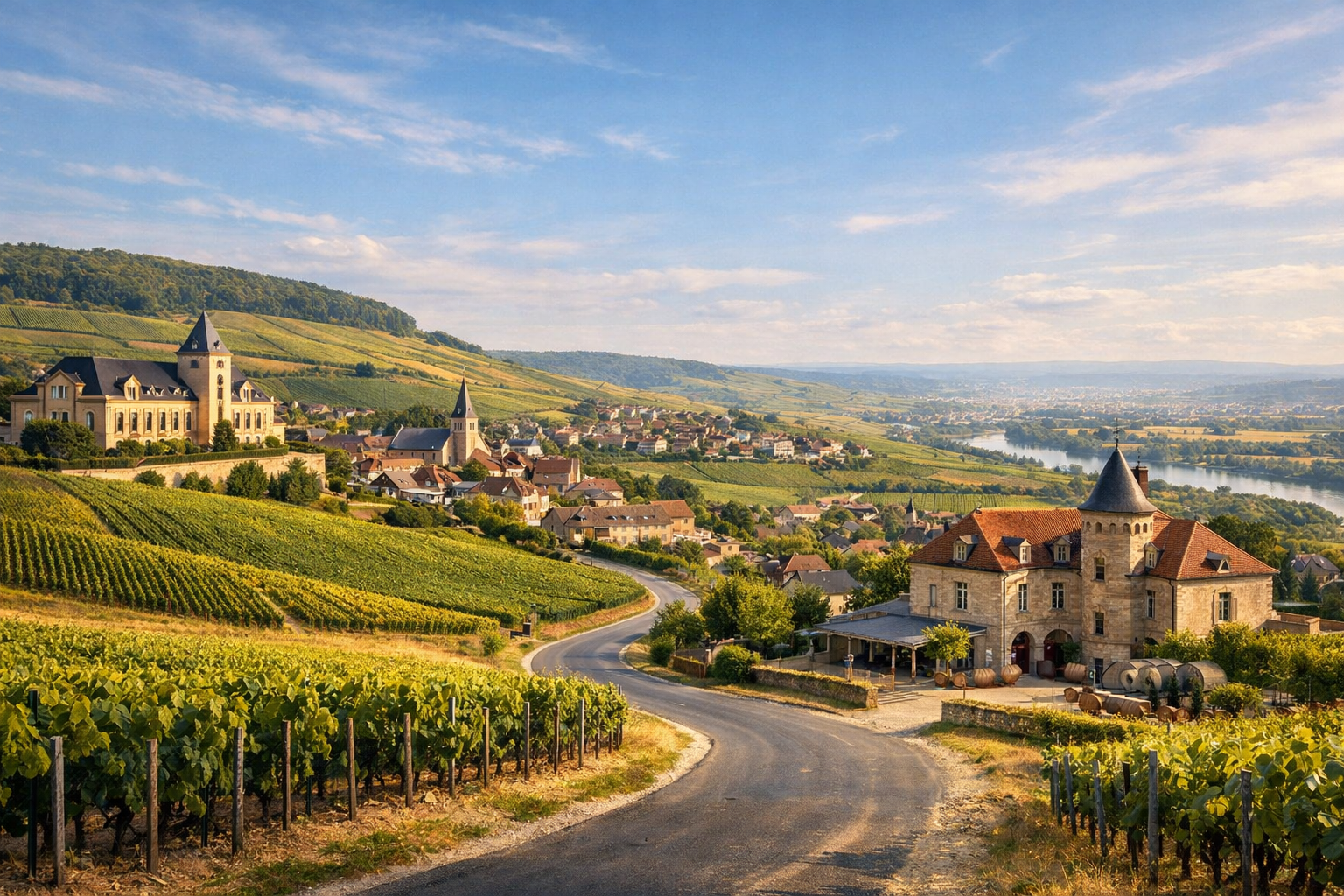
Day 1 — Reims → Verzenay → Mailly-Champagne: discovering Montagne de Reims and Champagne Mailly Grand Cru
🚆 The recommended way to enter the region is via Reims: it is the most convenient urban hub for a short wine trip around Montagne de Reims. From central Reims to Verzenay it is about 20–25 minutes by car, and then the road gently rises toward vine-covered slopes where forests, viewpoints, and Grand Cru villages alternate. If you plan tastings on the same day, do not combine them with driving yourself: appoint a sober driver in advance, book a VTC/taxi for half a day or a full day, or choose a private transfer with waiting time at the estates.
🚶 Start the day in Verzenay at Phare de Verzenay and the Champagne vine and wine museum. This unusual lighthouse among the vineyards has long become one of the symbols of the region: it is an especially good place to understand why Champagne is not just a drink, but a cultural landscape where chalky soils, slope exposure, climate, and a long history of winemaking come together in a single style. The museum is best visited at the beginning of the route: it provides context before visits to Champagne houses, explains the work of winegrowers throughout the year, and helps you better read the differences between the terroirs of Montagne de Reims. In good weather, be sure to go up for panoramic views over the vineyards and the forests of the Montagne de Reims Regional Nature Park.
🍇 After the museum, drive along the wine road through Verzenay to Mailly-Champagne — a short and highly photogenic stretch with views of rows of vines and typical Champagne villages. Mailly-Champagne itself is a Grand Cru village known for vineyards on the northern slopes of Montagne de Reims. It is an especially pleasant place to feel the more строгий, focused character of the local wines: Pinot Noir brings structure and depth, while Chardonnay adds freshness and precision.
🥂 The main wine stop of the day is Champagne Mailly Grand Cru, 28 Rue de la Libération, 51500 Mailly-Champagne. The house welcomes guests for wine-tourism visits and tastings; this is exactly where it is especially interesting to see the combination of cooperative history and high Grand Cru status. A visit is usually built around discovering the house philosophy, immersing yourself in the underground spaces, and a comparative tasting of cuvées where the Mailly signature comes through clearly: precision, chalky freshness, gastronomic character, and a beautiful balance between fruit and aging. Visits should be booked in advance, and before your trip you should always double-check the current opening hours, available tour languages, and guest reception conditions on the official website.
🍽️ For lunch, it makes sense to choose a leisurely gastronomic break in one of the villages on the route, or return to Reims for dinner. Pairings that work naturally in the region include Champagne with jambon de Reims, pâté en croûte, soft cheeses from northeastern France, poultry in cream sauce, river fish, and seasonal vegetables. If you want a local specialty pause, also look out for the pink biscuits of Reims as a sweet souvenir to enjoy with a glass of Champagne.
🌿 In the second half of the day, leave time for a calm walk along one of the short sections of the Route Touristique du Champagne in the Montagne de Reims sector. This region is most beautiful at a slow pace: vine lines stretch to the horizon, villages are compact, and the forest quite literally borders the vineyards. In spring and summer the route is especially picturesque, in autumn it is almost theatrical thanks to its golden-copper palette, and in winter the focus shifts to cellars, tasting rooms, and gastronomy. It is convenient to spend the night in Reims or closer to the vineyards if you want a more relaxed rhythm for the following days.