
Buy PDF guide

Buy PDF guide — 6.43 USD

PDF — 6.43 USD

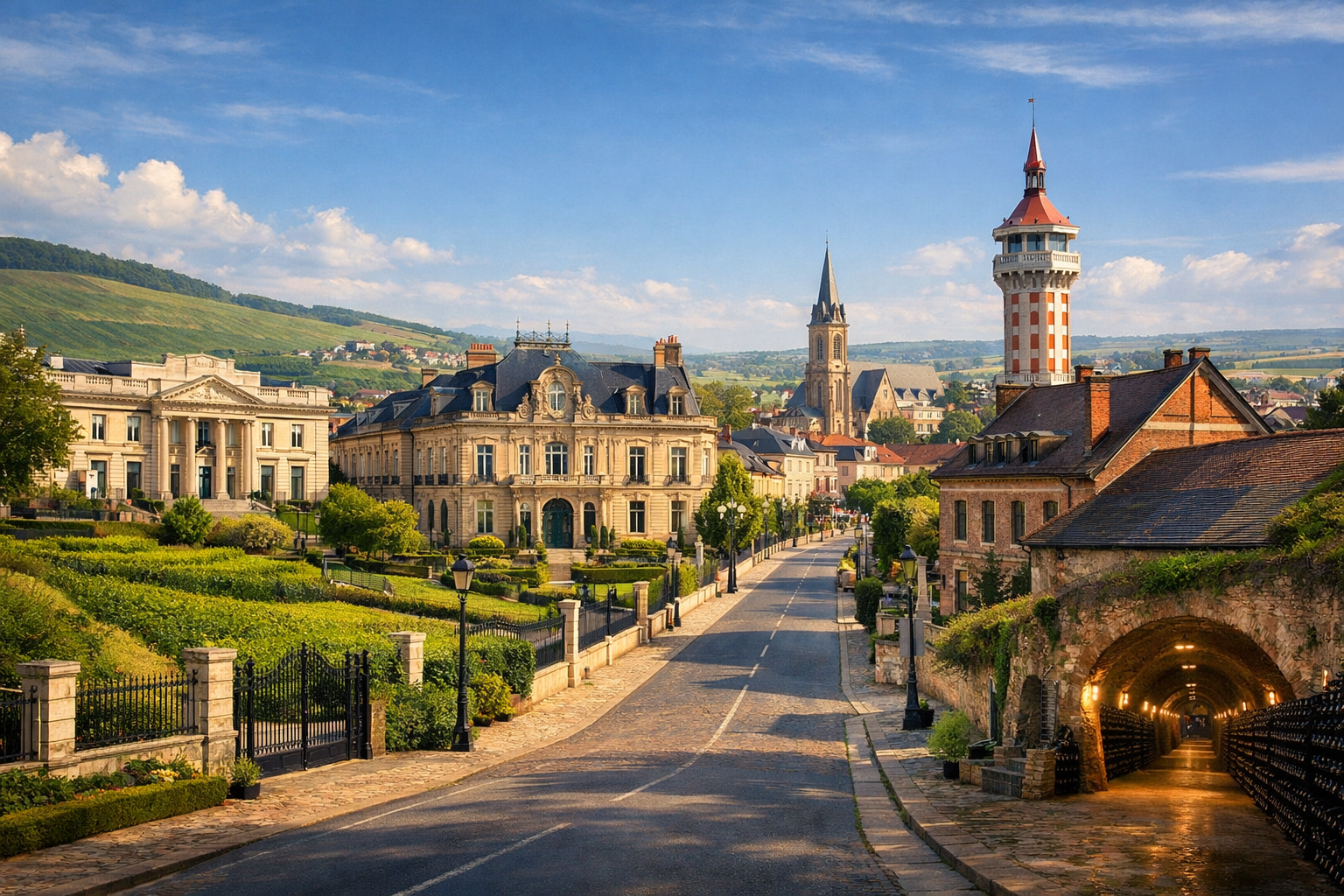
France, Champagne, Épernay. Route along Avenue de Champagne with visits to Moët & Chandon, Perrier-Jouët, and Champagne de Castellane, walks around Épernay, and tours of the many-kilometer underground cellars.

France, Champagne, Épernay. Route along Avenue de Champagne with visits to Moët & Chandon, Perrier-Jouët, and Champagne de Castellane, walks around Épernay, and tours of the many-kilometer underground cellars.

Discover Épernay, the elegant heart of Champagne, where the famed Avenue de Champagne leads past legendary houses like Moët & Chandon, Perrier-Jouët, and Champagne de Castellane. Wander the town’s refined streets, descend into vast underground cellars, and follow the route onward to Aÿ-Champagne and the rolling vineyard landscapes that define the region.

🧭 DAY-BY-DAY ITINERARY

Ready-made country and city routes with daily plans, sights, transport and accommodation. Buy PDF guides for independent travel.

🧭 DAY-BY-DAY ITINERARY


Day 1 — Épernay: Avenue de Champagne, Moët & Chandon, walk through the center

  • 🚆 It is convenient to plan your arrival in Épernay by train: from Paris to Épernay station the journey usually takes about 1.5 hours, and Avenue de Champagne itself begins literally just a few minutes’ walk from the station. For a wine weekend, this is the best scenario: you find yourself at the heart of it all right away and from day one you do not tie the itinerary to driving after tastings.

  • 🚶 Begin your introduction to Épernay with a leisurely walk along Avenue de Champagne — one of the most striking wine streets in Europe. This is not just a beautiful ceremonial avenue about one and a half kilometers long, but a true stage for the Champagne lifestyle: mansions, wrought-iron gates, manicured parks, stone façades of trading houses, and the feeling that the entire town was built around the idea of wine, aging, and celebration. Beneath the street stretch many kilometers of chalk cellars where millions of bottles rest; that is why a walk here feels like a journey not only through space, but deep into the wine history of the region.

  • 🥂 The main wine stop of the day is Moët & Chandon, 18 avenue de Champagne. The house is about a 5-minute walk from the station and is considered one of the most iconic addresses in all of Champagne. It is worth booking an official tour of the underground cellars in advance here: the route leads into a cool chalk labyrinth where the scale of production and the role of aging in shaping Champagne style are felt especially vividly. After the visit, it makes sense to leave time for a tasting in the house’s official space. In high season and on weekends, slots fill quickly, so it is best to book ahead and, just before the trip, check opening hours, tour language, and current visiting rules again on the official website.

  • 🍽️ For lunch, choose a format that supports the theme of the route: a light gastronomic lunch with local Champagne products. Look for dishes with jambon de Reims, pâté en croûte, regional cheeses, seasonal tarts, and if you want a more festive mood — a menu with food pairing alongside a glass of Blanc de Blancs or Brut. It is important not to overload the day: after visiting the cellars and tasting, it is better to keep the itinerary walkable.

  • 🏛️ In the second half of the day, head to the Musée du vin de Champagne et d’Archéologie régionale, Château Perrier, entrance through the courtyard at 13 avenue de Champagne. This is the ideal museum for the first day because it explains Champagne as a whole: from the geology of the chalk soils and the ancient history of the area to the evolution of winemaking, the bottle, the cork, the label, and drinking culture. Inside, you get exactly the kind of foundation that makes later visits to Champagne houses much more meaningful. It is sensible to allow about 1.5 hours for the museum.

  • 🌆 Toward evening, stroll through central Épernay: from Avenue de Champagne to quieter streets, squares, and cafés. This town reveals itself best at a slow pace — through the light on the façades, quiet inner courtyards, wine boutique windows, and the gentle feeling of provincial elegance. If you want to end the day with a glass, do so without a car and within walking distance of your hotel.

  • ⚠️ An important rule for the day: after tastings, completely avoid driving yourself. If you still came to the region by car, assign a sober driver for tasting days or do not use the car at all. For this compact itinerary around Épernay, the safest option is to walk, use taxis, or arrange a transfer in advance.


Day 2 — Épernay: Perrier-Jouët, Champagne de Castellane, underground cellars and panoramas

  • 🥐 Dedicate the morning of the second day to another great chapter of Champagne history — Maison Perrier-Jouët. The main address for visits and tasting formats is 26 Avenue de Champagne, while the gastronomic and more intimate Maison Belle Epoque experience is linked to 11 Avenue de Champagne. It is important to understand the difference: some programs offer a guided tasting, others a restaurant or gastronomic format, and some do not include a cellar visit. So before your trip, be sure to recheck on the official website exactly which experience you want: a tasting workshop, a table at Cellier Belle Epoque, or a bookable lunch/dinner experience at Maison Belle Epoque.

  • 🍾 Perrier-Jouët is especially good for those who love the combination of wine, art, and Belle Époque aesthetics. A visit here feels not like a mass-flow attraction, but like a more elegant and curated introduction to the house style. If you choose a tasting atelier, you get a focus on the house signature, especially Chardonnay and its trademark floral delicacy. If you choose a gastronomic format, the day becomes more festive and unhurried. This stop perfectly complements Moët & Chandon: the first house gives a sense of scale and legend, the second of refinement and artistic character.

  • 🚶 After Perrier-Jouët, continue your walk along Avenue de Champagne toward Champagne de Castellane, 63 avenue de Champagne. Along the way, the avenue itself works as part of the route: mansions, historic walls, rare gates, long vistas, and wine architecture create the impression of an open-air museum. Walk without rushing, with pauses for photos and brief stops by the façades — in Épernay this is not a “transition between points,” but a complete experience.

  • 🗼 Champagne de Castellane is one of the most expressive and visually striking visits in town. The house is known for its 66-meter tower, which dominates the Épernay skyline, as well as its historic atmosphere and connection with the Museum of Champagne Traditions. The tour here is especially good for those who want to combine the wine theme, a beautiful panoramic view, and a clear immersion into the region’s artisanal past. If suitable slots are available, it is worth choosing a visit with the tower and tasting; some programs may differ in content and number of cuvées.

  • 🍇 In the second half of the day, if the pace allows, devote time to another slow walk: the upper part of Avenue de Champagne and the surrounding views are especially beautiful in the soft evening light. Unlike the first day, when the emphasis is on getting to know the town, today you already begin to feel the wine rhythm: you notice not only façades, but also the logic of the houses, the differences in style, and the link between brand, architecture, history, and the tasting ritual.

  • 🍽️ For dinner, choose the region’s gastronomy without rushing and without driving anywhere: dishes with local poultry, mushrooms, seasonal vegetables, soft creamy sauces, cheeses, and desserts that pair well with Champagne. A wine tour in Champagne is especially beautiful when the food does not compete with the wine, but highlights its acidity, minerality, and bubble texture.

  • 🔔 A practical note: most tasting and gastronomic programs in Champagne houses require advance booking, and some activities are designed specifically for adult audiences. For visitors under the legal age, alcoholic tastings are not available. If you are traveling as a family, check in advance whether children are allowed for the specific visit format and whether non-alcoholic alternatives are available.

Day 3 — Aÿ-Champagne and wine landscapes: Pressoria, vineyard route, local gastronomy

  • 🚖 The third day is best planned without driving yourself after samplings and tastings. The optimal scenario is a taxi, a pre-booked transfer, or an organized half-day outing. The destination is Aÿ-Champagne, located just a few minutes from Épernay. This allows you to add real contact with the vineyard landscape of Champagne to the urban itinerary without turning the day into a tiring transfer.

  • 🏛️ The main stop of the day is Pressoria, 11 boulevard Pierre Cheval, 51160 Aÿ-Champagne. This is a modern sensory space about Champagne that complements the classic visits to the great houses very well. Here the emphasis is not on a specific brand, but on the wine itself, its birth, sound, light, texture, aroma, soil, and human work. Pressoria is especially valuable at the end of the trip: after two days of tastings and cellar walks, you begin to read the exhibition not as an abstract museum, but as a decoding of what you have personally seen and tasted.

  • ⏰ Pressoria has a strong seasonal variation in opening hours, so be sure to check the schedule for your specific date the day before. Hours differ between the warm and cold seasons, and it is also important to consider the day of the week and the time of the last entry. If you want a format with a tasting or a special atelier, book in advance and clarify the language.

  • 🍇 After Pressoria, set out on a short route through the vineyard landscapes around Aÿ-Champagne and Épernay — this is part of the famous Champagne Tourist Route. Here Champagne opens up no longer as a town of brands, but as a living agricultural and cultural landscape: gentle slopes, neat rows of vines, villages with stone houses, small estates, old walls, and viewpoints above the Marne Valley. If you book an organized wine outing, you can add a stop at an independent producer or in a small tasting room by prior appointment. This format is especially good for those who want to see not only famous maisons, but also a more intimate side of the region.

  • 🧺 For lunch, a gastronomic break in a village or a return to Épernay for a late lunch is ideal. On the final day, focus on local products: Champagne cheese, terrines, seasonal dishes, pastries, and desserts that pair well even with one final glass. If another tasting at a small producer is planned, give up the idea of driving yourself back.

  • 🌿 The second half of the day can end with a gentle walk without a packed schedule — through the Château Perrier park, along Avenue de Champagne once again in farewell mode, or through the quiet neighborhoods of Épernay. After days full of Champagne houses and museum formats, this very unhurriedness is what lets the journey “settle”: you already distinguish the style of the houses, understand the role of chalk cellars, the importance of Chardonnay, Pinot Noir, and Pinot Meunier, and Champagne itself ceases to be just a beautiful name on a label.

  • ✅ Final wine recommendations: all key visits on this tour should be reserved in advance, especially for Friday, Saturday, holidays, and the warm season. Before departure, be sure to recheck the official websites of wineries and museums: opening hours, availability of English- or French-language tours, admission of children, cancellation terms, seasonality, tasting format, and punctuality requirements. Responsible consumption here is not a formality, but part of the region’s culture.

Flight tickets

eSIM for travel

Buy PDF guide

Buy PDF guide — 6.43 USD

PDF — 6.43 USD