
Buy PDF guide

Buy PDF guide — 10.71 USD

PDF — 10.71 USD

France and the Alpine rings of the Tour du Mont Blanc (Northern part). Season (July–September)

France and the Alpine rings of the Tour du Mont Blanc (Northern part). Season (July–September)

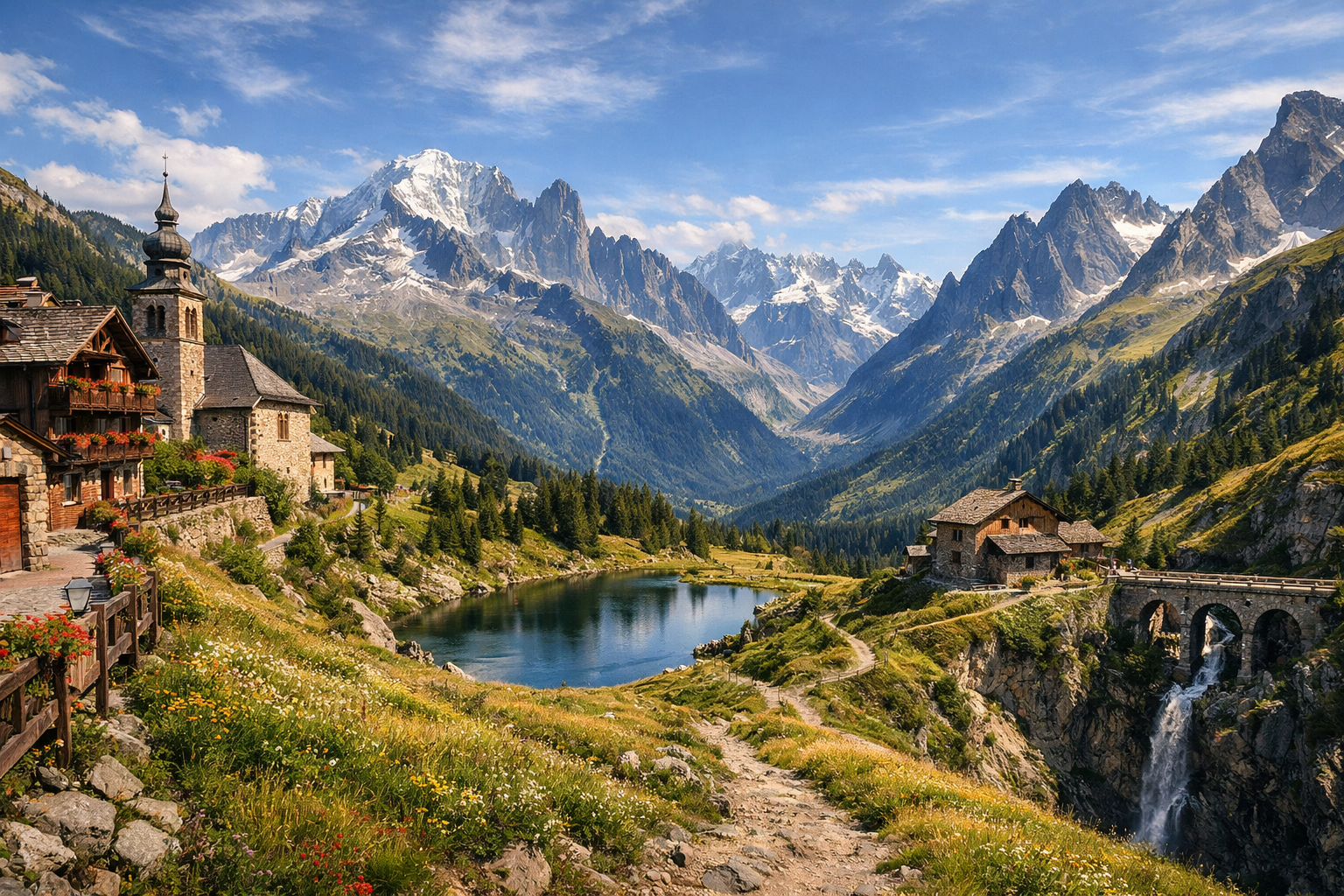
Discover France at its most dramatic on the northern arc of the Tour du Mont Blanc, where green valleys rise into jagged peaks and bright glaciers above classic Alpine villages. From Les Houches through Chamonix to Les Contamines-Montjoie and Saint-Gervais, July to September brings clear trails, wildflower meadows, and long mountain days made for walking.

🥾 DAY-BY-DAY ROUTE

Ready-made country and city routes with daily plans, sights, transport and accommodation. Buy PDF guides for independent travel.

🥾 DAY-BY-DAY ROUTE


Day 1 — Les Houches: a gentle start to the route via Bellevue and a section of the TMB

  • 🥾 On the first day, it’s better not to storm the elevation, but to ease into the rhythm of the northern part of the Tour du Mont Blanc from Les Houches. Taking the cable car up to Bellevue makes the start much easier and lets you immediately enter a world of alpine meadows, panoramas of the Mont Blanc massif, and classic TMB trails without an exhausting climb from the very bottom of the valley. The walk is characterized by mountain meadows, scenic slopes, and forest sections. The active part of the day usually takes 3–4.5 hours at a relaxed pace. For a regular traveler, a good option is a walk along the well-known marked trails around Bellevue with access to a short section of the TMB route and a return the same way or via a simple loop. Difficulty is easy / moderate; distance guideline: 6–8 km, with walking ascent after the cable car of about 200–350 m. This is a good day for those who want to feel the atmosphere of the legendary route, but without a long crossing, a heavy backpack, or technically difficult sections. In July, remnants of snow may still remain on high shaded sections after a snowy spring, and in September the weather changes faster and sunset comes earlier, so it’s best to start in the morning. Be sure to check the Bellevue lift operation and the forecast before heading out: in the mountains, even an easy walk becomes unpleasant in rain and low cloud.


Day 2 — Chamonix / Les Praz: Lac Blanc from Flégère as the main scenic hike

  • 🥾 This is the most spectacular day of the whole short tour: Lac Blanc is one of the best-known panoramic walks in the Chamonix valley. In character, the route combines a high-mountain lake, rocky but popular and well-trodden trails, views of the glaciers opposite, and alpine pastures. For regular tourists without special gear, the best option is specifically the ascent by the Flégère gondola, which is officially recommended as more convenient for beginners and families. From the upper station to the lake and back, the active part of the day takes about 4–5 hours with stops for photos and rest; distance guideline is about 7.8 km, with elevation gain of around 600 m. Difficulty is moderate. Why the route suits an ordinary traveler: no ice gear is needed, no mountaineering experience is required, and the most popular option follows a well-known summer trail with clear navigation. But it is important not to choose approaches via Col des Montets or Tré-le-Champ, because those are noticeably more technical in places. Seasonal nuances matter: high-mountain trails are accessible only in summer-autumn conditions; in early July there may be snowfields, after rain the rocks can be slippery, and in windy weather it is noticeably colder by the lakeshore than down in Chamonix. A separate rule for the area: swimming in Lac Blanc and the lacs des Chéserys is prohibited, so people come here for the views and the walk, not for a beach outing. It’s best to set out early: by midday the trail becomes much busier.

Day 3 — Les Contamines-Montjoie: Notre-Dame de la Gorge and the nature reserve

  • 🥾 On the third day, the route becomes calmer and greener. A base in Les Contamines-Montjoie is ideal for gentle hiking on the lower and middle sections of the northern TMB, where there are more forests, mountain valley scenery, streams, bridges, meadows, and old pilgrimage roads than harsh high mountains. The best format for an ordinary traveler is to get to Notre-Dame de la Gorge, stop by the new nature center Les Dômes de la Gorge, and then take a calm walk along the marked valley trail of the reserve and return without climbing to the high passes. The active part is about 3–4 hours; distance guideline 6–10 km depending on turnaround point, elevation gain 150–300 m. Difficulty is easy. This day is especially good after Lac Blanc: it gives recovery while still preserving the feeling of real Alpine nature. For a regular traveler, the route is convenient because the start is close to the road and parking/shuttle, the trails are clear, and there is no need for a helmet, crampons, or crossing steep ridges. In July the meadows are especially beautiful in bloom, in August it can be warm and sunny during the day, and in September mornings can be cool and damp in the forest shade. If the water level is high after rain, walk more carefully on wet stones near the stream and do not try to extend the walk toward the Bonhomme passes or the higher sections of the TMB.

Day 4 — Les Houches: Petit Balcon Sud and Parc de Merlet

  • 🥾 The fourth day is one of the friendliest and most photogenic in this tour. The route along Petit Balcon Sud to Parc de Merlet is easy Alpine hiking with magnificent views of the Chamonix valley and the Mont Blanc massif. In character, the walk combines a forest trail, sunny balcony paths above the valley, pasture slopes, and a nature park with mountain wildlife. From the Les Bossons or Chamonix area, you can walk to Merlet on a marked trail; from Les Bossons the ascent takes about 1.5 hours, from Chamonix about 2 hours. For an out-and-back walk or a linear option using transport, allow 3–5 hours of active walking. Distance guideline 6–9 km, elevation gain about 450–550 m; difficulty is easy / moderate. Why it suits an ordinary traveler: the trail is popular, well known, without dangerous technical sections, and Merlet Park itself is a convenient route goal if you want not only views but also a calm place to rest. In summer the park is higher than the valley and is usually cooler than Chamonix. In July and August, parking at Merlet fills up quickly, but the park also has a free shuttle from Les Houches station on summer-season weekdays. After rain, roots and soil in the forest can be slippery, so it is better to walk in good trekking shoes. This is an excellent day for families, beginners, and those who want a beautiful mountain walk without the feeling of an expedition.

Day 5 — Saint-Gervais: Saint-Nicolas-de-Véroce and easy alpine meadows for farewell

  • 🥾 The final day is best kept scenic and not too long. From Saint-Gervais / Saint-Nicolas-de-Véroce, it is easy to arrange a walk through alpine meadows, forest paths, and panoramic trails with gentle terrain and broad views of the surrounding ridges. This is no longer a classic TMB walking day, but a comfortable ending to the tour in the same Mont Blanc alpine region. The ascent from Le Fayet to Saint-Gervais can be conveniently shortened using Le Valléen, after which you can continue by local transport or taxi to a higher starting point. The active part of the day is 2.5–4 hours; distance guideline 5–7 km, elevation gain about 200–300 m; difficulty is easy. This format suits a regular traveler because you can choose a simple walk along marked paths without going onto high-mountain, snowy, or remote sections. In July there are green pastures and long daylight hours, in August it is important to bring water and sun protection, and in September it is especially pleasant to walk in clear weather for the transparent views. If the forecast is unstable, keep the route short: a quality 3-hour walk is better than trying to gain more elevation in fog or rain.

Flight tickets

eSIM for travel

Buy PDF guide

Buy PDF guide — 10.71 USD

PDF — 10.71 USD