
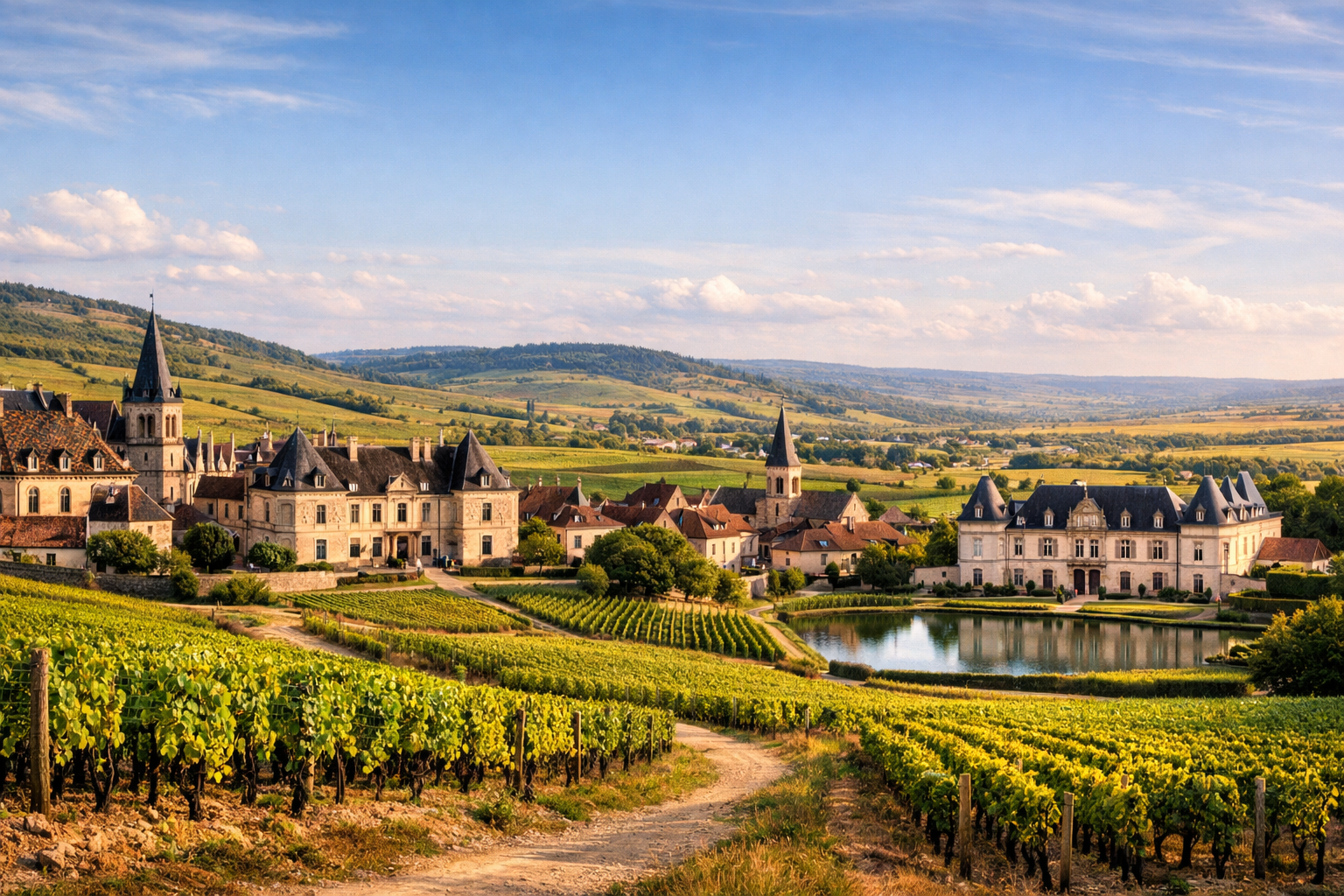
Day 1 — Beaune: getting to know the wine capital of Burgundy
🚆 It is convenient to plan your arrival in Beaune via Dijon or Lyon, with a connection to a regional train to Gare de Beaune. From the station to the historic center is usually 10–15 minutes by taxi or about 15–20 minutes on foot, and to the Cité des Climats et vins de Bourgogne it is about 25 minutes on foot or around 5 minutes by electric shuttle. If you are flying in through Lyon or Paris, it is best to keep this day free of heavy tastings until after lunch so you can check in, eat, and ease into the rhythm of the region.
🚶 Start your route with the Cité des Climats et vins de Bourgogne in Beaune — it is a modern and very accessible introduction to the entire journey through Côte de Beaune. The exhibition helps you understand, without rushing, why concepts such as terroir, climat, exposition, and work with limestone-clay soils are so important here. After this visit, names like Pommard, Volnay, or Meursault stop being just village names: you begin to feel how the wine style changes literally from slope to slope. For a short four-day tour, this is almost the perfect start, because the museum provides context and makes the tastings that follow far more meaningful.
🏛️ Then head to the historic center to Hôtel-Dieu des Hospices de Beaune, one of Burgundy’s most recognizable symbols. It is not just an outstanding monument of late medieval architecture with painted roof tiles, but a place closely connected with the wine history of the region: it was precisely around the tradition of the Hospices de Beaune that the global reputation of the local wine trade was formed. Inside, the courtyard, the halls of the old hospital, and the overall sense of how charity, merchant wealth, religious history, and the wine economy intertwine in Beaune are especially impressive.
🍷 In the afternoon, plan a tasting at Maison Joseph Drouhin, 7 Rue d’Enfer, Beaune. This is one of the most respected Burgundy houses, and a visit here is especially valuable because it allows you to compare wines from different appellations in one place and better sense the stylistic difference between Pinot Noir from the villages of Côte de Beaune and white Chardonnay from the southern slopes. At the Oenothèque Joseph Drouhin, the atmosphere is usually more intimate and focused than in larger tourist flows, and the presentation itself helps you read Burgundy through the vineyard map, family history, and the language of vintages.
🍽️ For dinner, leave room for classic Burgundy gastronomy: oeufs en meurette, jambon persillé, boeuf bourguignon, Burgundy snails, and the cheeses Époisses and Citeaux. On the first evening, it is better not to overload the program with a second serious tasting, but instead to focus on food-and-wine pairings by the glass. For Pinot Noir, dishes with red wine sauces, duck, and veal work especially well here; for Chardonnay from Côte de Beaune, river fish in beurre blanc, poultry in cream sauces, and aged soft cheeses are excellent choices.
⚠️ An important rule of a wine tour: do not drive after a tasting. Even if the distances between villages seem very short, for an evening in Beaune it is best to choose walking, a taxi, or a pre-booked transfer. Age restrictions apply to tastings and alcohol sales: minors are not served alcohol. Nearly all visits to well-known houses should be booked in advance, especially from May to October and during autumn wine events.