
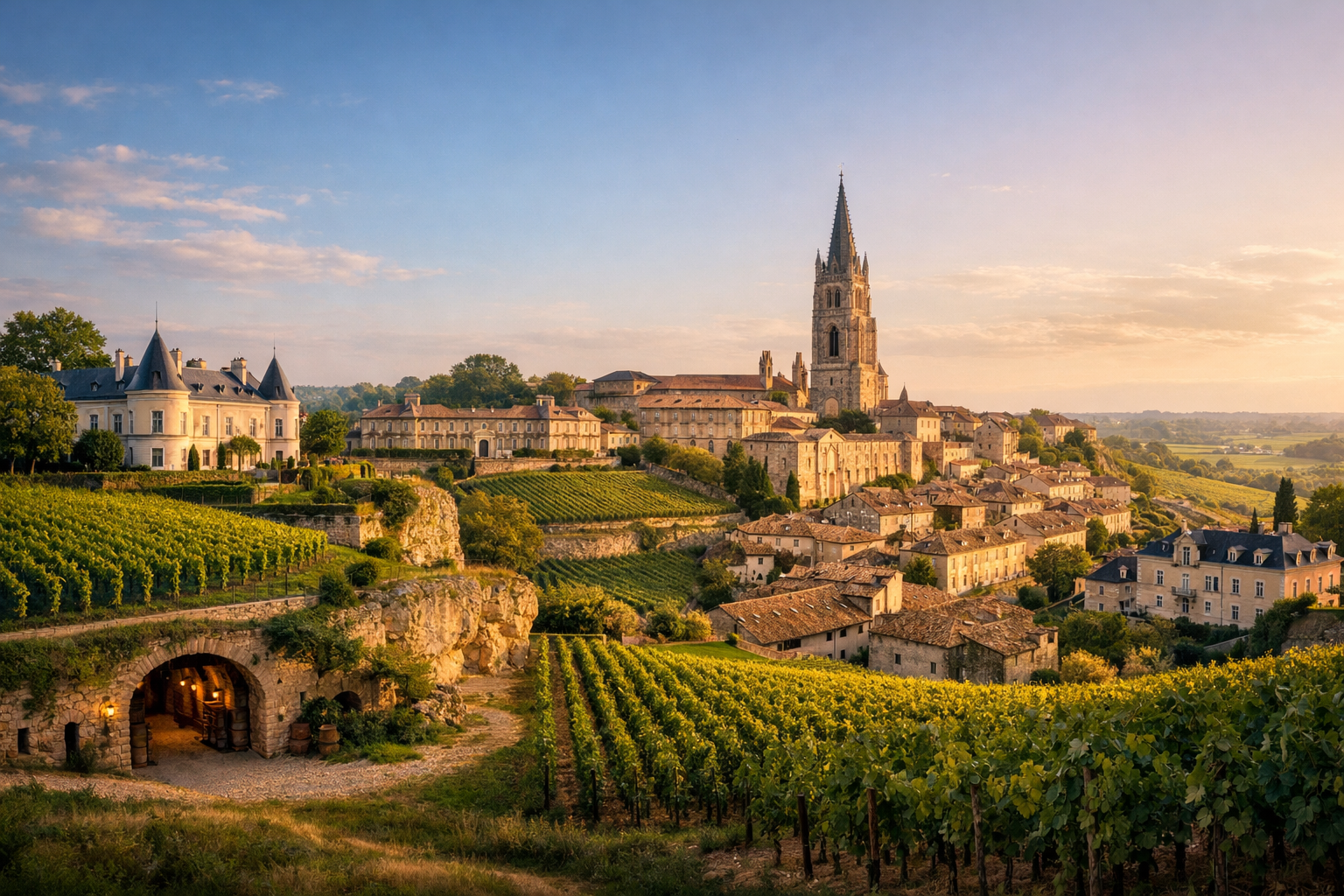
Day 1 — Bordeaux: entering wine culture and a gentle transfer to Saint-Émilion
🚶 Begin your journey in Bordeaux at La Cité du Vin — one of the most striking wine culture centers in Europe, located on the Garonne riverfront. It is not just a museum, but a full immersion into the civilization of wine: the architecture of the building resembles a swirling stream of wine in a glass, and inside the route is designed to introduce guests not only to Bordeaux, but also to global wine traditions, aromas, terroirs, and tasting rituals. For a wine tour, this is the ideal prelude: it is a convenient place to refresh basic concepts about grape varieties, blends, appellations, and tasting style, and on the upper level the visit usually ends in the panoramic Belvédère space. It is important to remember that tasting formats are intended only for adults under local rules, so if there are minors in the group, it is better for them to plan the museum part without the alcohol component. It is wise to book tickets and time slots in advance, especially in spring, summer, and on weekends, when visitor flow is at its peak.
🍷 After the museum, you can make a short thematic stop at the Musée du Vin et du Négoce de Bordeaux in the Chartrons district — the historic wine merchants’ quarter, where Bordeaux’s old commercial glory is especially tangible. The museum is housed in the atmospheric setting of an 18th-century négociant’s house and tells less about the romance of wine and more about how trade in Bordeaux wines was formed, how connections between the port, merchants, and the global market developed. It is a good place to understand why a bottle from Saint-Émilion is not only about taste, but also an entire economic and cultural story. If you do not want to overload the day, you can limit yourself to one wine museum, but for those passionate about wine tourism, the combination of La Cité du Vin and the wine trade museum provides a very complete picture of the region.
🚆 Transfer: Bordeaux-Saint-Jean → Saint-Émilion by direct TER: on average about 29–35 minutes. Trains run regularly, so this is the most convenient and safest way to reach the wine village without a car and without the risk of combining driving with tastings. From Saint-Émilion station to the historic center and some of the wine estates, you will need a short transfer or an uphill walk; keep in mind that the streets here are cobbled and sometimes steep, so it is better to bring a compact wheeled suitcase.
🏰 In the second half of the day, devote time to the town of Saint-Émilion itself — a rare place where the wine landscape and the medieval fabric of the settlement literally merge with each other. Narrow stone streets, arches, limestone facades, viewpoints over the vineyards, and the warm golden hue of the local stone create the feeling that you have stepped into the set of a historical film, only everything around you is real and alive. Walk through the upper and lower levels of the town without rushing, stop by the shop windows of wine houses, notice the old gates, small squares, and views of the vines that surround the town on almost all sides. It is here that you understand most clearly that Saint-Émilion is not just a beautiful village, but a wine landscape of global significance.
🕯️ Toward evening, plan an official tour of the underground monuments of Saint-Émilion Souterrain. This is one of the strongest historical points of the route: the descent into the cool mass of limestone leads to the monolithic church, catacombs, the Trinity Chapel, and the hermitage of Saint Émilion. The impression is almost theatrical: above ground — light, wine, terraces, and vineyards; underground — the silent stone memory of religious and urban history. Visits are possible only with a guide, and in some languages separate tours or printed translations are available; photography inside is not allowed, and you need to arrive early because latecomers are not added once the group has started. In summer, the temperature difference between the street and the underground spaces is noticeable, so even in the heat a light extra layer of clothing is useful.
🍽️ Dinner is best enjoyed in the historic center with an emphasis on local gastronomy: foie gras, duck breast, terrines, Bordeaux cheeses, sourdough bread, seasonal vegetables, canelé for dessert, and, if you wish, a glass of Saint-Émilion Grand Cru. An important rule of this tour: after any tasting or wine-paired dinner, do not plan to drive yourself. For evening movement, choose walking, a pre-booked taxi, or a transfer from the hotel.