
Buy PDF guide

Buy PDF guide — 25.71 USD

PDF — 25.71 USD

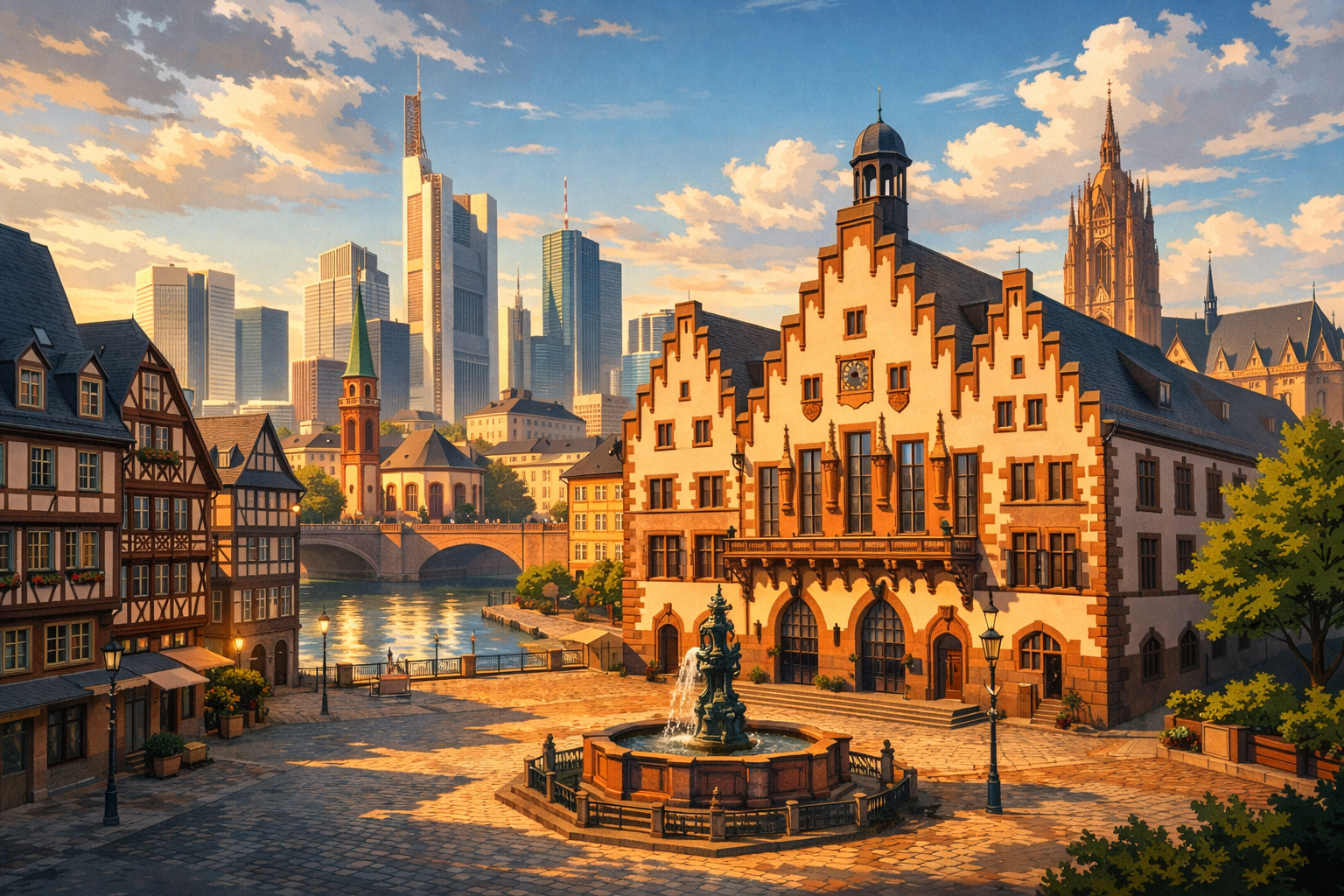
Frankfurt, Old Town and Römer

Frankfurt, Old Town and Römer

Germany blends storybook squares with sleek city energy, and Frankfurt am Main is a perfect place to feel both. Wander from the Old Town and Römerberg to the Kaiserdom, then spend the afternoon in the central museums before ending with a relaxed walk along the Main.

🧭 DAY-BY-DAY ITINERARY

Ready-made country and city routes with daily plans, sights, transport and accommodation. Buy PDF guides for independent travel.

🧭 DAY-BY-DAY ITINERARY


Day 1 — Arrival in Frankfurt and first acquaintance with the Dom-Römer quarter

  • ✈️ Arrival in Frankfurt am Main. From the airport, the historical center is conveniently reached by the S-Bahn suburban train to the Hauptwache or Konstablerwache area, and then on foot, or by taxi/transfer. On average, the journey to the Old Town area takes about 25–30 minutes by train and about 20–30 minutes by car without heavy traffic; including leaving the terminal and a short walk to the hotel, it is reasonable to allow about 40–55 minutes in total.

  • 🚶 After check-in, keep the evening light and beautiful: walk through the Neue Altstadt quarter, where careful modern reconstruction has returned to the center of Frankfurt the scale of narrow lanes, the silhouettes of gables, the coziness of stone passages, and the feeling of medieval density. It is especially pleasant not to hurry here: at dusk the facades look almost theatrical, while the paving stones, small squares, and the view of the Kaiserdom tower immediately set the tone for the whole journey.


Day 2 — Römerberg and the Römer: the heart of the free imperial city

  • 🚶 Dedicate the day to Römerberg, Frankfurt’s main historic square. What matters here is not only its “picture-postcard” quality, but also the political memory of the space: it is here that one feels especially clearly that Frankfurt was not just a trading city, but a place of imperial ceremonies, urban autonomy, and centuries-old civic culture. The Römer complex, with its stepped facades, is perceived as a stage for German urban history: from medieval self-government to ceremonial receptions and official events.

  • ☕ After the main walk, take a break on the square or in one of the nearby cafés. It is convenient to allow 3–4 hours for Römerberg, the exterior facades of the Römer, the neighboring lanes, and short photo stops, and then leave 1–1.5 hours for a relaxed lunch and rest — the historic center is best experienced here without rushing.

Day 3 — Kaiserdom of St. Bartholomew: the vertical of power, memory, and Gothic

  • 🚶 The Kaiserdom of St. Bartholomew is one of the main architectural dominants of historic Frankfurt. Although formally it is not a bishop’s cathedral, it is here that the city’s connection with the history of the Holy Roman Empire is read most vividly: the elections and coronation traditions of German rulers made this church one of the most significant symbols of the political geography of Central Europe. Red sandstone, powerful Gothic massing, an elongated interior space, and a high tower create an image that is austere, solemn, and almost “state-like” in mood.

  • 🚶 If you have the energy, climb the tower: it is not just a panoramic viewpoint, but a way to see how the medieval core is embedded within the modern financial city. For visiting the interior, exploring the cathedral surroundings, and a possible tower climb, it is sensible to plan about 2.5–3 hours, followed by a break of at least 45–60 minutes in the shade of the square or at a nearby restaurant.

Day 4 — Dommuseum Frankfurt: cathedral treasures and the archaeology of sacred memory

  • 🏛️ Today, focus on Dommuseum Frankfurt. This museum matters as the “quiet depth” of the route: if the cathedral gives a monumental image of history, the museum allows you to come closer to the details — liturgical objects, the church treasury, textiles, decorative fragments, and archaeological layers that connect architecture with ritual, power, and memory. It is especially interesting here to observe how church art functions not only as aesthetics, but also as a language of status, faith, and urban identity.

  • 🚶 After the museum, take a short walk around Domplatz and the neighboring streets without a packed program. This day is best kept more intimate: 1.5–2 hours for the museum, then lunch and a slow evening. This kind of “lighter” day makes the second half of the route much more enjoyable.

Day 5 — Historisches Museum Frankfurt: the city as a layered historical organism

  • 🏛️ Historisches Museum Frankfurt on Römerberg is a key point for understanding Frankfurt itself. It is important to look at it not as a set of display cases, but as a major interpretation of the city: a medieval trading center, a place of imperial rituals, a bourgeois urban world, modernization, wartime destruction, and complex postwar reconstruction. It is especially valuable that the museum combines the old buildings of the Saalhof complex with a modern museum language, and this itself becomes an architectural statement about continuity.

  • 🚶 After the museum, return to Römerberg and try to see the square with an already “prepared eye.” After the historical context, the facades, the riverside relief, and the logic of the old core are read differently. It is worth setting aside 3–4 hours for the museum, plus at least 1 hour for rest.

Day 6 — Frankfurt Archaeological Museum: the underground roots of the city

  • 🏛️ Archäologisches Museum Frankfurt helps you go even deeper — to the prehistoric and early historic, Roman, and early medieval layers of the region. This is especially important for a historical tour of the Old Town: modern Frankfurt seems very composed and clear, but archaeology shows that beneath this clarity lie centuries of changing settlements, sacred spaces, defensive structures, and craft zones. For lovers of ancient architecture, this is a day not about a “beautiful facade,” but about the foundation of civilization.

  • 🚶 The museum is conveniently combined with a leisurely walk to the former Carmelite monastery and then back to the center. Distances here are short: within the central zone, many points can be reached on foot in 10–20 minutes, which makes the day comfortable even without transport.

Day 7 — Kaiserpfalz Franconofurd and early medieval Frankfurt

  • 🏛️ One of the most substantial days of the route is devoted to Kaiserpfalz Franconofurd, an archaeological space connected with the early royal and imperial history of Frankfurt. Here one feels especially sharply that the city did not grow “around a beautiful square,” but from a politically important node of the early Middle Ages. The remains of the palace, archaeological structures, and explanations of the historical context help imagine what Frankfurt was like even before the Gothic and late medieval urban scene familiar to us.

  • 🚶 This day is best structured as an intellectual walk: museum-archaeological block in the morning, then a long lunch and an evening without a packed program. The material here is dense, and it is better to leave yourself time to “finish seeing it mentally” while already walking through the streets of the Old Town.

Day 8 — SCHIRN Kunsthalle Frankfurt and the space between the cathedral and the Römer

  • 🏛️ Although SCHIRN Kunsthalle Frankfurt is not directly related to ancient architecture, it stands at an exceptionally important point between the cathedral and the Römer and helps you feel how modern cultural Frankfurt is embedded in the historic core. This is a good day for a change of rhythm: after several history-filled days, you see how the old town lives today — not as an open-air museum, but as a real cultural space.

  • 🚶 The main emphasis of the day is not only the exhibition, but also the urban corridor around SCHIRN itself: the junctions of passages, the proximity of Römerberg, the perspective toward the cathedral, and the neighborhood with the reconstructed New Old Town. After lunch, it is good to leave time for sitting calmly on the square and observing city life.

Day 9 — The Dom-Römer quarter in detail: half-timbering, passages, facades, textures

  • 🚶 After the main museums and key monuments, dedicate the day to a “slow reading” of the quarter between the cathedral and the Römer. The point of the day is to notice details: how the gables are arranged, how narrow the passages are, how the scale of the street changes at every turn, and how wood, plaster, stone, and red sandstone create a complex, almost scenographic image of the Old Town. Even the reconstructed houses here are interesting not only visually, but also as a cultural gesture — an attempt to return historical density and human scale to the lost urban fabric.

  • 📷 This is the best day for photos early in the morning or closer to sunset. Without a heavy museum load, you can calmly alternate short walks of 60–90 minutes with breaks for coffee and rest. In a historical route, such “airy” days are especially valuable: they are exactly what fix the impression of the city in memory.

Day 10 — The Main, Eiserner Steg, and panoramas of the old core

  • 🚶 To understand Frankfurt as a complete urban organism, you need to see the historic center from the side of the Main. Walk to the embankment and across Eiserner Steg — a pedestrian bridge from which the city’s contrast opens up especially expressively: on one side, the cathedral tower, the Römer, and the old core; on the other, the high-rise silhouette of business Frankfurt. This visual dialogue between medieval and modern is almost ideal here.

  • 🌇 The second half of the day is perfect for rest: a walk along the river, a light lunch, and stops at viewpoints. The route itself is not difficult, but emotionally very rewarding. It is convenient to allow 2–3 hours of unhurried time for the embankment and bridge, plus a separate pause for sunset.

Day 11 — Spare historical day: returning to favorite spots and additional central museums

  • 🚶 It is best to keep this day flexible. It can be used for a repeat visit to a museum you liked, climbing the cathedral tower in good weather, extra time at Historisches Museum Frankfurt, or a calm return to Römerberg early in the morning, when the square is still almost empty. It is at such hours that old Frankfurt looks especially expressive: without the crowd, the proportions, rooflines, and drama of the space are easier to read.

  • ☕ Do not overload the program: plan no more than 1–2 main points and a long break. A historical tour benefits when there is room not only for “visiting,” but also for contemplation.

Day 12 — Final walk around the Römer and departure

  • 🚶 Before departure, return to the heart of the route: a short final walk through Römerberg, the lanes of the New Old Town, and toward the cathedral helps gather the whole route into a single line — from the early medieval palace and archaeology to the Gothic vertical of the Kaiserdom and the civic space of the Römer. In this trip, Frankfurt reveals itself not as a city of one symbol, but as a rare combination of political, ecclesiastical, and urban history.

  • 🚆/✈️ Departure for the airport. If you are traveling by public transport, it is worth allowing about 25–30 minutes on the S-Bahn from the Old Town area to the airport, plus time for the walk to the station and terminal procedures. For a taxi or transfer, a reasonable estimate is 20–30 minutes on the road, but during busy hours it is better to have extra time in reserve.

Flight tickets

eSIM for travel

Buy PDF guide

Buy PDF guide — 25.71 USD

PDF — 25.71 USD