
Buy PDF guide

Buy PDF guide — 25.71 USD

PDF — 25.71 USD

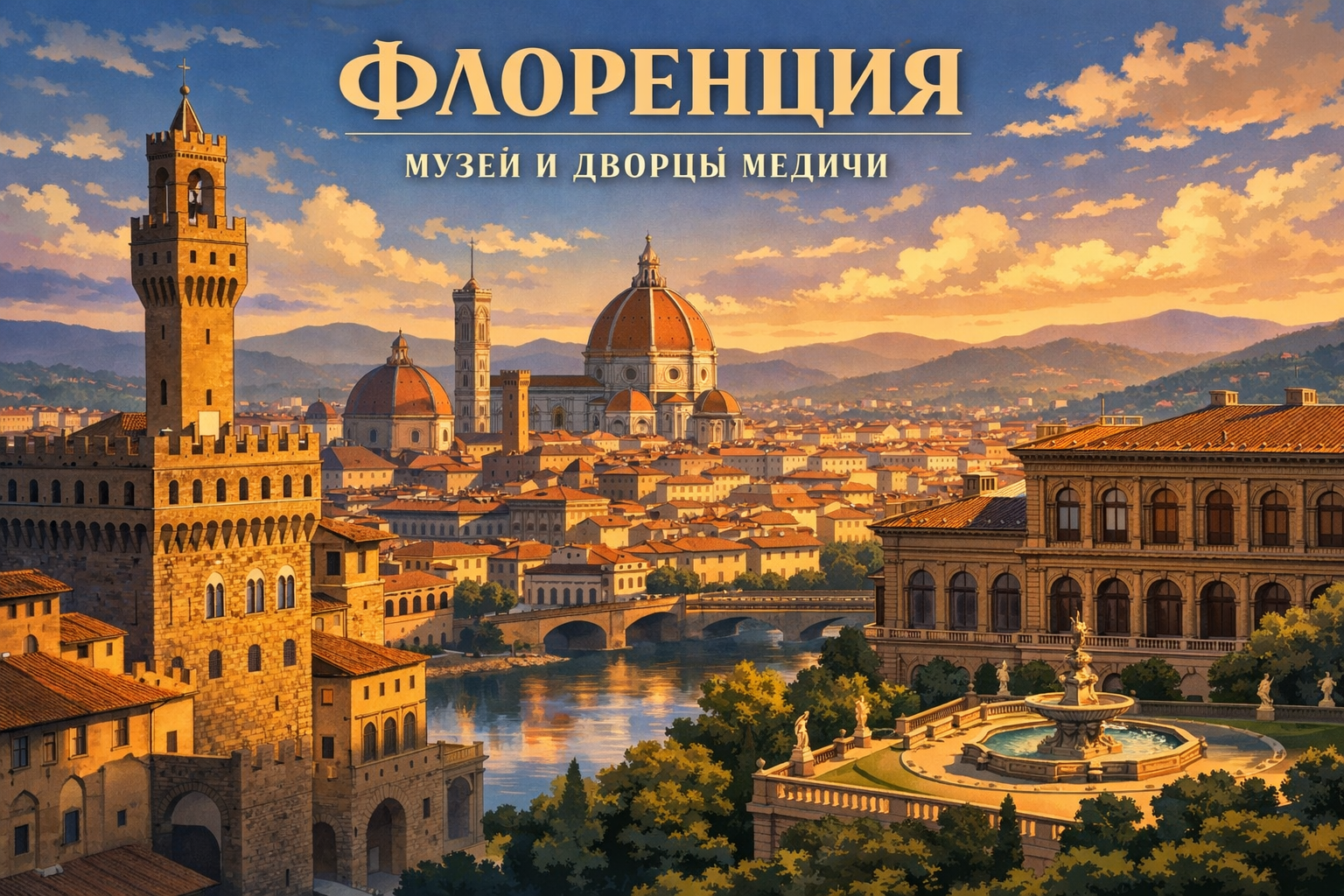
FLORENCE • MEDICI MUSEUMS AND PALACES

FLORENCE • MEDICI MUSEUMS AND PALACES

Trace the Medici legacy through Florence’s museums and palaces, on to hilltop Fiesole and the serene villas of Castello, La Petraia, and Poggio a Caiano. Sweep across Tuscany to Pisa’s dazzling Piazza dei Miracoli and Siena’s medieval heart before circling back to Florence for a grand finale.

🧭 DAY-BY-DAY ITINERARY

Ready-made country and city routes with daily plans, sights, transport and accommodation. Buy PDF guides for independent travel.

🧭 DAY-BY-DAY ITINERARY


Day 1 — Florence: a first look at the city of the Medici

  • 🚶 Arrival and an easy walk through the historic center: Piazza del Duomo with the dome of Santa Maria del Fiore, Giotto’s bell tower, and the baptistery as an “architectural prologue” to the whole trip. Read the facades like a text: striped marble graphics, proportions, the rhythm of pilasters—this will all become a useful “template” for taking in Renaissance palaces.

  • ☕ Evening: the Piazza della Signoria area and the Loggia dei Lanzi—a public stage of the city, where power and art have always stood side by side. Night lighting makes the volumes and stone sculpture especially expressive.


Day 2 — Uffizi Gallery: a “pantheon” of painting and courtly taste

  • 🚶 The Uffizi is not only a collection of masterpieces, but also a statement about the power and enlightenment of rulers. Read the sequence of rooms as a “curated history”: from Giotto and Simone Martini to Botticelli, Leonardo, and Michelangelo. The corridor windows are important “pause shots”: the Arno, Ponte Vecchio, and Palazzo Vecchio bring together the dynasty’s urban context.

Day 3 — Palazzo Vecchio: a palace of power and the stage for civic ceremonies

  • 🚶 Palazzo Vecchio is a fortress-city, where a stern stone shell hides ceremonial interiors. The Hall of the Five Hundred is an architectural “machine” for the rhetoric of power; the apartments of Eleonora of Toledo are Renaissance coziness and the iconography of status. In the courtyard—Della Robbia ceramics; from the tower—a panorama like a textbook of Florence’s topography.

Day 4 — Pitti Palace and the Boboli Gardens: from a private palace to a “landscape theater”

  • 🚶 The Pitti Palace is the residence of the Medici grand dukes, with the Palatine Gallery. The Boboli Gardens are a model of an Early Modern court park: amphitheater, perspective alleys, grottos, ancient sculptures. It’s ideal to come in the morning: softer light and fewer people, and the terraced volumetric composition reads better.

Day 5 — San Lorenzo and the Medici Chapels: the “family necropolis” and Michelangelo’s genius

  • 🚶 The Basilica of San Lorenzo is the Medici “house church”; continuing on—the Medici Chapels: the Chapel of the Princes with polychrome stones and Michelangelo’s New Sacristy (the allegories “Day/Night,” “Dawn/Dusk”). Outside, note the Laurentian Library—a rare case when a staircase’s architecture becomes an independent manifesto.

Day 6 — Bargello and “sculptural Florence”: Donatello, Verrocchio, Cellini

  • 🚶 The Bargello Museum shows the Renaissance’s “physicality”: bronze and marble without a painterly “translation.” Compare Donatello’s Davids (bronze and marble), see Giambologna’s “Mercury,” and trace how the logic of using inner courtyards and halls changes as a medieval palace becomes a museum.

Day 7 — Fiesole: an ancient theater and baths on a hill above the Arno

  • 🚌 Transfer from central Florence to Fiesole (≈ 25–35 min).

  • 🚶 The Fiesole archaeological area is a rare chance to “read” the plan of an ancient city in the natural terrain. The theater with modern seating, fragments of the baths, and the temple plateau add context to the Roman collections you saw in museums.

Day 8 — The Medici Villas near Castello: La Petraia and the Villa di Castello garden

  • 🚌 North of Florence (Castello district): a short half-day trip (one way ≈ 30–45 min including waiting).

  • 🚶 Villa La Petraia offers intimate interiors, terraces, and a view of Brunelleschi’s dome from a “family residence.” The neighboring Garden of Villa di Castello is an exemplary Mannerist garden with grottos and fountains. Look at the axes, terraces, and water accents—this is the Renaissance’s “landscape geometry.”

Day 9 — Poggio a Caiano: the “Villa Ambra” and the Still Life Museum

  • 🚌/🚆 Transfer from Florence (train to Prato + bus or a direct bus; one-way travel time usually 60–90 min).

  • 🚶 The Medici Villa in Poggio a Caiano is a prototype of an enlightened country residence: loggia, pediments, Sangallo’s clear symmetry. Inside—frescoes and the Still Life Museum with courtly “quiet” masterpieces: the Medici court’s inventory-like aesthetic.

Day 10 — Pisa: Piazza dei Miracoli and “Romanesque whiteness”

  • 🚆 Train Florence SMN → Pisa Centrale (≈ 60–80 min; per timetable). From the station—bus/on foot to the square. The cathedral complex (cathedral, baptistery, Campo Santo, and the Tower) shows the Tuscan version of Romanesque: marble facades, arcaded bands, sculpture as “facade prose.”

Day 11 — Siena: Gothic in stone and marble

  • 🚌 Fast bus 131R Florence Bus Station → Siena (≈ 1h 15m) or train (longer, with a transfer).

  • 🚶 Siena Cathedral — a marble “striped” cosmos and the Piccolomini Library; nearby is Santa Maria della Scala, a giant hospital complex where architecture is a labyrinth of levels, vaults, and pilgrim logistics.

Day 12 — Finale in Florence: Galileo’s science and monastic cloisters

  • 🚶 Museo Galileo — the shift from the Renaissance “artist’s eye” to optics and the precision of measurement. To finish — the museum and cloisters of Santa Maria Novella: fresco cycles as the city’s “quiet encyclopedia.” In the evening — a farewell view of the Arno and Ponte Vecchio.

Flight tickets

eSIM for travel

Buy PDF guide

Buy PDF guide — 25.71 USD

PDF — 25.71 USD