
Buy PDF guide

Buy PDF guide — 12.85 USD

PDF — 12.85 USD

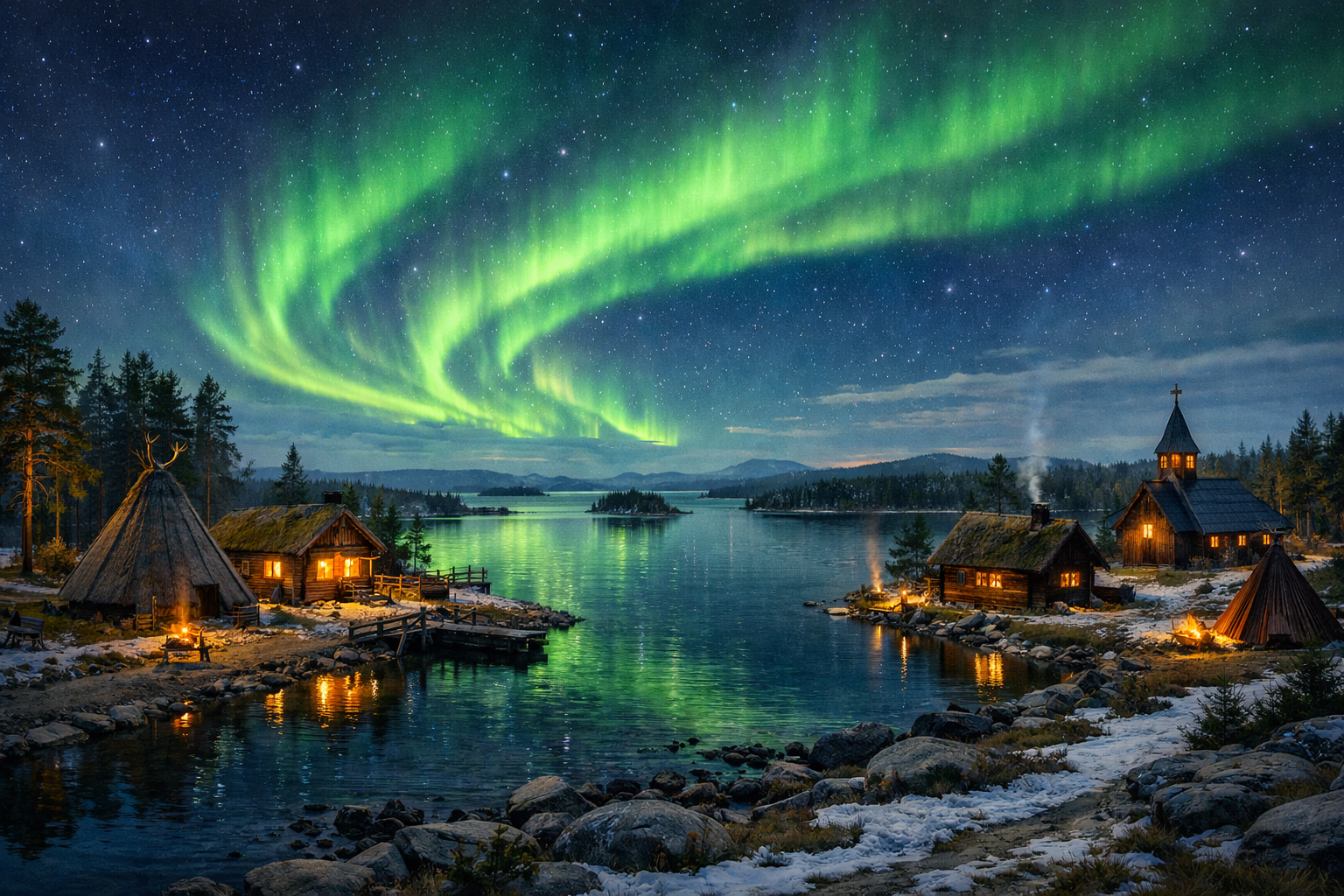
Finland, Inari and Lake Inari. A peaceful Arctic route with Northern Lights viewing over the lake, an introduction to Sámi culture, and overnight stays بعيد from light pollution.

Finland, Inari and Lake Inari. A peaceful Arctic route with Northern Lights viewing over the lake, an introduction to Sámi culture, and overnight stays بعيد from light pollution.

Follow a peaceful Arctic route from Ivalo to Inari and Lake Inari, where dark, quiet skies set the stage for Northern Lights dancing above the water. Along the way, discover Sámi culture and settle in for remote overnight stays far from light pollution.

🧭 DAY-BY-DAY ROUTE

Ready-made country and city routes with daily plans, sights, transport and accommodation. Buy PDF guides for independent travel.

🧭 DAY-BY-DAY ROUTE


Day 1 — Ivalo → Inari: a gentle entry into the Arctic and the first hunt for the sky

  • ✈️ The main arrival point for this route is Ivalo Airport, the northernmost airport in Finland. From here to the village of Inari it is usually about 45–50 minutes by car or transfer, so the route stays compact and free of exhausting long drives. For a 6-day trip, this is one of the most logical formats: fly into Ivalo, pick up a car, and already on the first day reach the shores of Lake Inari, where light pollution is noticeably lower than in large cities.

  • 🚗 After arrival, it is best not to overload the day with activities: pick up your car, buy water, a thermos, and simple snacks in Ivalo, and calmly head to Inari. The road runs through the northern landscapes of Lapland, where the drive itself feels like part of the journey: sparse forest, open spaces, a low Arctic sky, and the feeling that civilization is gradually dissolving. In winter and the shoulder seasons, it is especially important not to plan a tight schedule right after your flight: short daylight hours, possible snow, ice, and travel fatigue make a calm pace the wisest choice.

  • 🌌 Dedicate the evening to your first outing to Lake Inari. If the weather is clear, without dense cloud cover, and the Moon is not too bright, you may already see an impressive starry sky on the first night and, with suitable geomagnetic activity, the northern lights. But this is always a matter of probability: even in a good region, it can never be guaranteed. The best approach is to treat the evening as an observation of the Arctic night as a whole, not as a hunt for a mandatory result.

  • 🛟 For your first nighttime stop, choose the simplest and safest point possible near your accommodation or with easy access by the shore, rather than distant unserviced forest areas. In September darkness falls faster, but in autumn wind and damp cold are possible; from December to March there is also ice, snowbanks, slippery parking areas, and the risk of drifts. Be sure to have a headlamp with a red mode, warm layers, a reflective element, and do not head into an unfamiliar forest at night without a marked trail.


Day 2 — Inari: Siida Museum, Sámi culture, and a quiet evening by the lake

  • 🏛️ Dedicate the morning to Siida — it is one of the key cultural places in the whole region and probably the best place not just to “see Lapland,” but to understand how the Sámi have lived and still live here, how the Arctic natural cycle works, and why the northern landscape cannot be seen only as a beautiful backdrop for photographs. The exhibitions help reveal the connection between the landscape, seasonality, reindeer herding, water, winter roads, traditional livelihoods, and the modern identity of the Sámi region.

  • 🚶 After the museum, take a leisurely walk around the village of Inari and along the shoreline near Siida. This day is intentionally left light: after the flight and the first nighttime outing, your body needs a rhythm without rushing. Nature works subtly here — low northern light, pines, water, silence, a wide sky. Even a short walk in Inari gives a sense of Arctic depth, especially in September and October, when twilight paints the lake in steel and copper tones, and in the frosty months snow makes sound almost disappear.

  • 🌠 If your trip falls during a notable meteor shower period or simply on moonless clear nights, this evening is again worth dedicating to sky watching. For stargazing here, three factors matter: cloud cover, the Moon phase, and the absence of extra light. Ideally, night outings should be planned close to the new moon or on days with a thin crescent, because bright moonlight noticeably “eats up” faint stars and makes the sky less expressive, although a bright aurora can still be visible with the Moon out.

  • 📡 Before going out in the evening, check the cloud and space weather forecast. In Finland, it is convenient to use the Finnish Meteorological Institute services: they provide information on clouds, the probability of aurora activity, as well as sunset times, moonrise, and the general geomagnetic situation. It is important to remember that a high activity level on a graph still does not mean visible aurora right above you: local cloud cover and broken skies often matter more than pretty numbers in an app.

Day 3 — Inari: the trail to Pielpajärvi Wilderness Church and a night away from excess light

  • 🥾 Today is the most “nature-focused” day, but it still remains easy in terms of difficulty if you walk at a calm pace and do not turn the outing into a sporty hike. The route to Pielpajärvi Wilderness Church runs through ancient pine forests and small marshy woodland sections. It is one of those rare northern walks where the cultural site does not appear immediately, but seems to grow out of the silence: the old church in forest isolation is perceived not as a separate attraction, but as part of the Arctic landscape.

  • ⛪ Pielpajärvi Wilderness Church is a historic place that is best visited during the day, so you do not risk being on the trail in the dark. In a dry autumn, the route is pleasant and meditative, while in winter or during icy conditions you need to watch your step especially carefully and check the trail condition in advance, because this trail does not have winter maintenance in the classic urban sense. It is an easy walk for a prepared traveler in proper footwear, but not a walk “in sneakers after dinner.”

  • 🌌 After the daytime route, rest at the hotel and closer to evening head to a specially chosen dark location by the lake or an open area without lamps and without direct glow from the village. The idea of this day is not to chase the number of spots, but to gradually immerse yourself in northern darkness. In clear weather above Lake Inari, reflections of stars, broken bands of the Milky Way, and the movement of clouds are often especially beautiful, and if the geomagnetic conditions line up well, the aurora may appear as a thin arc or as moving curtains — but no scenario can be promised in advance.

  • 🔥 If your accommodation offers organized aurora outings or suggests safe viewing points, it is worth using them. For an easy trip, this format is often more sensible than searching independently in complete darkness at night. The important principle of the route is this: nighttime observations should be beautiful, but not heroic. If the wind strengthens, snow begins, the temperature drops sharply, or visibility on the road becomes poor, it is better to shorten the session and move the attempt to the next night.

Day 4 — Inari → Otsamotunturi viewpoint or Juutua Trail: a day of views and northern silence

  • 🌲 On the fourth day, it is best to choose one of two scenarios depending on how you feel, the season, and the weather. If you want a very easy format, choose Juutua Trail: it is one of the most pleasant routes near Inari, where you can walk a beautiful stretch by the Juutuanjoki River, see rapids, a suspension bridge, and northern forest without overexertion. This option is especially good in winter, when long hikes are unnecessary and it is better to save energy for the evening sky.

  • ⛰️ If conditions are dry, your footwear is suitable, and the group enjoys a moderate walk with a panoramic goal, you can make a daytime outing toward Otsamotunturi. The climb should not be seen as a mandatory part of the route: it is an option for good weather. But it is from the higher points that some of the most expressive views of Lake Inari and the surrounding fells open up. In clear light, the northern landscape here feels almost endless — the lake breaks into bays and islands, the forests recede into gray-blue layers on the horizon, and the sky takes up almost half the impression.

  • 📸 This day is great for twilight photography and the “blue hour.” In autumn and winter, northern light lingers for a long time between day and night, and it is at this time that the landscape looks especially cinematic. But it is important to return to base before full darkness if your route follows trails: nighttime descents on icy or snowy surfaces for the sake of beautiful photos are not justified.

  • 🌠 In the evening — another observation attempt. The most comfortable rhythm for such a tour is: daytime rest, an early dinner, then a short sleep window or a calm pause, and after that a drive based on the actual cloud forecast. Sometimes in Lapland, the best chance comes not from an “ideal plan,” but from being ready to drive at a specific hour to where the sky has suddenly cleared. If the sky remains closed, the evening can still be devoted to the Arctic landscape, the light on snow, silence, and slow cloud watching — that too is part of the essence of a northern route.

Day 5 — Inari → Ivalo: glass cabins, gentle relaxation, and the final strong night

  • 🚗 Today it makes sense to move closer to Ivalo and spend the last full night in accommodation designed specifically around the Arctic sky. This ending works well logistically: the next day the road to the airport is short, and you do not have to rush on departure day from a remote location. The drive from Inari to Ivalo usually takes about 40–50 minutes, so the day can be spent without fuss.

  • 🛖 If you choose a glass cabin or aurora-cabin format, that does not remove the need to check the forecast, but it does make observation more comfortable. Such hotels are especially convenient in the cold months: you can wait out the wind, step outside only when there is a real clear window, and avoid spending the entire night on an open shore. At the same time, it is important to understand honestly: even the most beautiful aurora cabins do not guarantee the lights. They offer comfort, a view, and atmosphere — not a promise of the phenomenon.

  • 🦌 The day can be complemented with a short cultural or nature activity in the Ivalo area or with time in a sauna. After several nights in “waiting for the sky” mode, it is good for the body to recover. For an easy route, comfort is part of the concept, not a compromise. The North is best experienced not through exhaustion, but in a state where you notice details: pink glow on the snow, steam above the river, the black silhouette of pines, the creak of the boardwalk under your boots, and a sudden break in the clouds on the horizon.

  • 🌌 Dedicate the last night to the most disciplined observation attempt: mark 1–2 backup points in advance, check the moon phase, the cloud map, and the travel time from the hotel. Do not stand by the highway, do not block pull-offs, do not step onto questionable ice, and do not go far into the darkness alone. If the weather aligns well, this is often the night that feels like the culmination of the trip; if not, the experience of Arctic solitude will still remain complete.

Day 6 — Ivalo: a calm finish and departure

  • ☕ It is best to leave the final day as free as possible. After nighttime observations, do not plan long activities: sleep in, have breakfast, if you wish take a short walk along the river in Ivalo, or simply give yourself time to pack calmly. This is especially important in winter, when a morning departure may require clearing snow off the car, allowing extra time for a slow road, and avoiding stress because of weather conditions.

  • 🚘 Before heading to the airport, check the road conditions and traffic cameras. In northern Finland, weather changes quickly: visibility, snow, ice, and road maintenance can affect the real travel time. In practice, it is better to leave with extra time, even if your hotel is only 10–15 minutes from Ivalo Airport.

  • 🌍 This 6-day route is designed not as a “tick the aurora off the list,” but as a gentle immersion into Arctic nature and the Sámi North. The main result here is not a guaranteed sky show, but the combination of dark lakeshores, the cultural depth of Inari, safe nighttime observations, winter silence, and a sense of space that is very rare in Europe.

Flight tickets

eSIM for travel

Buy PDF guide

Buy PDF guide — 12.85 USD

PDF — 12.85 USD