
Buy PDF guide

Buy PDF guide — 6.43 USD

PDF — 6.43 USD

Estonia, Tartu. A budget trip to a student city with museums, street art, a riverside promenade, and a calm youthful atmosphere. Season: May - September.

Estonia, Tartu. A budget trip to a student city with museums, street art, a riverside promenade, and a calm youthful atmosphere. Season: May - September.

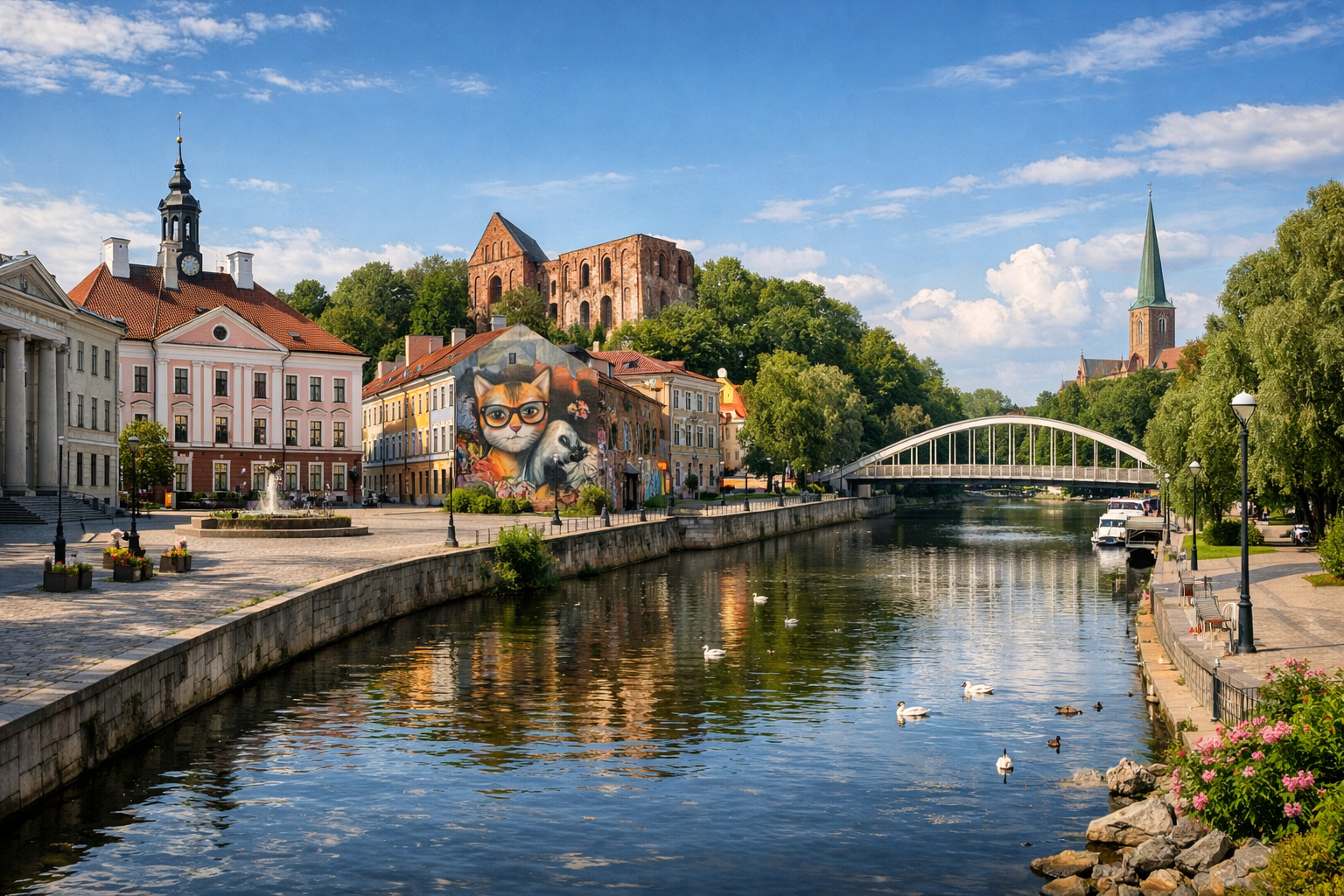
Discover Tartu, Estonia’s laid-back student city, where colorful street art, thoughtful museums, and a scenic riverside promenade make it easy to fill three budget-friendly days. From May to September, the city feels calm, youthful, and full of light, with café terraces and green riverfront walks at their best.

🧭 DAY-BY-DAY ITINERARY

Ready-made country and city routes with daily plans, sights, transport and accommodation. Buy PDF guides for independent travel.

🧭 DAY-BY-DAY ITINERARY


Day 1 — Old Tartu, university hill, and an evening by the river

  • 🚆 If you are flying into Tallinn or arriving there the day before, the most budget-friendly and realistic way to get to Tartu is by intercity bus or train. By bus, Tallinn → Tartu usually takes about 2.5–3 hours; by Elron train, about 2–2.5 hours depending on the service. To save money, it is best to buy tickets online in advance: promo bus fares can sometimes be noticeably cheaper than standard ones, while the train is convenient because it arrives directly in the city without extra transfers. Once you arrive in Tartu, it is convenient to check into accommodation near the center or the railway station, leave your bags, and then spend almost the whole day on foot — this is the most budget-friendly format for a compact student city.

  • 🚶 Start getting to know Tartu from Town Hall Square and the surrounding old town. This is not a grand metropolis, but a city that charms precisely through its human scale: here it is easy to feel the rhythm of university life, where historic facades, coffee shops, bookstore windows, and calm walks naturally blend into one atmosphere. On the square you are welcomed by the famous Kissing Students fountain — almost the perfect symbol of Tartu, where romance, youth, and the habit of living without haste can literally be felt in the air. From here, it is easy to take a slow walk to the main building of the University of Tartu, admire the classical architecture, and imagine how for almost four centuries this city has lived around knowledge, student conversations, and cultural events.

  • 🚶 Then head up Toomemägi — the university hill, where the soft, slightly intellectual soul of Tartu is felt best. Here you will find the ruins of the cathedral and the University Museum at Lossi 25. Even if you are not planning a major museum morning, the walk up the hill itself is worth your time: old trees, stairways, brick ruins, quiet alleys, and viewpoints create the mood not of a noisy capital, but of a city where it is pleasant to linger. In good weather from May to September, this is one of the best places simply to walk without rushing, listen to birds, and catch that rare urban calm for which people often come to Tartu.

  • 🏛️ If you want an inexpensive cultural stop already on the first day, visit the University of Tartu Museum. It is located inside the former cathedral complex and tells not only the history of the university, but also of the city itself, science, old academic life, and local identity. The museum format works especially well for a budget trip: you get a meaningful experience without feeling that you need to dedicate a whole day and a big budget to it. In the May–September season, the cathedral towers are also accessible here, and if you have the energy, the climb adds a beautiful panoramic view over treetops, rooftops, and the calm silhouette of the city.

  • 🚶 After lunch, walk to the Emajõgi riverfront. The new city promenade and the stretches along the river are one of the most pleasant free elements of the route. Here Tartu reveals itself not as an open-air museum, but as a living young city: someone sits on the steps by the water with coffee, someone reads a book, someone rides a bicycle, and someone simply looks at the river in silence. In the evening, the soft light makes the walk especially beautiful: bridges, water reflections, and quiet city life create exactly that calm youthful atmosphere that sets Tartu apart from more touristically intense places.

  • 🍜 For a budget dinner, look for simple daytime cafés, lunch-spot canteens, bakeries, and inexpensive Asian/burger places in the center. A realistic benchmark for affordable food in Tartu is about €8–15 for a filling meal, €4–7 for soup, pastries, or a light lunch, and €2.5–4.5 for coffee. On the first day, it is better not to plan expensive restaurants: the old town and the riverside area are full of places where you can eat simply, safely, and without overpaying for a “view” table.

  • 💤 It makes sense to spend the night in a budget hostel or a simple central hotel. For a low-cost trip, expect roughly €25–45 for a hostel bed or a simple room in very basic accommodation and about €55–90 for an inexpensive private room in a good, logistically convenient hotel. Distances in Tartu are small, so overpaying for taxis and “super-central” locations is usually unnecessary.


Day 2 — Estonian National Museum, street art, and creative Tartu

  • 🚌 Dedicate the morning to the main museum highlight of the trip — the Estonian National Museum at Muuseumi tee 2. It is easy to get here from the center by city bus No. 7; the ride usually takes about 15–20 minutes without needing a taxi. This is an important detail for a budget itinerary: the museum is not within walking distance of the old core, but it is easy and inexpensive to reach by public transport. For non-residents of Tartu, after the fare changes from July 1, 2026, you should budget approximately €1.8 for a one-hour ticket or about €4.5 for a day ticket if you plan several rides during the day.

  • 🏛️ The Estonian National Museum is one of the strongest reasons to come to Tartu even for a short stay. It is the country’s largest museum, but it impresses not only by its scale: the space is designed so that history, ethnography, memory, and contemporary cultural identity are presented not dryly, but in a very visual and lively way. Here you can literally walk through layers of Estonian everyday life, language, traditions, and the northern sensitivity to home, landscape, and objects. Even if you are not a museum fan, this place works as a key to the country: after a visit, both Tartu and Estonia as a whole become much more understandable and deeper.

  • 💰 To keep the trip budget-friendly, on the second day it makes sense to choose one “big” paid museum and build the rest around free walks. For ERM, plan about 2.5–4 hours without trying to see absolutely everything. This way the itinerary stays rich but not exhausting. After the museum, do not rush back: around it there is openness, modern architecture, and a sense of air — a rare combination of museum depth and calm without big-city hustle.

  • 🚶 After returning to the center, dedicate the second half of the day to street art. Tartu is deservedly called the Estonian capital of street art: here murals, stencils, and unexpected urban works do not look like random noise, but become part of the city’s image. One of the most interesting low-budget formats is a walk without a strict goal through the center, former industrial quarters, and underpasses beneath bridges, where contemporary art suddenly appears on a wall, the side of a building, or under a concrete arch. It is especially worth visiting the street art gallery under Vabaduse sild bridge — this is not a museum with a ticket desk, but a living urban scene that is constantly changing.

  • 🎨 After that, go to the Aparaaditehas district — one of the most atmospheric places in modern Tartu. A former industrial space has turned into a creative cluster with workshops, small shops, cafés, courtyards, and a constant feeling that the city speaks a contemporary language here, but without forced trendiness. For a budget traveler, this is almost an ideal environment: walking is free, taking photos is interesting, you can grab a bite without high bills, and the location itself gives that “young” urban vibe for which many people choose Tartu over glossier destinations.

  • 🍲 For dinner, it is better again to stick to a simple strategy: choose a lunch offer, soup of the day, pizza by the slice, noodles, kebab, or a basic local menu. A comfortable budget for the whole second day, excluding accommodation and the intercity transfer, can usually be kept within about €25–45 per person: city transport, one major museum, two inexpensive meals, and coffee/dessert on the way.

Day 3 — AHHAA, botanical garden, calm walks, and departure

  • 🏛️ On the third day, choose between two paces: active and very relaxed. If you want one more vivid paid stop, head to the AHHAA Science Centre at Sadama 1. It is conveniently located not far from the center and the river, so it is easy to fit into the morning before departure. This is a modern interactive space that works well not only for families with children: there are many visual and hands-on elements, a planetarium, experiments, and a feeling that science can be easy, tactile, and alive. But for a truly budget trip, AHHAA should be seen as an option rather than a must, because tickets here are noticeably more expensive than at smaller museums.

  • 🌿 If you want to save more and spend the day at a calmer pace, the best alternative is the University of Tartu Botanical Garden at Lai 38. From May to September this is an especially good choice: the garden itself is open daily, and a walk through the outdoor grounds feels like a small break within the city. It is pleasant to stroll slowly among green zones, rare plants, and old trees, and if the weather is warm, bring a coffee with you and make this one of the coziest spots of the whole trip. For a budget itinerary, the botanical garden is especially good because it offers a beautiful experience without major expenses.

  • 🏛️ If on the first day you did not have time for a small museum, the third day is well suited for an intimate cultural stop: for example, the Tartu Art Museum at Raekoja plats 18 or the Toy Museum at Lutsu 8. The first is suitable for those who like compact exhibitions and contemporary/classical art without overload; the second for those interested in the nostalgic, very warm side of urban culture. On a short trip, do not try to fit in everything at once: it is better to choose one calm museum stop and leave time for the city.

  • 🚶 Before departure, be sure to leave 1.5–2 hours for one final unstructured walk along the river or through the old town. In Tartu, this format is especially valuable — not “checking boxes,” but the chance to simply be inside the city. You can walk the embankment once more, sit by the water, cross a bridge, browse a bookstore, or pick up an inexpensive bun from a bakery. Tartu reveals itself best not through loud attractions, but through gentle everyday life: this is a city where student energy does not make noise, but seems to quietly keep the whole space around it alive.

  • 🚆 For the return trip to Tallinn, allow for the same estimates: Elron train about 2–2.5 hours, bus around 2.5–3 hours. The railway station can be reached on foot from the center in about 20–30 minutes depending on your starting point, or by city bus in 10–15 minutes. If you are leaving from the bus station, it is very conveniently located in relation to the center. Thanks to this, Tartu works perfectly as a short budget city break without unnecessary spending on internal transfers.

  • 💶 Overall, the city itself makes it possible to keep a reasonable budget. In an economical scenario for 3 days, without expensive restaurants and without taxis, expect roughly €140–260 per person for accommodation, local transport, food, and 1–2 paid museums within Tartu. If you add the intercity journey from Tallinn and back, the total budget usually still remains fairly gentle by European standards, especially if you book accommodation in advance and walk more.

Flight tickets

eSIM for travel

Buy PDF guide

Buy PDF guide — 6.43 USD

PDF — 6.43 USD