
Buy PDF guide

Buy PDF guide — 8.57 USD

PDF — 8.57 USD

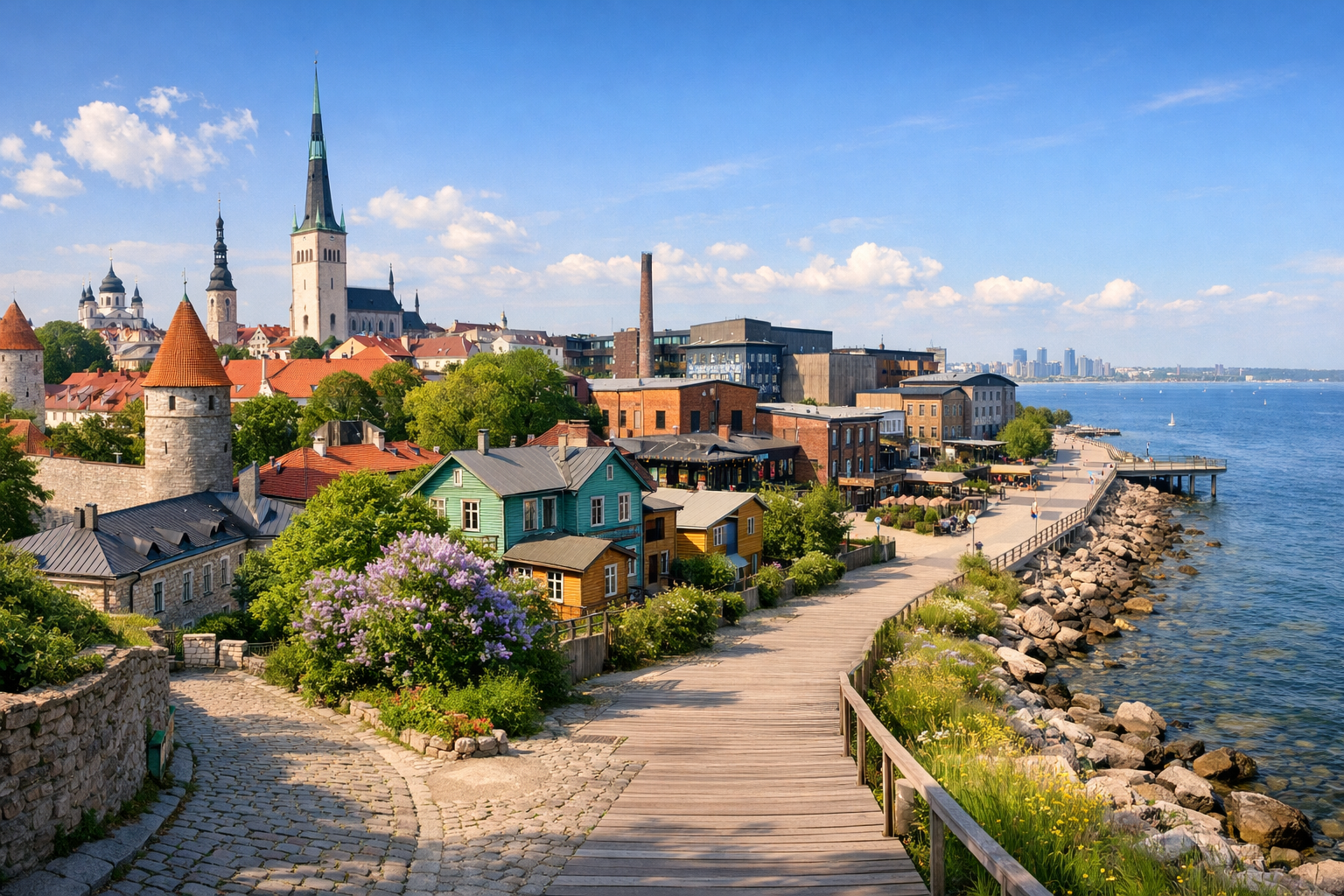
Estonia, Tallinn. An inexpensive city tour of the medieval center, the Kalamaja district, the Telliskivi creative quarter, and the seaside promenade. Season: May - September.

Estonia, Tallinn. An inexpensive city tour of the medieval center, the Kalamaja district, the Telliskivi creative quarter, and the seaside promenade. Season: May - September.

Discover Tallinn from its fairytale medieval Old Town to the wooden houses of Kalamaja and the creative buzz of Telliskivi. Between May and September, this inexpensive city tour finishes with a stroll along the seaside promenade, where fresh sea air and Baltic views round off the day.

🧭 DAY-BY-DAY ROUTE

Ready-made country and city routes with daily plans, sights, transport and accommodation. Buy PDF guides for independent travel.

🧭 DAY-BY-DAY ROUTE


Day 1 — Tallinn: the medieval Old Town

  • 🚶 It’s best to devote the first day entirely to Tallinn’s Old Town — compact, highly photogenic, and at the same time very convenient for a budget-friendly introduction to the city on foot. This is one of those European capitals where the historic center does not feel like a “tourist set,” but genuinely lives: behind the stone facades and Gothic spires, you still find courtyards, workshops, small cafés, and old passageways. Start in the Lower Town — the area around Town Hall Square, where the atmosphere of Hanseatic Tallinn is especially tangible: uneven cobblestones, merchant houses, austere facades, and a sense of Northern Middle Ages without unnecessary pomp. Be sure to stop by the Town Hall Pharmacy — one of the oldest continuously operating pharmacies in Europe, where alongside the working section there is also a small museum space. It is an inexpensive and very distinctive stop that helps you see the city not only as a beautiful postcard, but also as a real trading and craft center with a long history.

  • 🚶 Then make your way up to the Upper Town, Toompea, unhurriedly and with stops at the viewpoints. In Tallinn, it is precisely the changes in elevation that make a walk especially expressive: in just a few minutes you can move from narrow shopping lanes to panoramas of red roofs, church towers, and the gray-blue line of the Baltic Sea on the horizon. The Old Town opens up best from the viewpoints — especially in clear weather from May to September, when the evening light softens the stone walls and the roofs seem to flow down toward the Lower Town like a warm copper carpet. For a budget itinerary, this is an ideal day: almost all the impressions here come from the walk itself, and paid entries can be kept to a minimum. For lunch, it makes sense to choose one of the simple soup or bakery formats at roughly €7–12 per person, and in the evening — affordable local or international cuisine in the range of about €10–16.

  • ⏱️ Day logistics: airport → center by public transport usually takes about 15–25 minutes to the central stops, then another 5–15 minutes to the hotel on foot or by tram. The walk around the Old Town itself, with pauses for photos, coffee, and rest, comfortably takes 6–8 hours. It’s a good day without overload: lots of walking, but almost no long transfers.


Day 2 — Tallinn: Kalamaja and the Telliskivi creative quarter

  • 🚶 The second day is best built around Kalamaja — one of Tallinn’s most atmospheric districts, once a fishermen’s and working-class outskirts, and today a symbol of calm northern urbanism. Here the city is no longer medieval, but wooden, homely, and slightly bohemian: low-rise houses, quiet streets, front gardens, traces of old industry, and the feeling of a neighborhood where it is pleasant not so much to “tick boxes” as simply to wander. It is in Kalamaja that you can especially see how Tallinn manages to be trendy without aggressive gloss. Start the day with a walk along Vana-Kalamaja and the neighboring streets, where characteristic wooden houses and the rhythm of the old port suburb have been preserved. This is an area for a slow pace: takeaway coffee, stops by facades, short peeks into courtyards, and the feeling that the big city has suddenly become almost intimate.

  • 🏛️ If you want an inexpensive and meaningful museum highlight, it is worth including Kalamaja Museum. It is especially good because it tells not about “great rulers,” but about the everyday life of the district and the city, making local history very vivid and accessible. After the museum, it is convenient to head to Telliskivi Creative City — a former industrial area turned into a creative quarter. The energy here is completely different: brick buildings, courtyards with street art, designer shops, small galleries, cafés, workshops, and a space where the industrial past has become part of contemporary urban culture. Even if you do not go into paid exhibitions, the quarter itself is worth a full walk: it is bright, photogenic, and at the same time free as an urban environment.

  • 🍽️ For a budget trip, Telliskivi is also convenient because Balti Jaam Market and various casual dining options are nearby, making it easier to put together an inexpensive lunch. A realistic food range here is about €6–10 for a quick lunch or street food and €10–15 for a more relaxed dinner. From the Old Town to Kalamaja and Telliskivi, it is often more выгодно to walk: the route takes about 15–30 minutes one way, with no transport costs and a good feel for the city’s fabric. If you get tired, you can always add a tram or bus for a short stretch.

Day 3 — Tallinn: the seaside promenade and Seaplane Harbour

  • 🚶 The third day is dedicated to the sea — and this is one of the most pleasant options for the warm season from May to September. In Tallinn, the sea is not always “beachy” in the classic sense, but it is exactly what gives the city air, horizon, and space after the intimate streets of the center. Start the route from the edge of the Old Town and move toward Kalaranna and Lennusadam. This walk is especially good in the morning or closer to evening, when the promenade is not overcrowded and the light falls beautifully on the water, ships, and industrial silhouettes. Along the way, you feel an important feature of Tallinn: it is not just a capital with a beautiful center, but an old port city whose history has always been tied to the sea, trade, the fleet, and northern winds.

  • 🏛️ The main point of the day is Seaplane Harbour, one of the city’s strongest museums if you want not only to walk but also to get an impressive exhibition in an unusual space. The building itself — former seaplane hangars — makes almost as strong an impression as the exhibits inside: a huge industrial volume, ships, a submarine, icebreakers, and maritime technology create not a dry museum route, but a real sense of scale. For a budget tour, this is that rare paid attraction that truly justifies inclusion in the program: if you choose one major museum in this part of the city, it should be this one. It is best to allow at least 2 hours for the visit, and 2.5–3 hours if you want to take it at a relaxed pace.

  • 🌊 After the museum, leave time simply for the sea and the waterfront without rushing. You can walk farther along the water, sit by the shore, pause for coffee, and let the route “breathe.” These stretches of free time are exactly what make a budget trip no less valuable than a packed museum list: in Tallinn, a great deal works through atmosphere — wind, the view over the bay, the combination of old stone and port architecture, the white nights of the northern summer. For food on this day, it is reasonable to allow about €7–12 for lunch and €10–16 for dinner, and you can either walk to the museum or use a bus if you want to save energy.

Day 4 — Tallinn: Kadriorg, KUMU, or a flexible finale before departure

  • 🚶 It’s best to make the fourth day softer and more flexible so that it works well for both an evening and a daytime flight. After several days on cobbled streets and industrial-seaside routes, it is pleasant to see a different side of Tallinn — greener, lighter, and almost resort-like. Kadriorg is perfect for this: a large historic park where the walk no longer feels like an urban march, but like a calm ending to the trip. Alleys, well-kept green areas, more open space, and proximity to cultural venues make the district a successful finale to the route. In good weather, it is easy to spend half a day here without major expenses: simply walking, resting on benches, taking coffee to go, and enjoying how the city’s mood changes.

  • 🏛️ If you want one more cultural highlight, the strongest option will be KUMU — the country’s main art museum and at the same time a modern architectural building integrated into the landscape by the park. It is a good choice for those who want to replace medieval and port imagery at the end of the trip with Estonian art and a more contemporary cultural context. If the museum does not fit your mood or you want to keep the budget especially compact, you can limit yourself to the park and its surroundings, and then return to the center for a final walk, souvenirs, or an unhurried lunch.

  • 🚆 Day logistics: from the center to Kadriorg it is convenient to get there by tram; the journey usually takes about 10–20 minutes depending on your starting point. From the center to the airport, it is sensible to allow about 20–35 minutes by public transport, including waiting and boarding time. The final day should be kept free of overload and long trips: this helps avoid spending extra money on taxis and lets you finish the tour calmly. For food, it is enough to budget about €6–10 for a simple breakfast or brunch and €8–14 for a final lunch.

Flight tickets

eSIM for travel

Buy PDF guide

Buy PDF guide — 8.57 USD

PDF — 8.57 USD