
Buy PDF guide

Buy PDF guide — 10.71 USD

PDF — 10.71 USD

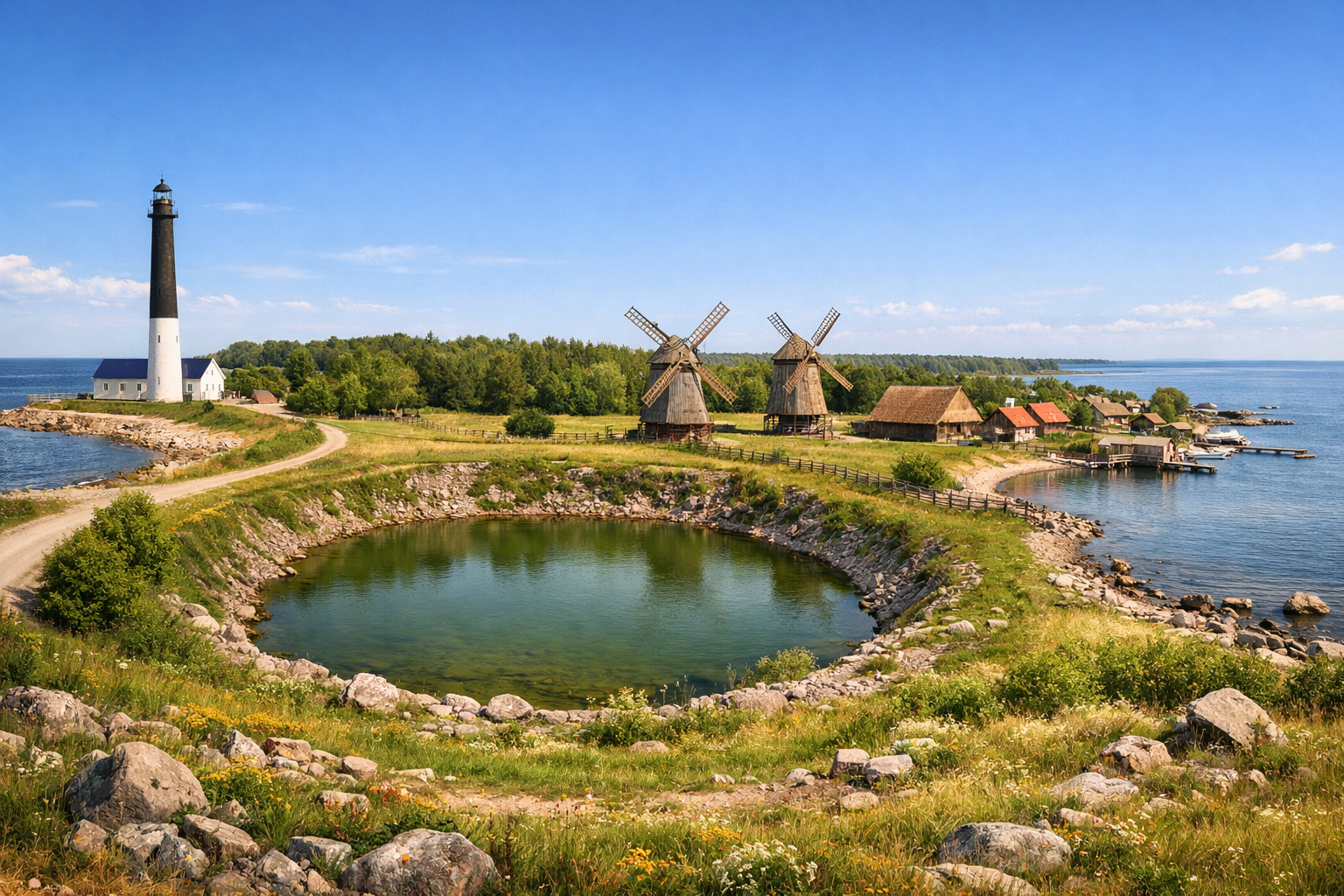
Estonia, Saaremaa Island. An inexpensive nature route featuring lighthouses, windmills, a meteorite crater, and coastal villages; it is more convenient to travel by car or bicycle. Season: May - September.

Estonia, Saaremaa Island. An inexpensive nature route featuring lighthouses, windmills, a meteorite crater, and coastal villages; it is more convenient to travel by car or bicycle. Season: May - September.

Discover Saaremaa, Estonia’s laid-back island of sea winds, juniper fields, and quiet village roads. From Kuressaare to the Kaali meteorite crater, Angla’s windmills, Panga’s cliffs, and the Sõrve Peninsula, this is an affordable nature escape best explored by car or bicycle between May and September.

🧭 DAY-BY-DAY ROUTE

Ready-made country and city routes with daily plans, sights, transport and accommodation. Buy PDF guides for independent travel.

🧭 DAY-BY-DAY ROUTE


Day 1 — Tallinn → Kuressaare: transfer to the island and an evening in the old town

  • 🚆 For a budget-friendly start, the most convenient way is to travel from Tallinn to Kuressaare by intercity bus via Muhu and Saaremaa: this is the most practical option without having to handle separate ferry transfers yourself, because on some services the ferry is already built into the route. Travel time is usually about 3 hr 45 min – 4 hr 05 min, which makes the bus the most economical way to reach the island without renting a car. It is sensible to buy your ticket in advance, especially for the May–September period, when the island becomes noticeably livelier.

  • 🏨 After arrival, check into simple accommodation in Kuressaare and keep this town as your base for all 4 nights on the island: this way you avoid unnecessary moves, save on logistics, and can make radial day trips to different parts of Saaremaa. For a budget route, this is more выгодно than changing accommodation every day.

  • 🚶 In the evening, take a relaxed walk around Kuressaare — it is a very pleasant and compact island town with no sense of rush. Its main star is Kuressaare Episcopal Castle, one of the best-preserved medieval castles in Estonia. Even if you do not go into the exhibition right away, simply walking along the ramparts, through the park, and enjoying the open views of the fortress, moat, and bay already gives you that first feeling of Saaremaa: wind, stone, water, and calm northern light.

  • 🌅 If you still have energy, walk to the waterfront and the kurhaus. In the soft evening light, the island character of the town is felt especially well here: neat wooden buildings, silence, sea air, and long bright twilight. It is a good day without overload — after the road, it is better not to try to fit in long trips, but simply adapt, have a simple dinner, and go to bed early.

  • 💸 Daily cost guideline: the Tallinn → Kuressaare bus usually falls within a budget range; food can be kept at the level of inexpensive cafés, bakeries, and grocery stores; an evening walk through the center and around the castle is almost free if you limit yourself to an exterior visit.


Day 2 — Kaali and surroundings: meteorite crater, country roads, and the island interior

  • 🚌/🚴 This is the day to discover the most unusual natural site in central Saaremaa — the Kaali meteorite crater field. If you are traveling on a very tight budget, check local bus services and combine them with short walking sections; if you want more freedom, this is exactly the day when it makes sense to rent a bicycle or a short-term car/car-sharing vehicle where available through mainland services. By bicycle, the route suits prepared travelers: the terrain is generally moderate, but the day will be long.

  • 🌍 Kaali is one of Estonia’s best-known natural wonders and one of the most impressive crater fields in Eurasia. The main crater, surrounded by trees and calm greenery, looks almost meditative today, yet that is exactly what makes it so powerful: it is hard to believe that in the middle of a quiet rural landscape there is the trace of a cosmic impact. The crater looks less like a harsh scientific set and more like a mysterious round lake where it is especially pleasant just to sit in silence.

  • 🏛️ Nearby is the Kaali Meteoritics and Limestone Museum. It is a good budget addition to the walk, because the museum provides context: why the craters matter to science, how meteorites were studied in Estonia, and why Saaremaa is so closely connected not only with the sea, but also with geology. The exhibition is small, so it is not tiring and fits perfectly into a calm nature day.

  • 🚶 After the museum, do not rush straight back. The most pleasant part of the day is precisely to walk a little along the village roads and feel the inner Saaremaa: low houses, fields, stone fences, juniper, open sky, and almost complete absence of noise. There is no need to fill the day with dozens of points — the island reveals itself precisely in the pauses between locations.

  • 🍞 To save money, bring water, snacks, and something for a picnic from a supermarket in Kuressaare. On Saaremaa this is especially convenient: in the good months it is pleasant to have a simple lunch outdoors and not overpay at every stop. In the evening, return to Kuressaare and leave the rest of the day for rest.

Day 3 — Angla and the north of the island: windmills, Panga, and wide sea views

  • 🚗/🚴 This day is best suited for a car or for a strong cycling day with an early start, because it combines two very characteristic points of the northern part of the island. First, head to Angla — one of Saaremaa’s most recognizable symbols, where the old windmills very clearly show why the island is so often associated with wind, craftsmanship, and rural life.

  • 🌬️ Angla Windmill Mount is not just a photo stop with pretty windmills. It is a place where the historical rhythm of island life is easy to read: how people worked here, how they used the wind, and how they built their livelihoods in harsh yet generous coastal conditions. Against the open sky and grassy slopes, the windmills look almost like an open-air museum, but without heavy academic formality — rather like a very living image of Saaremaa.

  • 🧺 After Angla, continue to Panga Cliff. This is one of the most striking natural sites in western Estonia: the limestone coast rises above the sea, and below stretches the cold, almost steel-colored Baltic. Here the contrast of Saaremaa is felt especially well — the island is both gentle and severe at once. You can walk along the trails, sit at the viewpoints, and simply watch how the wind changes the color of the water and the movement of the clouds.

  • 📸 Panga is an excellent place for a long pause, not just a quick checkmark. Do not allocate only 15 minutes here. Even on a budget route, this place deserves a slow pace: a walk along the cliff edge, photos, a short rest, a thermos of coffee, or tea from the shop. If the weather is kind, the northern coast will stay in your memory more strongly than any expensive attractions.

  • 💸 Financially, this is one of the best days of the whole tour: the natural sites themselves are either free or very inexpensive, and the main costs are transport and food. So for a budget trip, it makes sense to spend money on convenient movement rather than on expensive attractions.

Day 4 — Sõrve Peninsula: lighthouse, the edge of the island, and coastal villages

  • 🚗 A day on the Sõrve Peninsula is the most “lighthouse-focused” and one of the most atmospheric in the whole route. It is longer than the others, so a car is especially convenient here. If you are traveling by bicycle, it is better to consider only part of the southern direction or be prepared for a very early departure and serious physical effort. For a budget traveler, it is wiser to combine 2–3 key points and not chase too many stops.

  • 🗼 Sõrve Lighthouse stands at the southern tip of Saaremaa and makes a strong impression not only because of its height, but also because of the very feeling of being at the edge of the earth. It is a place where sea and sky almost merge, and the long narrow spit creates an amazing sense of remoteness from the mainland. In good weather, it is especially beautiful to watch the light, the open space, and the sharp line of the horizon from here.

  • 🌊 On the way to the lighthouse and back, pay attention to the small coastal settlements, old farm buildings, fishing atmosphere, and almost minimalist landscape of southern Saaremaa. There is no bright classic “postcard” beauty here — the beauty is more restrained: stone, shrubs, low trees, sea, wind, and occasional houses standing far apart from one another.

  • 📍 If there is time left, you can add a short stop at Salme or pause in the southern villages for a simple lunch. On a budget trip, it is better to rely on inexpensive cafés along the way and COOP-format stores rather than make it a restaurant day. This allows you to spend more time on the route without going over budget.

  • 🌇 Returning to Kuressaare in the evening is especially pleasant: after the severe southern coast, the town feels warm and cozy again. It is a good moment for a second walk through the castle park or along the waterfront — now with the feeling that you have seen the real “wild” side of the island and are returning to a comfortable base.

Day 5 — Kuressaare → Tallinn: a calm morning and the return journey

  • ☕ It is best not to overload the last day. Start the morning in Kuressaare without rushing: a short walk through the old center, coffee with pastry, one more look at the castle, the moat, and the seafront. Such an ending is especially good after busy nature outings: instead of fuss, you are left with a complete feeling of the island.

  • 🏰 If on the first day you limited yourself to an exterior look, now you can go inside Kuressaare Castle and the museum within it. It is a logical end to the trip: after lighthouses, villages, cliffs, and the crater, you already have your own geography of the island, and the museum helps turn it into a historical picture — from the medieval fortress to the modern history of Saaremaa.

  • 🚌 The return trip to Tallinn is again most convenient by direct bus. Travel time is usually about 3 hr 45 min – 4 hr 05 min. Plan your departure so you do not have to worry about weather, seasonal queues, and possible heavy summer traffic on the approaches to the crossing.

  • 💸 General budget guideline for the whole 5-day trip: with accommodation in a simple guesthouse/budget hotel in Kuressaare, travel by intercity bus, and moderate spending on food, the route can be kept within an economical range. The main increase in costs happens only if you add car rental for 2–3 days, but even then the route remains noticeably cheaper than many self-drive tours in Scandinavia.

  • 🛡️ Estonia is generally safe for travel. For this route, ordinary caution is enough: keep an eye on your belongings at bus stations and on transport, follow traffic rules on bike rides, bring water and a windbreaker to the coast, and on remote nature stretches do not expect dense infrastructure every few kilometers.

Flight tickets

eSIM for travel

Buy PDF guide

Buy PDF guide — 10.71 USD

PDF — 10.71 USD