Buy PDF guide

Buy PDF guide — 25.71 USD

PDF — 25.71 USD

ESSEN • FOLKWANG AND ZOLLVEREIN

ESSEN • FOLKWANG AND ZOLLVEREIN

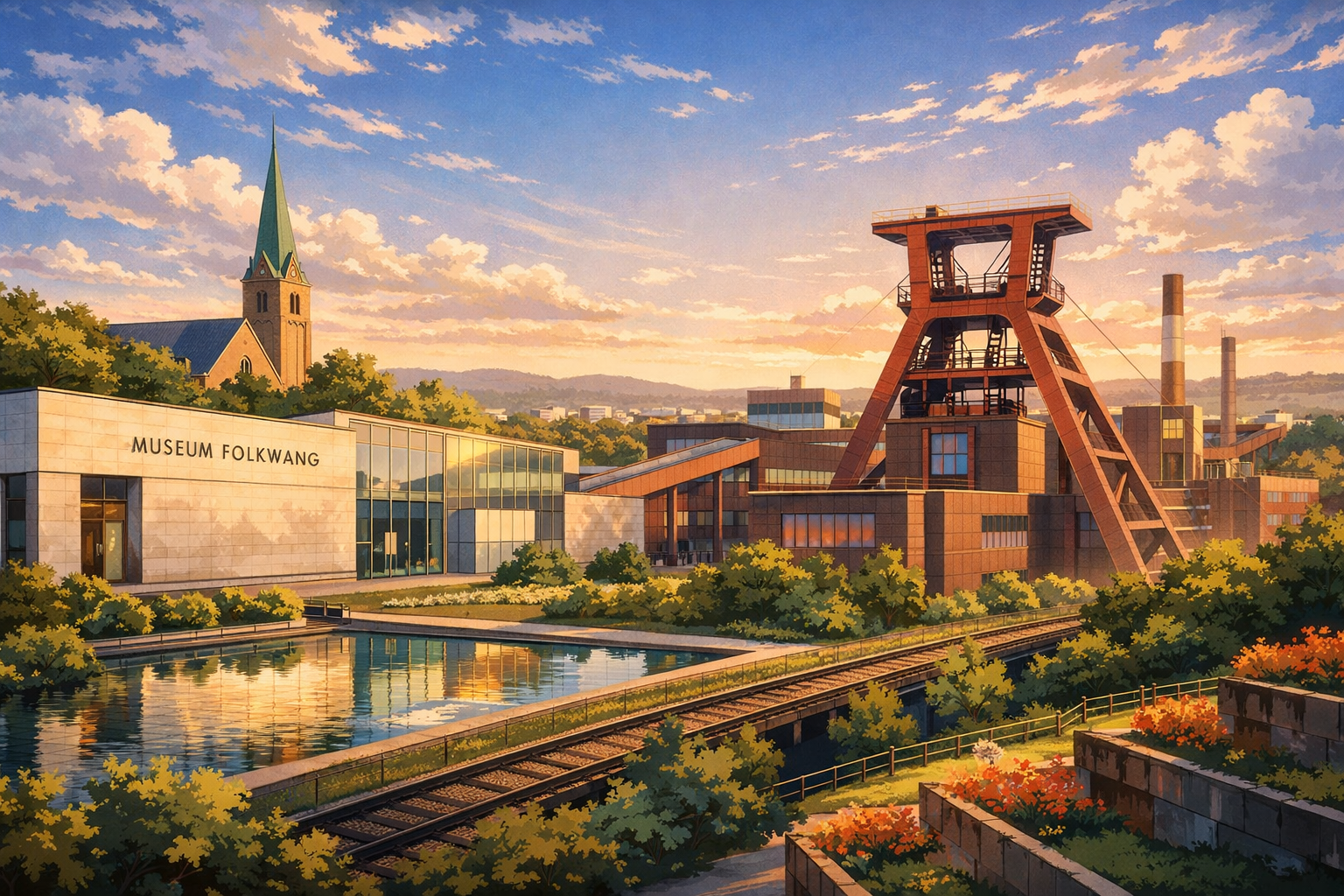
Begin in Essen’s lively Rüttenscheid, pairing Museum Folkwang’s world-class art with the monumental UNESCO Zollverein, home to the Ruhr Museum and Red Dot Design Museum. Trace millennia along the Rhine—from Werden’s St. Ludgerus to Roman Xanten and Haltern, the Neanderthal in Mettmann, and Düsseldorf-Kaiserswerth—before looping back to the Ruhr.

🧭 DAY-BY-DAY ROUTE

Ready-made country and city routes with daily plans, sights, transport and accommodation. Buy PDF guides for independent travel.

🧭 DAY-BY-DAY ROUTE


Day 1 — Arrival in the Ruhr: Essen, the old center and the “meeting point”

  • ✈️ Arrival at Düsseldorf Airport (DUS) or Köln/Bonn (CGN) → train to Essen Hbf. Check-in and an easy walk: Burgplatz with Essen Cathedral (Essener Dom) and the line of the old abbey, where you can already feel the link “early Middle Ages → industrial era.” The square makes the city’s scale easy to read: from cobbled frontages to modern inserts of glass and steel.

  • 🌆 In the evening — viewpoints from Kettwiger Straße to the Domschatz (treasury): the “jewel-box” building next to the cathedral hints that the route ahead will be about things “in the hand” and “in stone” — relics, slabs, fragments of masonry.


Day 2 — Museum Folkwang: an eye for form and light

  • 🚶 At Folkwang, not only the 19th–20th century masterpieces matter, but also the museography itself: soft northern light, “breathing” passages, clear wayfinding — it teaches you to read form, texture, and proportion. Watch the dialogue between modernism and the classical: how clean planes and large openings gather space around the exhibits.

  • ☕ Afterward — the Rüttenscheid quarters: street rhythm, bistros, a “human-scale city” down to the size of a door and shop window. A short walk to the Philharmonie/Saalbau shows how cultural venues are integrated into the city’s green framework.

Day 3 — Essen-Werden: the Romanesque basilica of St. Ludgerus and the “archaeology of faith”

  • 🚆 S-Bahn S6 or the SB19 express bus takes you to Werden — a historic core on the Ruhr. The Basilica of St. Ludger (late 12th century) is a heavy stone mass with a powerful transept and crypt. Here the “Romanesque beat” matters: wall thickness, semicircular arches, the rhythm of pilasters. In the Schatzkammer you’ll see reliquaries and carving that link the church to everyday monastic life.

  • 🌳 Afterward — a walk along the Ruhr riverfront toward Villa Hügel: a panorama over Lake Baldeney, the Krupps’ “residence of the industrial era” (269 rooms) with its park — a textbook of 19th-century representation and private life.

Day 4 — Zollverein (UNESCO): a “machine city” — the Shaft XII ensemble

  • 🚋 Tram 107 (“Culture Line”) straight to Zollverein. Start with the monumental silhouette of Schacht XII: perfect symmetry, the steel frame of the Förderturm, brick, ribbon windows — industrial modernism as a “total composition.” Walk the squares and elevated walkways: pay attention to rhythms, stairs, long facades, and views through trusses.

  • 🏛️ The Red Dot Design Museum — in the former boiler house: the exhibition is embedded into the “body” of an industrial power block, showing how contemporary design “re-flashes” a historic framework.

Day 5 — Ruhr Museum and the coking plant: the Ruhr region’s “material of memory”

  • 🚶 The Ruhr Museum in the former coal-washing plant: orange escalators, brutal spans, a clear vertical dramaturgy of levels (12/17/24/35 m). This is not just a museum — it’s a “cross-section of the depths and history” of the region: minerals, technology, everyday life, photo archives. From the panoramic roof — shots that clarify the site plan and scale of the complex.

  • 🌇 The coking plant (Kokerei) at sunset — warm refractory walls, oven batteries, long galleries and pipelines give a rare sense of an “architecture of processes.”

Day 6 — Essen: the Old Synagogue and urban modernism

  • 🚶 The Old Synagogue (1911–1913) is one of the largest freestanding synagogues north of the Alps. Look at the dome, the tectonics of the portal, the way light works in the interior, and how the building survived the transformations of the 20th century. Nearby — a delicate dialogue with the city hall building and the quarters of the eastern center.

  • 🧩 Afterward — unhurried “urban sketching”: authentic facades around Kettwiger Straße, public art, courtyards. Devote the evening to the Domschatz — as the final chord of Essen’s “sacred heritage” line.

Day 7 — Xanten (APX): the Roman city of Colonia Ulpia Traiana

  • 🚆 Essen → Wesel → Xanten (RE + RB). In the LVR Archaeological Park: city walls, gates, amphitheater, reconstructions of forum buildings and baths. Switch to “reading the city plan” mode: how the main roads ran, where the “nodes” of public life were, how the quarters interacted with the fortifications and landscape.

  • 🏛️ The LVR RömerMuseum is the “second chapter”: artifacts, models, and epigraphy connect the ruins with the people and their everyday lives on the Lower Rhine.

Day 8 — Haltern am See: the Roman camp of Aliso and the logistics of war

  • 🚆 S-Bahn/RE to Haltern am See. The LWL Roman Museum shows the strategy of Roman advance: camps, ports on the Lippe, supply. In the courtyard there’s a reconstruction of fortification elements; inside — weapons, pottery, engineering solutions. You’ll understand how forts were planned and what Roman “military modularity” is.

Day 9 — Cologne (day trip): traces of Colonia Claudia Ara Agrippinensium + the Gothic cathedral

  • 🚆 Essen → Köln Hbf. At Roncalliplatz, look at the “Roman layer” around the Romano-Germanic Museum and the square by the cathedral: fragments of a paved street, archaeological zones (parts of the Praetorium complex and Roman infrastructure are shown depending on ongoing works). Then — Cologne Cathedral: verticals, framework, “stone as lace,” reading the structure of Gothic.

Day 10 — Mettmann: the Neanderthal Museum and a “long history” before architecture

  • 🚆 Via Düsseldorf → Mettmann and bus to the museum. Neanderthal is the “zero level” before antiquity: anthropology, migrations, early human technologies. The exhibition helps you grasp the scale of time; after the museum, walk the “evolution trail” and take a look at the excavation site platform.

Day 11 — Düsseldorf-Kaiserswerth: ruins of the imperial residence and a Romanesque basilica

  • 🚇 Essen → Düsseldorf Hbf → U79 to Klemensplatz. The ruins of the Kaiserpfalz (Barbarossa, 12th c.): massive rusticated walls on the Rhine bank, an excellent textbook of stone fortification. Nearby is the Basilica of St. Suitbertus (Romanesque layer). The atmospheric streets of old Kaiserswerth complete the arc “Romans → Middle Ages → Ruhr modernism”.

Day 12 — Essen: Baldeneysee, farewell overview and free time

  • 🚶 In the morning — an easy walk along Baldeneysee or a short revisit to a favorite place (Folkwang/Zollverein/Domschatz). In the first half of the day — shopping and cafés in the center, in the second — transfer to the airport. Put the tour’s line together in your head: “nature → Romans → monasteries and treasuries → industrial modernism” — all within a 60–90 minute radius of your base.

Flight tickets

eSIM for travel

Buy PDF guide

Buy PDF guide — 25.71 USD

PDF — 25.71 USD