
Buy PDF guide

Buy PDF guide — 15.00 USD

PDF — 15.00 USD

Elbe Cycle Route: Dresden - Magdeburg - Difficulty: Easy - One of Germany's most popular routes; cities, castles, the Elbe River.

Elbe Cycle Route: Dresden - Magdeburg - Difficulty: Easy - One of Germany's most popular routes; cities, castles, the Elbe River.

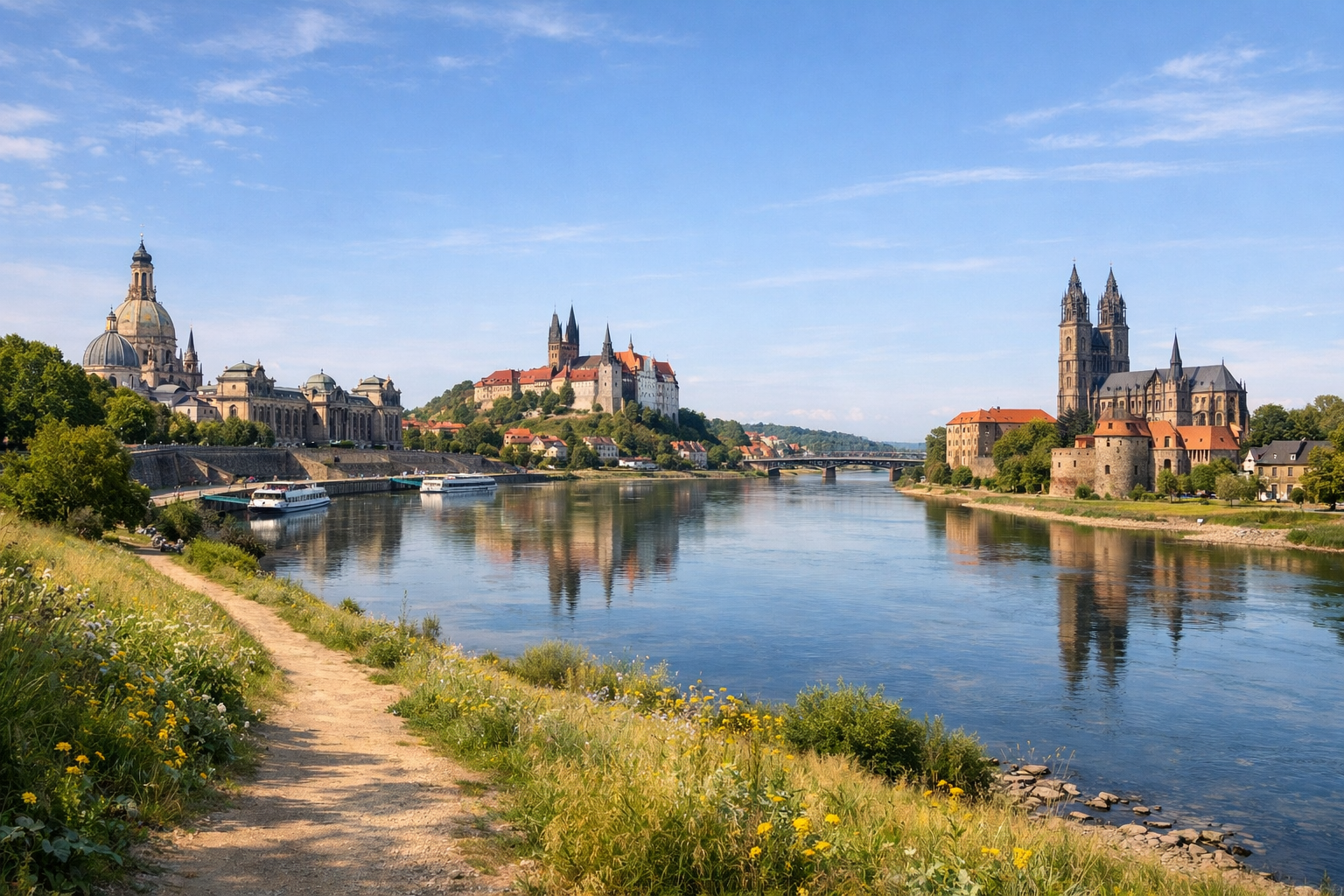
Cycle one of Germany’s most popular routes as the Elbe leads you from Dresden to Magdeburg through a changing landscape of baroque cities, vineyard hills, and castle-topped riverbanks. With easy, mostly gentle riding, this stretch blends cultural highlights like Meissen, Torgau, Wittenberg, and Dessau with relaxed days beside the water.

🚲 ROUTE BY DAY

Ready-made country and city routes with daily plans, sights, transport and accommodation. Buy PDF guides for independent travel.

🚲 ROUTE BY DAY


Day 1 — Dresden → Meissen: a gentle start along the Elbe

  • 🚲 Start in Dresden, finish in Meissen. About 32 km, pure riding time around 2 hours, with only a small elevation gain — roughly 80–120 m if you stick to the river line without unnecessary detours into the hills. The surface is mostly excellent: urban cycle paths, embankments, asphalt, and short firm gravel sections on riverside paths. Difficulty is easy. Main stops along the way: Dresden’s old center with views of the Frauenkirche and Brühl’s Terrace, the Pillnitz palace and park area as a beautiful morning detour, then wine and river scenery around Radebeul. It’s convenient to stock up on water and snacks in Dresden before departure, at ferry and suburban areas along the way, and to take a proper break in Meissen by the riverside or in the old town. For the overnight stay, it makes sense to choose central Meissen near the Elberadweg and the train station. Route nuances: in Dresden, the Elberadweg works well as the city’s main cycling axis; within the city there are DVB ferries across the Elbe if you need to switch banks; on weekends around Dresden and between Pirna/Heidenau/Dresden there can be bike traffic, so it’s better to start early and ride calmly. This day is realistic for an average cycle tourist because it is short, almost without difficult terrain, has good infrastructure, and gives you time to pick up a rental bike, get used to your luggage, and check into Meissen without rushing.


Day 2 — Meissen → Riesa: castles, vineyards, and a broad river

  • 🚲 Start in Meissen, finish in Riesa. About 45 km, pure riding time around 2 hours 45 minutes to 3 hours, with moderate elevation gain only on short waves of the riverside terrain, usually up to 150 m for the day. Surface: asphalt cycle paths, dikes, rural roads, and occasional firm gravel. Difficulty is easy. Before setting off, it’s worth climbing up to the Albrechtsburg and Meissen Cathedral complex: this is one of the most impressive panoramas on the whole route. Along the way, pleasant stops include wine villages and riverside sections of the Saxon Elbe, as well as quiet towns such as Coswig or the surroundings of Zeithain depending on which bank you choose. Water is easy to refill in Meissen, in supermarkets in small towns, and at stations near the river valley; for lunch it’s better to stop in one of the small centers along the way rather than wait for Riesa. It’s best to stay overnight in Riesa near the station or closer to the center, so that you have a backup train option if needed. Day nuances: the farther north from Meissen, the less constantly visible the river becomes, but the route remains very logical and flat; after rain, some riverside dirt sections may be slower, so with road tires it’s better to stick to the main marked Elberadweg lines. The day is realistic because the distance is comfortable, the terrain does not get in the way, and there are enough towns and services along the way for a regular tourist.

Day 3 — Riesa → Torgau: a calm, long riverside scene

  • 🚲 Start in Riesa, finish in Torgau. About 55 km, pure riding time around 3 hours 25 minutes to 3 hours 45 minutes, with a small elevation gain of roughly 100–160 m. The surface is mixed but tourist-friendly: asphalt, dikes, smooth country roads, and occasional compacted gravel. Difficulty is easy. Main stops along the way are river villages and viewpoints over the Elbe floodplain, while the main cultural highlight comes right at the end of the day: Schloss Hartenfels in Torgau. It’s sensible to bring water and food from Riesa for the first half of the day, then replenish in villages and small towns; in hot weather it is especially important not to rely on just one shop, because on floodplain sections services are not available every 5 km. The best overnight stay is in Torgau’s historic center: that way it’s easy to take an evening walk on foot without overloading the day with more cycling. Nuances: this section is very pleasant with a tailwind, but with a strong headwind along the open river even a flat 55 km feels longer; after higher water levels, some low sections of the Elberadweg may be temporarily rerouted along local roads, so it is useful to keep an offline map. The day is realistic for a regular cycle tourist thanks to the flat profile, straightforward navigation, and the fact that even with several long breaks it fits a relaxed vacation pace.

Day 4 — Torgau → Wittenberg: from a Saxon fortress to a Lutheran town

  • 🚲 Start in Torgau, finish in Lutherstadt Wittenberg. About 63 km, pure riding time around 3 hours 55 minutes to 4 hours 15 minutes, with minimal elevation gain, roughly 120–180 m. Surface: mostly asphalt and smooth cycle paths along the river, with occasional dikes and firm gravel sections. Difficulty is easy, leaning toward moderate only because of the distance. Main stops: a morning look around Torgau and the courtyard of Hartenfels Castle, nature breaks on the floodplain sections, then arrival in Wittenberg with its historic center, church towers, and Luther-related sites. Water and food are best planned according to the formula “full supply in the morning + lunch in the middle of the day + café in Wittenberg”; in the warm season there is not always shade on the dikes. Staying overnight in central Wittenberg makes sense so you can calmly explore the old town in the evening without pedaling extra kilometers. Nuances: the distance is already more serious, but the profile remains very gentle; on shared paths near urban approaches you need to slow down because of pedestrians. This day is realistic for an ordinary cycle tourist because with flat terrain, 60+ km on a safe riverside route is a normal daily distance, especially on a trekking bike or e-bike.

Day 5 — Wittenberg → Dessau: biosphere reserve and the road to the garden realm

  • 🚲 Start in Wittenberg, finish in Dessau-Roßlau. About 62 km, pure riding time around 3 hours 50 minutes to 4 hours 10 minutes, with a small elevation gain, usually up to 150 m. The surface is very cycle-tour-friendly: dikes, asphalt paths, long quiet sections through river meadows and forest edges. Difficulty is easy, leaning toward moderate because of the duration. Especially enjoyable along the way are the natural scenes of the UNESCO Biosphere Reserve Middle Elbe: flood meadows, forest belts, birdwatching, and the sense of a great river without city noise. The main stops are the banks and viewpoints of the biosphere reserve, then the urban parks of Dessau. Water and snacks are best taken from Wittenberg with enough for half a day, because infrastructure is sparser in the natural stretches; lunch is convenient in one of the small settlements before Dessau. Overnight stay — in central Dessau near the station or the park area. Nuances: on a hot and windy day this stretch feels longer than it looks on the map, and after floods local detours are possible; on the other hand, traffic is usually minimal. The day is realistic because its whole point is not speed, but smooth eco-friendly riding along one of the most comfortable stretches of the entire Elbe.

Day 6 — Dessau → Aken → Barby: Wörlitz Park and ferry romance

  • 🚲 Start in Dessau, finish in the Barby area or on the southern approach to Magdeburg. About 68 km, pure riding time around 4 hours 15 minutes to 4 hours 40 minutes, with low elevation gain, about 120–180 m. The surface is mixed and very pleasant: asphalt, dikes, the park network around Wörlitz, rural roads, and occasional firm gravel. Difficulty is moderate only because of the distance. Main stops along the way are the garden and park world of Gartenreich Dessau-Wörlitz, Wörlitz itself with its lakes and palace, then Aken with its historic Elbe ferry link. In Aken it makes sense to take a long break for water and food, and also to check the ferry operating times in advance, because it really matters if you need to switch banks. It’s best to stay overnight in Barby or in a quiet spot on the southern approach to Magdeburg so the final day does not become too long. Nuances: the Aken–Steutz ferry is a convenient and atmospheric crossing, but you need to check the schedule in advance; in strong wind and rain, the open dikes can noticeably slow you down. The day is realistic for a regular cycle tourist because it is almost entirely flat, packed with beautiful stops, and well suited even for an e-bike with a typical range of 40–70 km if daytime charging is available.

Day 7 — Barby → Magdeburg: finale at the water bridge and Elbe embankments

  • 🚲 Start in Barby or the southern suburb, finish in Magdeburg. About 52 km, pure riding time around 3 hours 15 minutes to 3 hours 30 minutes, with a small elevation gain of about 100–150 m. Surface: dikes, asphalt, urban bike paths, and Magdeburg embankments. Difficulty is easy. Main stops are the river scenery of the Middle Elbe, the approaches to Magdeburg, and then the urban finale with views of the Elbe, the cathedral skyline, and, if you wish, an extra ride out to the famous Wasserstraßenkreuz Magdeburg, one of the region’s most striking engineering landmarks. Water and snacks are easy to refill in the suburbs and in Magdeburg itself; it is better to plan the finishing lunch in the center, so you can return the bike or check in calmly. For the overnight stay, a hotel near the center or the station is ideal if you are taking a train the next day. Nuances: when entering a big city, the number of traffic lights and local traffic increases, so it’s best not to hurry; in windy weather, the open dikes before Magdeburg can be tiring. This day is realistic because it leaves energy for a city walk, sorting out logistics, returning a rental bike, or boarding a train with a bicycle.

Flight tickets

eSIM for travel

Buy PDF guide

Buy PDF guide — 15.00 USD

PDF — 15.00 USD