
Buy PDF guide

Buy PDF guide — 29.99 USD

PDF — 29.99 USD

YEKATERINBURG

YEKATERINBURG

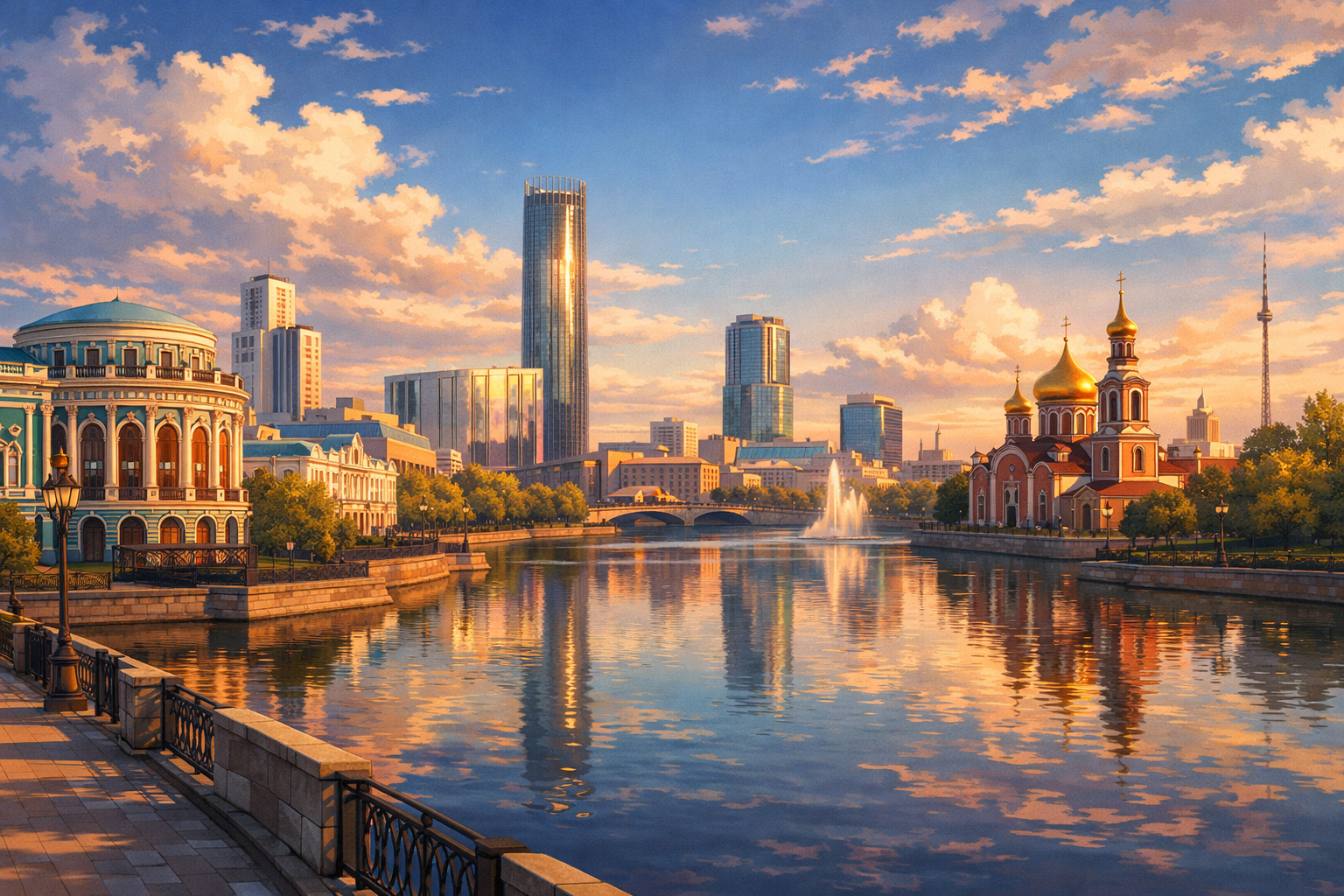
Yekaterinburg blends grand Ural history with a bold, modern edge, where elegant avenues, creative districts, and powerful landmarks give the city its distinct character. Just beyond the center, Verkhnyaya Pyshma adds another layer with one of Russia’s most impressive museum complexes, making this route a rich snapshot of the region’s industrial soul and cultural energy.

🧭 DAY-BY-DAY ITINERARY

Ready-made country and city routes with daily plans, sights, transport and accommodation. Buy PDF guides for independent travel.

🧭 DAY-BY-DAY ITINERARY


Day 1 — Yekaterinburg: arrival, Plotinka, and Historical Square

  • 🚆/🚌 After arriving at Koltsovo, it is convenient to allow about 45–60 minutes to get to central Yekaterinburg without rushing: by bus or taxi to your hotel, including baggage claim and exiting the terminal. If check-in is during the day, it is best to keep this day as gentle and introductory as possible.

  • 🚶 Start your acquaintance with the city at Plotinka and Historical Square — this is the place where you can feel the very pulse of Yekaterinburg. Here the city reveals itself not as a set of separate attractions, but as the living history of the Urals: its industrial past, the energy of a merchant city, Soviet scale, and a modern business skyline all come together on a single walking route. Plotinka grew around the old industrial core; this is where Yekaterinburg began as a mining and metallurgical capital. Today, the water rushes here, the Iset glitters, students, musicians, tourists, and local families stroll around, and old factory buildings and museum spaces stand side by side with broad promenades. It is especially beautiful in the evening, when the light softens, reflections of the city lights appear on the water, and the city seems to show its character: строгий, industrial, yet surprisingly warm and deeply human.

  • 💤 After the journey, do not overload the program: a walk along the embankment, an early dinner, and a calm return to the hotel will help you ease into the rhythm of the trip.


Day 2 — Yekaterinburg: Sevastyanov House, the Iset embankment, and the center

  • 🚶 Sevastyanov House is one of the most striking symbols of Yekaterinburg, as if created to break the stereotype of a harsh industrial city. This bright palace on the bank of the Iset, with its lace-like decor, elegant towers, arcades, and festive green-white-red palette, looks almost theatrical. Against the backdrop of the city’s more restrained architecture, it makes an especially strong impression: it feels as though a fragment of 19th-century European romantic architecture has suddenly appeared in the middle of the Urals. Even if you cannot go inside, seeing the exterior is more than enough to feel the special charm of this place. It is best combined with an unhurried walk by the water and through the central streets: here Yekaterinburg shows its photogenic side — reflections in the river, old facades, modern towers in the distance, and the ever-changing city light.

  • ☕ For this day, it is worth planning a walking pace without rushing: 15–20 minutes to walk from Plotinka to nearby points, coffee breaks, and 1–1.5 hours for simply taking it in and taking photos. The center of Yekaterinburg is convenient precisely because it can be experienced on foot, not just "checked off" a list.

Day 3 — Yekaterinburg: Church on the Blood and Voznesenskaya Gorka

  • 🚶 The Church on the Blood is one of the most emotionally powerful places in the city. It stands on elevated ground and immediately draws the eye with its white-stone mass, golden domes, and solemn severity. But the main thing here is not the outer scale, but the historical depth of the space. It is a place of memory where architecture, history, and personal reflection come together with particular intensity. Even without religious motivation, the complex is perceived as an important point for reflecting on the dramatic turns of 20th-century Russian history. After visiting the church, be sure to take a walk around Voznesenskaya Gorka: here the center of Yekaterinburg becomes quieter, greener, and more intimate. From the height, beautiful views of the city open up, and the district itself gives a rare sense of old Yekaterinburg preserved inside a large modern city.

  • 🕊️ It is comfortable to allow 2.5–3 hours for visiting the church and walking around the area, including an unhurried uphill walk, looking around the grounds, and a short rest on benches or in a nearby café.

Day 4 — Yekaterinburg: Literary Quarter

  • 🚶 The Literary Quarter is a surprisingly quiet and finely atmospheric corner of Yekaterinburg, where the noise of the big city seems to step aside. It is especially pleasant to walk here in the first half of the day or closer to evening, when the paths grow emptier, the greenery appears denser in the light, and the wooden and stone museum houses create the atmosphere of an old cultured city. This is not a place for rushing and quick photos, but a space for slow presence. In the quarter, you can feel several layers of Ural cultural memory at once: literary tradition, an old urban environment, intimate museum houses, and an almost park-like silence. Even if you do not visit every museum in a row, simply being here works as an emotional pause between the louder symbols of Yekaterinburg. It is especially good to combine a walk through the quarter with a visit to one of the literary museums and then simply give yourself an hour to rest in the shade of the trees.

  • 💤 This is one of the best days of the route for a relaxed rhythm: the walking distances here are short and the physical load is low, so the day works well both for families and for travelers who do not like to overexert themselves.

Day 5 — Yekaterinburg: Yeltsin Center

  • 🚶 The Yeltsin Center is one of the most modern and multilayered spaces in the city, where museum, public venue, architecture, and urban life come together into a single cultural hub. This place is perceived not only as a museum about a particular person, but also as a larger conversation about change, freedom, politics, everyday life, and the mood of the late 20th century. The space functions in a very contemporary way: large open volumes, light, media, exhibition design, a sense of movement and dialogue. Even those who are usually cautious about historical museums often remember the Yeltsin Center precisely because of the way it tells its story — it engages not with dry display cases, but with the atmosphere of being inside an era. It is important to allow at least half a day for the visit: the museum section is dense, and afterward you will likely want not to rush onward, but to exhale in the atrium, browse the bookstore, have a coffee, and simply observe the city crowd.

  • ☕ From the city center, the Yeltsin Center is easy to reach on foot or by a short taxi ride. For a comfortable visit with a break, it is worth allowing 4–5 hours.

Day 6 — Yekaterinburg: Vysotsky observation deck and the evening city

  • 🚶 The Vysotsky observation deck is the best way to see Yekaterinburg as a whole and finally understand its scale. From above, the city forms a clear composition: the river, avenues, the old center, business districts, residential areas, distant green expanses, and the Ural horizon. In clear weather, the panorama is especially impressive — the city seems both compact and very extended at the same time. During the day, the structure of Yekaterinburg is easy to read from here, while at sunset and in twilight a completely different magic appears: windows light up one after another, the main roads turn into threads of light, and the stern Ural metropolis becomes unexpectedly romantic. It is best to go up closer to golden hour and leave time to see the transition from daylight to evening lights. This is one of those views after which the city is perceived differently — not as a collection of addresses, but as a large, complex, and very living system.

  • 🚕 After the observation deck, it is convenient to end the evening with dinner in the center: from the skyscraper, many central streets and restaurants are within a 10–20 minute walk.

Day 7 — Yekaterinburg: Yekaterinburg Museum of Fine Arts

  • 🚶 It is best to plan an art day in Yekaterinburg without rushing, and the main point here is the Yekaterinburg Museum of Fine Arts. This place is especially valuable because it allows you to feel the Urals not only as an industrial region, but also as a space of artistic power, craftsmanship, and visual culture. The exhibitions here offer a beautiful combination of great art and local identity: from classical museum halls to the famous Kasli artistic cast iron, which feels almost miraculous — heavy metal suddenly becomes delicate, lace-like, and almost weightless. The museum works best in the format of a thoughtful visit: do not try to cover everything in a hurry, it is better to choose a few halls, give yourself time to look at the details, and then go out to the river and walk a little through the center. Such a day turns out calm, intelligent, and very fitting in the middle of the journey.

  • 💤 It is reasonable to allow 3–4 hours for the museum and rest afterward, and leave the second half of the day semi-free: for a walk, a café, or shopping in the center.

Day 8 — Yekaterinburg: Museum of the History of Yekaterinburg

  • 🚶 The Museum of the History of Yekaterinburg is the ideal place to bring together everything you have already seen in the city over the previous days. After walks around Plotinka, churches, quarters, and modern public spaces, it is especially interesting to visit the museum and see how the city explains itself. Here Yekaterinburg reveals itself as a multilayered organism: a mining-and-metallurgical foundation, merchant energy, revolutionary upheavals, Soviet industrialization, post-Soviet transformation, and its current role as one of Russia’s main cities outside Moscow and St. Petersburg. This is not so much a visit for the sake of checking a box, but for the sake of connecting your impressions. After the museum, it is good to walk once more through the neighboring central streets — and you will notice that familiar buildings, avenues, and courtyards begin to read differently, now through the prism of history.

  • 🚶 Since the museum is located in the central part of the city, the day combines well with short walks and no long transfers. This creates a good balance between substance and rest.

Day 9 — Yekaterinburg: Mayakovsky Park

  • 🚶 After several busy city days, it makes sense to take a green pause and devote some time to Mayakovsky Park. This is not just a city park, but a full-fledged space for changing pace: here Yekaterinburg becomes softer, more spacious, and almost resort-like in feeling. Broad alleys, forest air, open spaces, family life, runners, walks with coffee, children’s areas, and long paths for unhurried movement make the park a universal place for a break. It is good to come here not for one specific point, but for the state of being itself — to wander without a goal, sit for a while, ride around, and give yourself some quiet. If the weather is kind, this can be one of the most pleasant days of the whole route: without museum density, without mandatory narratives, just lively urban leisure in the fresh air.

  • 🚌/🚕 From the center, it usually takes 20–30 minutes to reach the park depending on traffic and the chosen transport, and for the visit itself it is worth allowing at least half a day.

Day 10 — Yekaterinburg: Museum of History and Archaeology of the Urals

  • 🚶 The Museum of History and Archaeology of the Urals adds important depth to the trip: it takes your взгляд beyond the limits of one city and shows the whole region as an ancient, complex, and culturally rich space. Here it becomes especially clear that the Urals are not only about metal, factories, and constructivism, but also a vast historical layer reaching into archaeology, ethnography, territorial development, and the formation of a distinct Ural character. Such a day is perceived especially well after more "urban" museums, because it broadens the frame: Yekaterinburg begins to read as the capital of a large region rather than an isolated point on the map. It is a calm, meaningful visit, especially suited to those who love not only beautiful views but also dense cultural context.

  • ☕ Given the museum format, it is convenient to plan 2–3 hours for the exhibition and another 1–1.5 hours for lunch or rest in the center near Lenin Avenue.

Day 11 — Yekaterinburg: railway museum and station district

  • 🚶 The Museum of History, Science and Technology of the Sverdlovsk Railway is a very successful stop for those who love transport, urban mechanics, and industrial aesthetics. It is located next to the station, in a historic transport environment, and therefore feels especially organic. Here you can clearly sense the role the railway played in the development of the Urals and Yekaterinburg itself: not only an economic one, but almost a civilizational one. The old building, railway themes, machinery, memories of a vast system of movement and regional connection create a special atmosphere — a little nostalgic, a little exploratory. Such a day usually feels less touristy and more "local," which makes the route richer and more varied.

  • 🚶 Transfers on this day are short: the museum combines well with a walk around the station district, a short trip into the center, and a calm evening without overload.

Day 12 — Verkhnyaya Pyshma: museum day

  • 🚆 Transfer: Yekaterinburg → Verkhnyaya Pyshma. Including the walk to the stop, waiting time, and the trip itself, it is reasonable to allow about 50–60 minutes each way. If going by taxi or car outside peak traffic, it is often faster, but it is still better to leave some extra time for a calm entrance to the museum complex.

  • 🚶 Verkhnyaya Pyshma is one of the most impressive excursions from Yekaterinburg for lovers of technology, industrial history, and large museum spaces. The format here is entirely different: more air, more scale, more of a feeling that you have entered a huge archive of machinery assembled with real ambition. Even those who do not usually consider themselves fans of military or automotive history often remember this complex precisely because of its scale and presentation. The exhibits here are perceived almost like a city within a city: metal, lines, the power of machines, engineering thought, and the visual drama of large halls. For such a day, you should not begrudge time — it is best to go in the morning, make it a full museum outing, and leave room for breaks, because there really are a lot of impressions.

  • 💤 Return to Yekaterinburg in the evening. After such a busy day, it is better not to plan a complicated second program.

Day 13 — Yekaterinburg: free day, shopping, gastronomy, and revisiting favorite places

  • 🚶 The thirteenth day in such a long itinerary is essential as a flexible reserve. It is best used not for yet another mandatory stop, but for the city as an experience: return to the embankment, go back into the center, drop into a museum shop you liked, walk along Vaynera Street, make time for Ural cuisine, choose souvenirs made of stone, metal, or local design. It is exactly these semi-free days that often become the warmest in feeling, because the tourist race disappears and the opportunity appears to live in the city rather than only look at it.

  • ☕ If you want some structure, you can divide the day into two gentle blocks: 2–3 hours for shopping and a walk during the day, then rest at the hotel, and in the evening — a final beautiful dinner in the center.

Day 14 — Yekaterinburg: final walk and departure

  • 🚶 It is best to keep the final day light and composed. The ideal scenario is a short final walk through the center, coffee with a view of the city, perhaps one more pass along the Iset embankment or to Plotinka, to end the trip where it began. Over two weeks, Yekaterinburg usually has time to reveal itself not only as a major Ural metropolis, but also as a city with a strong inner culture, a good rhythm, unexpectedly beautiful panoramas, and a rare combination of industrial power and human intimacy.

  • 🚕 It is best to plan the trip to Koltsovo Airport from the center with extra time: the journey usually takes about 45–60 minutes, and more during rush hour. For a calm end to the trip, it is better to leave early rather than turn the finale into a race.

Flight tickets

eSIM for travel

Buy PDF guide

Buy PDF guide — 29.99 USD

PDF — 29.99 USD