
Buy PDF guide

Buy PDF guide — 25.71 USD

PDF — 25.71 USD

EGYPT

EGYPT

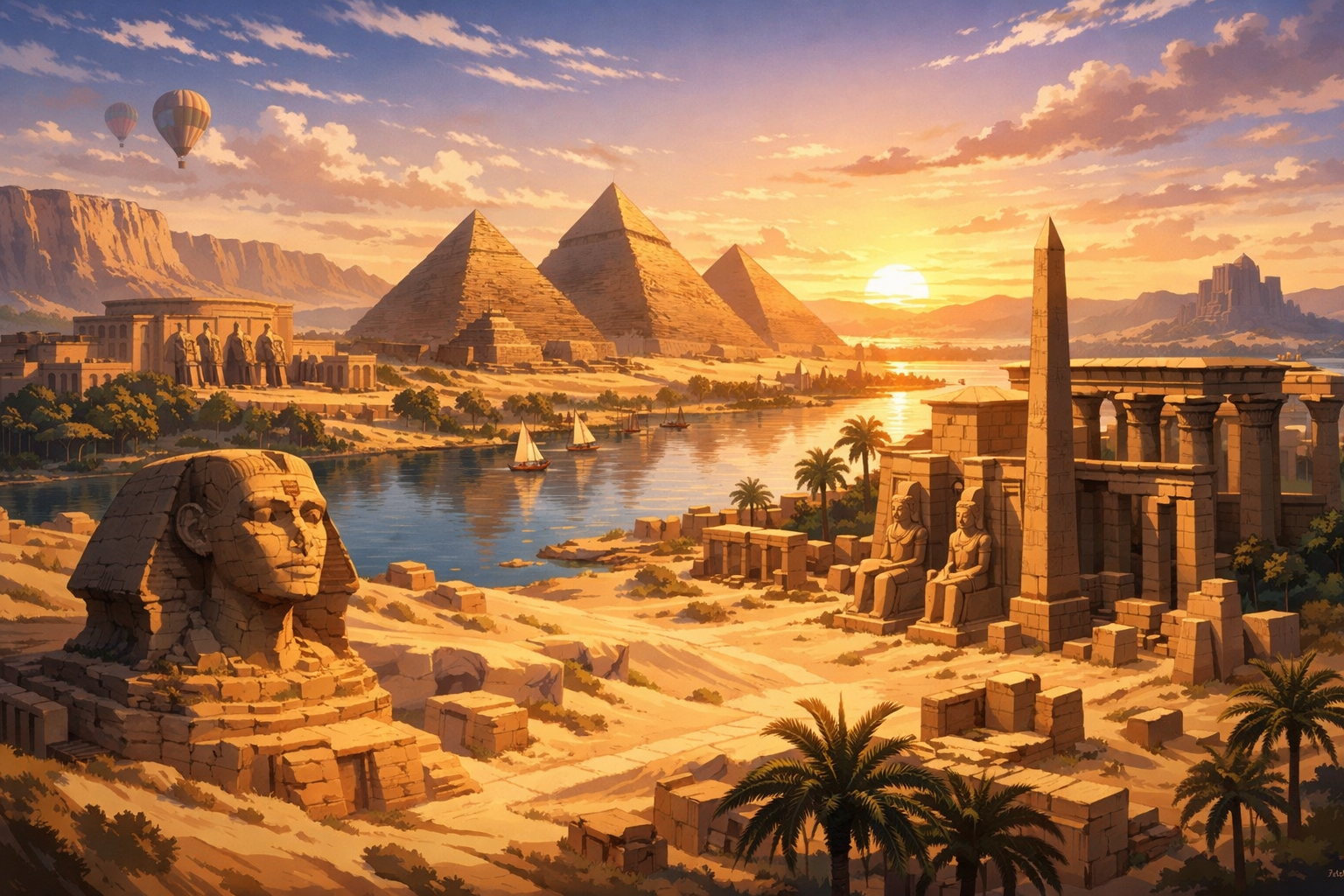
Egypt is a timeless tapestry of golden deserts, ancient temples, and Red Sea blues. Drift along the Nile from Cairo’s buzzing souks to Luxor’s soaring columns, then unwind on sunlit beaches beneath star-bright skies.

🧭 DAY-BY-DAY ITINERARY

Ready-made country and city routes with daily plans, sights, transport and accommodation. Buy PDF guides for independent travel.

🧭 DAY-BY-DAY ITINERARY


Day 1 — Cairo: The National Museum of Egyptian Civilization (Fustat) and Old Cairo

  • 🚶 Start with the National Museum of Egyptian Civilization in Fustat: from prehistoric artifacts to the Royal Mummies Hall—here you get an unbroken line of Egyptian history. The exhibits read like an “architectural prologue” to all the locations to come, and the panoramas over Ain el-Sira Lake give you a breather between galleries. Then take a walk through Coptic Cairo (Babylon Fortress, the Hanging Church), where the stone fabric of the streets shows the pliable connection between antiquity and the Christian and Islamic periods.


Day 2 — Giza: the pyramid plateau (Khufu, Khafre, Menkaure) and the Sphinx

  • 🚶 Morning departure to the Giza Plateau: in the soft light the proportions, horizon, and lines of the valley temples become legible. Focus on the urban logic of the complex: the “axis” of the Great Pyramid of Khufu, terraces and temple linkages, and the descent to the Sphinx as the culmination of the “procession.” The internal passages of the pyramids require separate tickets and have schedules: it’s an experience of an “architecture of limits,” where narrow shafts and corridors reveal the engineering meaning of the pyramid as a machine of transition.

Day 3 — Giza: the Grand Egyptian Museum (GEM)—a new “encyclopedia” of Ancient Egypt

  • 🚶 A detailed visit to the GEM at the foot of the plateau: the Grand Atrium with Ramesses II, the Grand Staircase, the Tutankhamun galleries, the Khufu Boat Museum—contemporary exhibition architecture neatly structures a gigantic mass of artifacts. Plan 4–5 hours, taking breaks in the gardens and at viewpoints toward the pyramids. Watch how light and huge openings bring the desert, the museum, and the ancient necropolis into a single scene.

Day 4 — Saqqara: Djoser’s Step Pyramid and the Imhotep Museum

  • 🚶 Saqqara is a laboratory of early monumental architecture. Djoser’s complex is the transition from mastaba to a “multi-tiered tower,” and the surrounding courts and walls show how geometry and ritual shape space. At the Imhotep Museum, connect fragments of casing, reliefs, and construction techniques with what you see on the plateau. On the way, you can stop by nobles’ mastabas to feel the “everyday” side of the necropolis.

Day 5 — Flight/train to Luxor + evening riverside promenade (East Bank)

  • ✈️ Transfer: Cairo → Luxor (flight ≈ 1 h 05–1 h 15) or overnight sleeper ≈ 9–10 h. Check in and take a relaxed walk along the Nile Corniche—setting the mood before the Theban temple “theater.”

  • 🚶 Evening: Luxor Temple at golden hour—its colonnades and obelisk against the shimmering Nile turn the ensemble into a living stage of cult and power.

Day 6 — Luxor: Karnak (hypostyle hall, processional axes, open-air museum)

  • 🚶 Karnak is a city of temples, where the hypostyle hall reads like a “stone forest,” and the Avenue of Sphinxes like an urban artery linking Karnak and Luxor. Drop by the Open-Air Museum: the “secondary” life of blocks and chapels lets you see restoration as a form of scholarly architectural composition.

Day 7 — Luxor (West Bank): the Valley of the Kings and the Temple of Hatshepsut

  • 🚶 Morning—Valley of the Kings: choose 3–4 tombs by ticket (pay attention to schedules and access rules). Compare the transition scripts: corridors, chambers, texts, and starry ceilings. Afternoon—Deir el-Bahri: the terraces of Hatshepsut’s temple are embedded into the cliff so that the landscape becomes architecture. At dusk—the Colossi of Memnon as the “gateway” to the necropolis.

Day 8 — Transfer Luxor → Aswan (via Edfu/Kom Ombo depending on season) + Aswan waterfront

  • 🚌/🚆 Transfer: Luxor → Aswan (train ≈ 3–3.5 h; car ≈ 3.5–4.5 h). On the way, with a daytime route, stops may be possible: Edfu (Horus) and Kom Ombo (Sobek/Haroeris).

  • 🚶 Evening Aswan—a calm Nile rhythm, a nuanced granite palette of the quays, and pink twilight over Elephantine.

Day 9 — Aswan: Philae (Isis) and the Unfinished Obelisk

  • 🚤 Philae’s temple island (moved to Agilkia) is a textbook of Hellenistic plasticity and late Egyptian cult: porticoes, Trajan’s Kiosk, and the surrounding waters as an ideal “light filter.” After that—the granite quarry with the Unfinished Obelisk: you can see tool marks and the method of separating the monolith—a rare chance to watch technology in mid-process.

Day 10 — Abu Simbel: Ramesses II’s “architecture of politics” on the edge of Nubia

  • 🚌 Early departure: Aswan → Abu Simbel (≈ 3.5–4 h one way) or ✈️ flight (≈ 45–50 min) if available. The Great Temple of Ra-Horakhty and the Small Temple of Hathor/Nefertari—scale, colossal façade figures, and a sunbeam entering the sanctuary twice a year—as a synchronization of architecture and cosmos. Return to Aswan by evening.

Day 11 — Return to Cairo + day trip to Alexandria

  • ✈️/🚆 Transfer: Aswan → Cairo (flight ≈ 1 h 25 min or overnight train). Then high-speed train/Talgo Cairo → Alexandria (≈ 2.5–3 h).

  • 🚶 Alexandria: The Bibliotheca Alexandrina — a modern iconography of the “sun of knowledge” on the waterfront; a stone façade inscribed with writing and the powerful cylindrical bowl of the reading halls. A walk along the Corniche — ancient memory woven into the city’s seaside fabric.

Day 12 — Cairo: Museum of Islamic Art or the Egyptian Museum on Tahrir + final panorama

  • 🚶 Finish the route at one of the key museums: the Museum of Islamic Art (a world of wood, stone, and the calligraphy of the Mamluks and Fatimids) or the Egyptian Museum on Tahrir — to see the “prehistory” of the GEM exhibits and connect the line in your mind: Old Kingdom → New Kingdom → Greco-Roman Egypt → Cairo as an Islamic metropolis. Evening — a view of the Nile from the Qasr el-Nil Bridge: that very “horizon of Egypt.”

Flight tickets

eSIM for travel

Buy PDF guide

Buy PDF guide — 25.71 USD

PDF — 25.71 USD