Buy PDF guide

Buy PDF guide — 25.71 USD

PDF — 25.71 USD

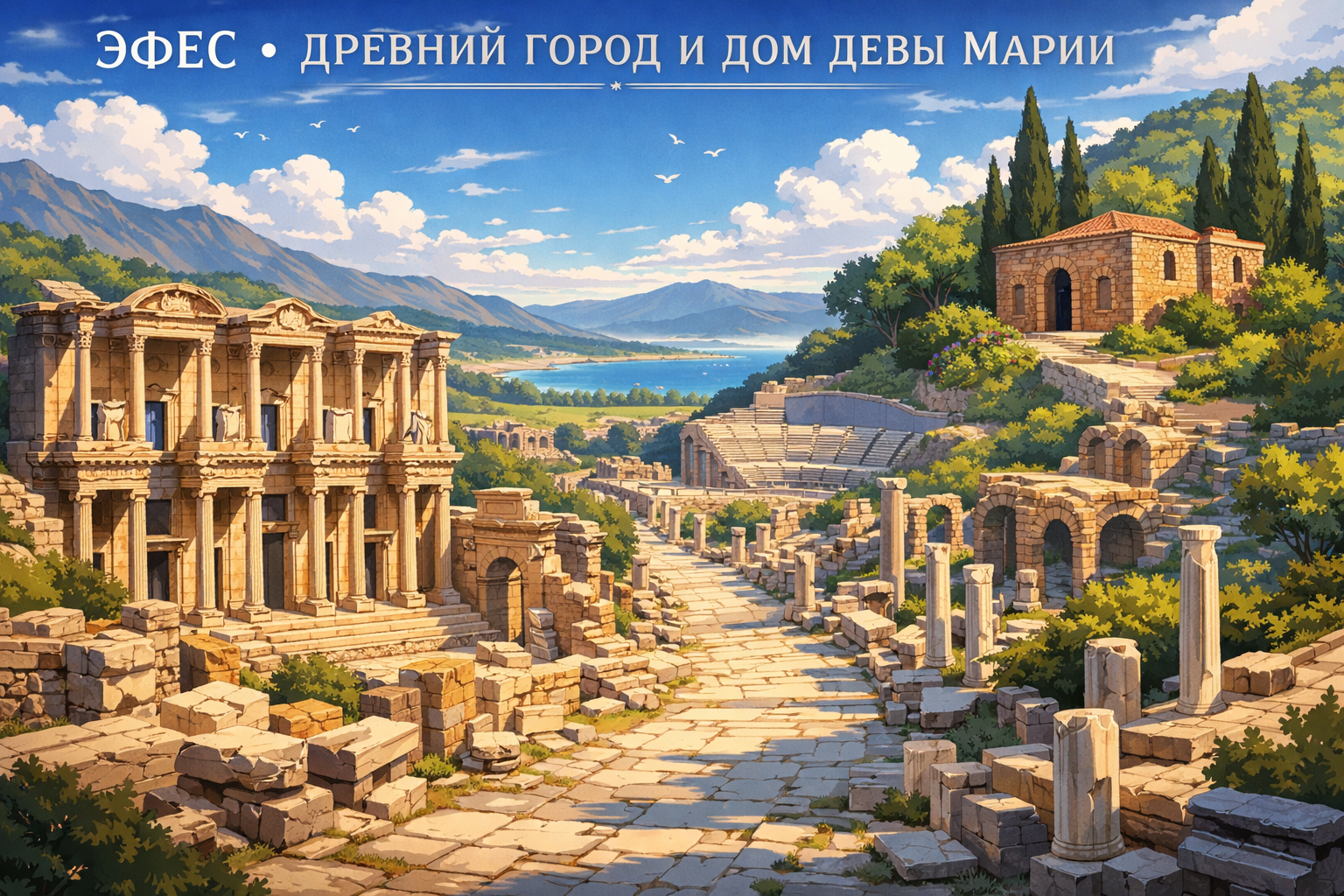
EPHESUS • ANCIENT CITY AND HOUSE OF THE VIRGIN MARY

EPHESUS • ANCIENT CITY AND HOUSE OF THE VIRGIN MARY

Trace the footsteps of saints and scholars along Turkey’s Aegean coast, from Izmir’s lively Konak and the Agora of Smyrna to the marble avenues of Ephesus and the serene House of the Virgin Mary in Selçuk. Continue to Kuşadası for Priene, Miletus, and Didyma, then return to Izmir for golden-hour harbors, bustling bazaars, and seafood by the bay.

🧭 DAY-BY-DAY ROUTE

Ready-made country and city routes with daily plans, sights, transport and accommodation. Buy PDF guides for independent travel.

🧭 DAY-BY-DAY ROUTE


Day 1 — Izmir: the “gateway” to Ionia (Konak, Archaeological Museum, Agora of Smyrna)

  • 🚶 Arrival in Izmir. A walk along the Kordon waterfront and Cumhuriyet Square sets a “Mediterranean rhythm.” Then — the İzmir Archaeological Museum (Bahri Baba Parkı, Halil Rıfat Paşa Cd. No:4, Konak): statues, sarcophagi, and epigraphy provide context for the ancient cities of Aegean Anatolia. Finish at the Agora of Smyrna (Namazgâh Mah., 816. Sk., Konak): underground galleries and vaults show how the public square of a Roman city “worked.”


Day 2 — Transfer to Selçuk: Ayasuluk, Basilica of St. John, Isa Bey Mosque

  • 🚆/🚌 Izmir → Selçuk (TCDD/İZBAN train + transfer; travel time approx. 1–1.5 hours). Check-in and get acquainted with Ayasuluk — the hill where the medieval chapter of Ephesus was born. The Basilica of St. John the Evangelist (İsa Bey Mah., St. Jean Cd. No:4) — the ruins of Justinian’s imperial project, massive buttresses, and views toward the fortress. Nearby — İsa Bey Camii (İsa Bey Mah., St. Jean Caddesi): a rare masterpiece of 14th-century Anatolian architecture, where the stone lacework of the portal sits alongside the rusticity of ancient blocks.

Day 3 — Ephesus: main avenues, the theatre, and the Library of Celsus

  • 🚶 Start at the Upper Gate of Ephesus (Atatürk Mah., Efes Alt Kapı Sok. No:53) and follow the “plot of the city”: the state agora, the Temple of Hadrian, the wealthy hillside houses, and the culmination — the Library of Celsus, whose facade is like a “theatrical backdrop” of civic pride. Finish at the Great Theatre: its semicircle, acoustics, and views toward the ancient harbor let you imagine the city as a living organism.

Day 4 — Ephesus: “details and interiors” + Ephesus Museum

  • 🏛️ In the morning — focus on interiors: the “slope” (terrace) houses with mosaics and frescoes, where everyday beauty and engineering (hypocaust, water supply) are especially clear. After lunch — the Ephesus Museum (Atatürk Mah., Uğur Mumcu Sevgi Yolu No:26): the Ephesian Artemises, portraits, reliefs, and finds connect the “ruins” with the faces and cults of the city.

Day 5 — House of the Virgin Mary and the Temple of Artemis

  • 🚖 Morning — ascent to Bülbüldağı: the House of the Virgin Mary (Atatürk Mah., Mevki Küme Evleri, 35922 Selçuk). A small domed memorial house in the hush of cypresses — an important pilgrimage site where time and space compress into a personal experience. In the second half of the day — the Temple of Artemis site (Atatürk Mah., Artemis Tapınağı Yolu): little remains of the wonder of the world, but the “emptiness” of the place and reflections in the water make photos and thoughts extraordinarily expressive.

Day 6 — Ayasuluk Fortress and “quiet” Şirince

  • 🏰 In the morning — Ayasuluk Fortress (in the complex with the Basilica of St. John): bastions, views, the feeling of a strategic “above-the-city” point. After lunch — a trip to the village of Şirince: narrow streets, stone buildings, and the Greek-Ottoman layer of “houses with open galleries.” A day to gather impressions before the Ionian triptych.

Day 7 — Transfer to Kuşadası + Priene: an “ideal polis” in the mountains

  • 🚌 Base transfer: Selçuk → Kuşadası (≈ 30–45 minutes by dolmuş/taxi).

  • 🚶 After check-in — head to Priene (Güllübahçe, Söke): a rare example of a strict Hippodamian grid on steep terrain. The Temple of Athena on a terrace overlooking the valley is the pinnacle of the “folded” plasticity of the Ionian landscape.

Day 8 — Miletus: theatre, agoras, and the Miletus Museum

  • 🚶 Miletus (Balat): a huge theatre, city axes, and traces of port life — today far from the sea due to millennia of silting. A must — the Miletus Museum (Balat Mah., Milet Sok. No:7, Didim/Aydın): plans, inscriptions, and finds assemble the “picture” of an ancient metropolis of science and trade.

Day 9 — Didyma: the Temple of Apollo

  • 🚶 Didyma (Hisar, Özgürlük Cd., 09270 Didim): a grand Doric peripteros, an oracle center of Ionia; the columns, monumental stairways, and the “labyrinth” of the adyton create an almost mystical impression. In the evening — отдых by the sea in Kuşadası.

Day 10 — Dilek National Park / “Milli Park” and ancient traces along the coast

  • 🌿 A day of nature and panoramas: beaches and viewpoints of the Dilek Peninsula. On the way — short stops at fortresses/watchtowers and piers; the mix of sea and mountains is the best “backdrop” for the finale of the Ionian segment.

Day 11 — Return to Selçuk + Ephesus Experience Museum

  • 🚌 Kuşadası → Selçuk (30–45 min). After lunch — Ephesus Experience Museum (Efes Antik Kenti, “opposite the Ancient Theatre”): a multimedia “retelling” of Ephesus’ history that helps match places, chronology, and images.

Day 12 — Return to Izmir and departure

  • 🚆/🚌 Selçuk → Izmir (Basmane/Alsancak) ≈ 1–1.5 hours by train; then transfer to ADB. If time allows, a final walk along the Kordon — to “close” the line: from the Smyrna agora to the Library of Celsus and back.

Flight tickets

eSIM for travel

Buy PDF guide

Buy PDF guide — 25.71 USD

PDF — 25.71 USD